
Four score and seven years ago our fathers brought forth on this continent, a new nation, conceived in Liberty, and dedicated to the proposition that all men are created equal.
Now we are engaged in a great civil war, testing whether that nation, or any nation so conceived and so dedicated, can long endure. We are met on a great battle-field of that war. We have come to dedicate a portion of that field, as a final resting place for those who here gave their lives that that nation might live. It is altogether fitting and proper that we should do this.
But, in a larger sense, we can not dedicate — we can not consecrate — we can not hallow — this ground. The brave men, living and dead, who struggled here, have consecrated it, far above our poor power to add or detract. The world will little note, nor long remember what we say here, but it can never forget what they did here. It is for us the living, rather, to be dedicated here to the unfinished work which they who fought here have thus far so nobly advanced. It is rather for us to be here dedicated to the great task remaining before us — that from these honored dead we take increased devotion to that cause for which they gave the last full measure of devotion — that we here highly resolve that these dead shall not have died in vain — that this nation, under God, shall have a new birth of freedom — and that government of the people, by the people, for the people, shall not perish from the earth
The background
The Battle — July 1–3, 1863
Three days. The largest battle ever fought on American soil. The Union (North) and Confederate (South) armies clashed in and around the small town of Gettysburg, Pennsylvania, population 2,400. By the time it was over, roughly 50,000 men were dead, wounded, or missing across three square miles of farmland and hills. Bodies lay in the summer heat for days. The smell was reported miles away.
The Union won — just barely. It was the turning point of the war.
The Cemetery Dedication — November 19, 1863
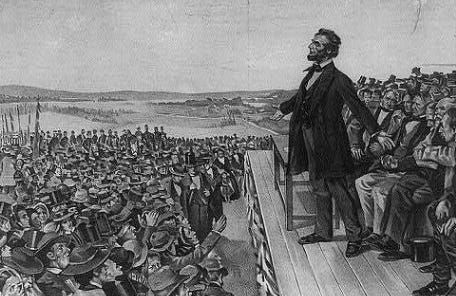
Four months later, the bodies had been gathered and a proper national cemetery was being dedicated on the site. The main speaker that day was Edward Everett — then considered the greatest orator in America. He spoke for two hours. It was polished, classical, exhaustive.
Lincoln spoke for two minutes. He was almost an afterthought on the programme.
Everett wrote to Lincoln the next day and said what Lincoln had achieved in two minutes, he had failed to do in two hours.
What makes the location so powerful
Lincoln was standing on ground where thousands of men had just died. The audience included survivors, widows, and grieving parents. He couldn’t make it sentimental or political. He had to justify the cost — not just of this battle, but of the entire war — in a way that would hold.
So he went to the deepest possible foundation: the idea that America was founded on a proposition, and that proposition was being tested right here, right now, by what these men had died for.
The implications
The implications were enormous - and they rippled outward in ways Lincoln probably didn’t fully anticipate.
1. It redefined what the war was about
Before the Address, the war was widely understood in the North as a war to preserve the Union — a political and constitutional struggle. Lincoln used the speech to reframe it as a war for human equality. He reached back to the Declaration of Independence (”all men are created equal”) rather than the Constitution, which actually protected slavery. That was a deliberate and radical move. He changed the moral stakes of the entire conflict in two minutes.
2. It redefined America’s founding idea
Lincoln effectively argued that equality — not just liberty, not just law — was the core promise of America. This was contested then and remains contested now. But by anchoring it so powerfully in the nation’s most sacred moment of sacrifice, he made it very hard to argue against. The speech didn’t just describe America. It changed what America believed it was.
3. It gave the dead a meaning
50,000 casualties needed a justification. Lincoln provided one that transcended politics — he said they died so that self-governance and human equality could survive on earth. Not just in America. On earth. He universalised the sacrifice. That is why it still lands emotionally 160 years later.
4. It set the moral foundation for abolition
The 13th Amendment abolishing slavery passed in 1865 — less than two years after the Address. The speech had already shifted the moral ground so decisively that abolition felt like the inevitable completion of what Lincoln had promised at Gettysburg.
5. It permanently changed political language
“Government of the people, by the people, for the people” became the defining phrase of democratic governance worldwide. It was quoted in independence movements, constitutions, and speeches across the globe for the next 160 years. That single clause shaped how democracy talks about itself.
6. It showed what language can do
This is perhaps the deepest implication for anyone studying it as an input. The speech demonstrated that the right words, at the right moment, framed correctly, can permanently alter how millions of people understand reality. Not through force. Not through law. Through pure rhetorical architecture.
Who was Lincoln at that time?
Politically, he was vulnerable
He was midway through his first term and deeply unpopular. Large sections of the North wanted to negotiate peace with the Confederacy and end the war. His own party was fractured. Radical Republicans thought he was moving too slowly on slavery. Conservative Republicans thought he was moving too fast. The Democratic opposition called him a tyrant and a dictator.
His approval ratings — by the rough measures of the day — were low. Re-election in 1864 looked unlikely. Many in his own cabinet thought they were more qualified than him to be president. His Secretary of State Seward had essentially expected to run the administration himself when Lincoln was elected.
Personally, he was broken
His son Willie had died in the White House in February 1862 — just 11 years old. Lincoln was reportedly seen standing over the boy’s body weeping for hours. His wife Mary Todd never fully recovered and had a mental breakdown. Lincoln suffered from what he called “the hypos” — what we would now recognise as severe depression. People who saw him during this period described a man who looked hollowed out, aged far beyond his years.
He was also physically exhausted. He was working 16-hour days, personally signing officer commissions, reading thousands of letters from soldiers and families, and making decisions that sent hundreds of thousands of men to their deaths.
Militarily, the war was a grinding nightmare
Gettysburg had been a Union victory but at catastrophic cost. The war showed no sign of ending. The casualty numbers were unlike anything Americans had ever experienced. Public support was eroding. There had been draft riots in New York City just months earlier in July 1863 — some of the deadliest civil unrest in American history — where working class men burned buildings and attacked Black citizens in fury at being conscripted into a war they didn’t believe in.
And yet
He was also a man who had been forging himself for this moment his entire life without knowing it. Born in a log cabin in Kentucky in 1809. Almost entirely self-educated — he estimated he had less than a year of formal schooling total. He taught himself law by reading borrowed books by firelight. He read the Bible and Shakespeare obsessively — not for religion or culture, but because he loved language and argument.
He had failed repeatedly — lost elections, failed businesses, suffered breakdowns. By the time he became president he had been tested in ways most leaders never are.
So when he stood at Gettysburg he was simultaneously a man at his most vulnerable and a man at the absolute peak of his moral clarity. The speech reflects that. There is no self-pity in it, no political calculation, no hedging. Just the clearest possible statement of what he believed the country was and what it had to become.
Is it true that CSC scholarship is not English taught bachelor program, If I apply through Type A ?