
The UK needs new towns and there is a New Towns Plan
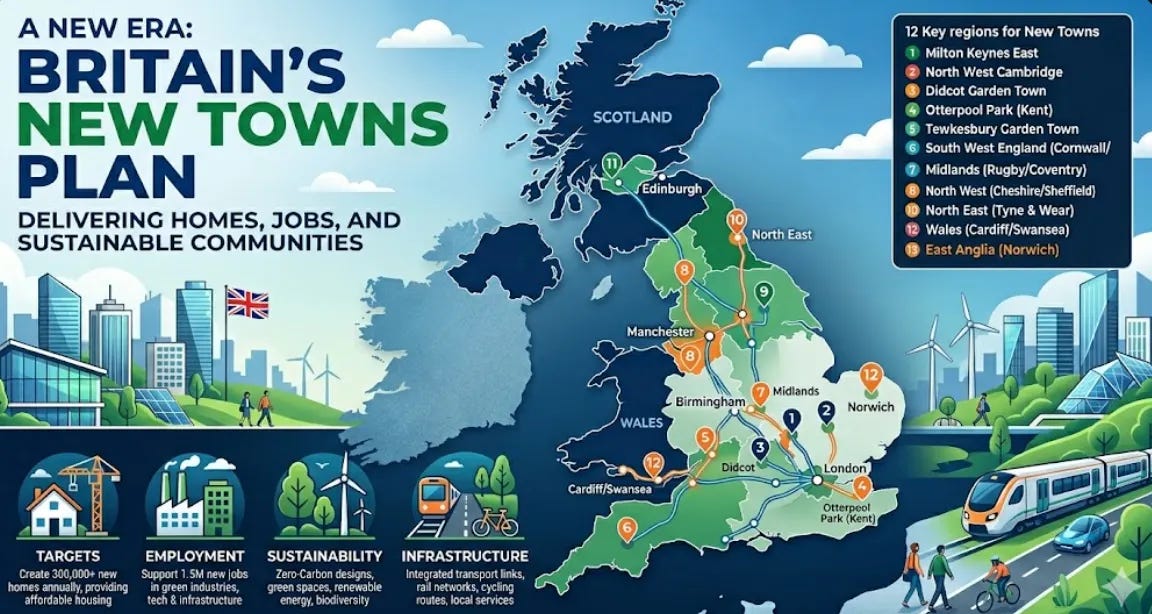
The ambition is real, the need is urgent, and the political will, is there.
The question planners and politicians need to ask is not “where will these people work?” as if work is a thing that happens elsewhere and the town just needs good rail links to it.
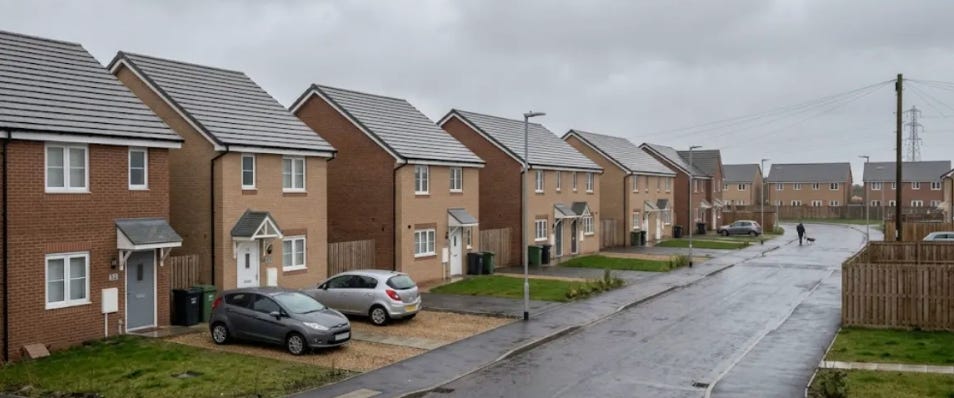
The question should be “what kind of place do we want this to be, and who do we want to build their lives here?”
What follows is an argument for building new towns around identity, industry, and creative energy rather than around proximity to a motorway junction to get to London, or the nearest city.
The Creator Town
The creator economy is real, growing fast, and it needs somewhere to go.
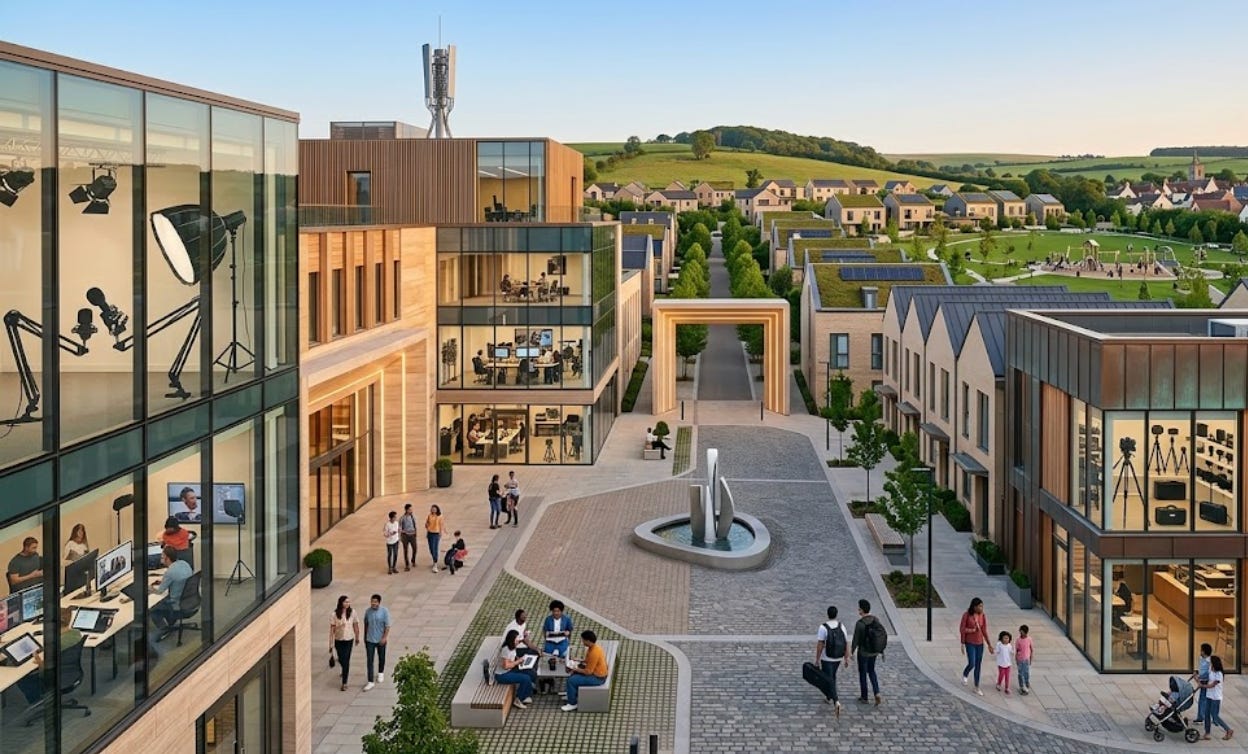
There are hundreds of thousands of people in Britain who make their living, or are trying to make their living, through YouTube, podcasting, newsletters, online courses, and content of every conceivable kind.
Most of them work from bedrooms, spare rooms, or rented desks in cities where the cost of living is crushing them.
They can go to London, but in truth, the costs and isolation of being in a big city is good for some but pushing many people to Thailand, Bali, or US.
A new town that took this seriously would build professional podcast studios that residents could book by the hour.
It could be a place people go to start their careers in the creator economy, rather than going to London, together with like minded people, or for creators to move to, or visit and build families.
It would have video production spaces with proper lighting rigs, soundproofing, and broadband that actually works.
It would attract the ecosystem around creators, the editors, the thumbnail designers, the social media managers, the agents and the equipment suppliers. Creators are not loners.
They form communities. Give them a place to form one and they will come.
Cities like Austin and Nashville have attracted creative communities not through accident but through deliberately building the infrastructure those communities need. Britain’s new towns could do the same at lower cost and with more intention.
Artist Town
Artists Need Affordable Space More Than They Need Prestige
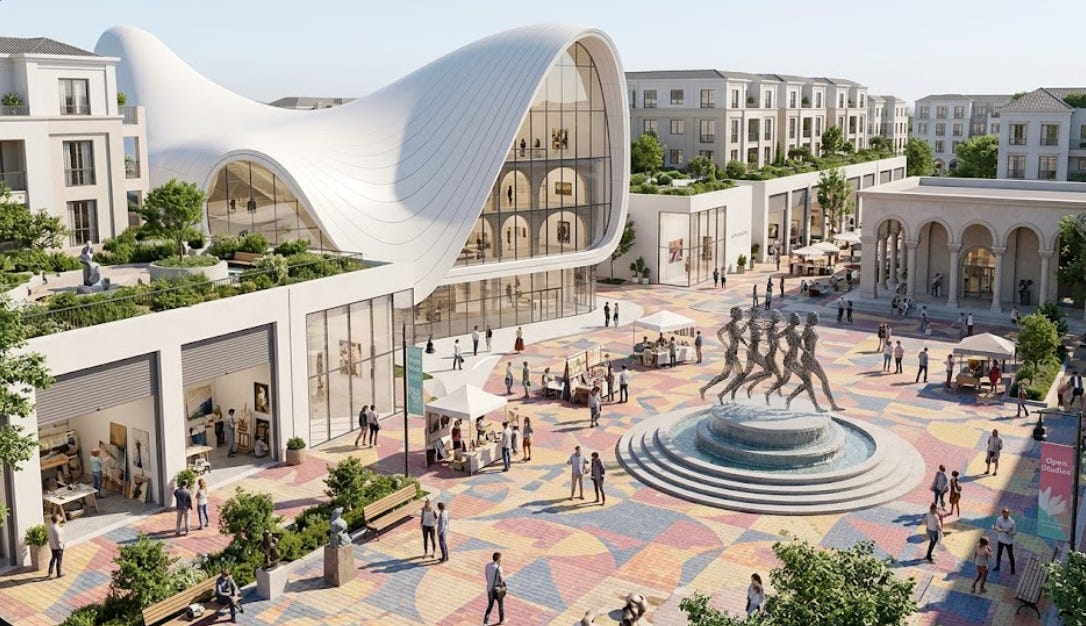
Artists move into an area, make it interesting, property prices rise, artists are priced out, the interesting thing dies.
Repeat endlessly.
A new town designed for artists would break this cycle at the start.
It would build affordable live-work studios as a permanent feature of the planning, not as a temporary concession.
It would have gallery space that is accessible to residents rather than purely commercial.
It would run classes, host residencies, fairs, festivals, and exhibitions, sculptures, to create the kind of low-level daily contact between working artists and the public that makes art feel like a living part of a community rather than something that happens in institutions in other cities.
The economic case for this is stronger than it sounds.
Towns with genuine creative cultures attract tourism, attract media attention, attract the kind of educated professional workers who want to live somewhere with character.
Art is not decoration. It is infrastructure.
Music City
Music is an Industry and It Has Been Ignored in Planning for Decades
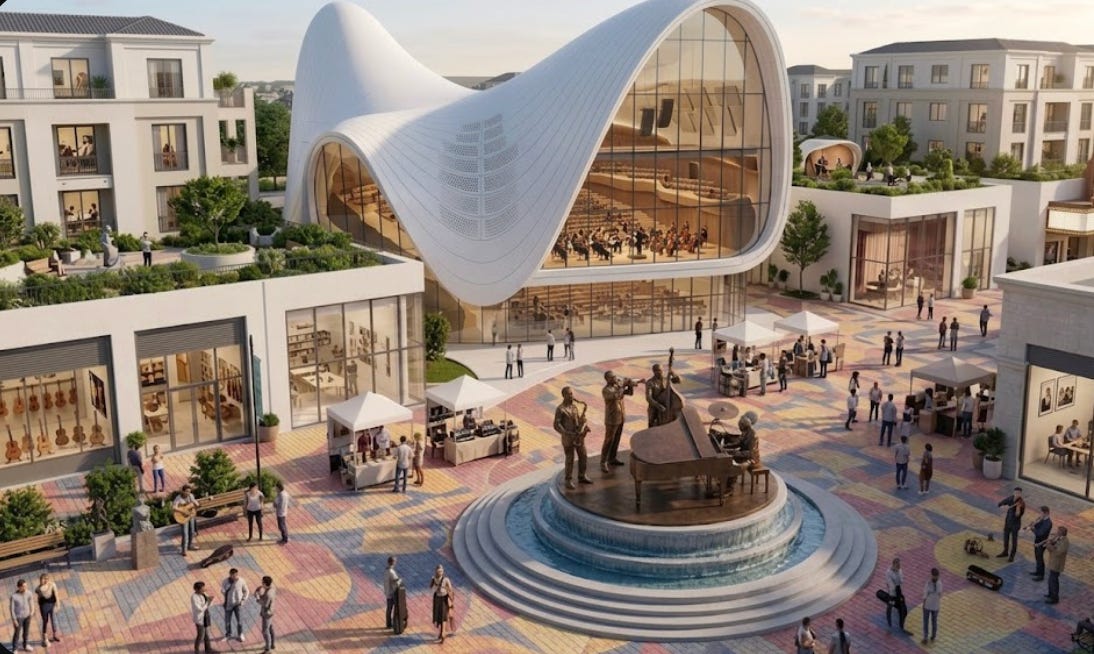
Britain has one of the most extraordinary music cultures in the world.
It also has a crisis of venue closures, unaffordable rehearsal space, and musicians priced out of the cities where the industry is concentrated.
A new town with real performance halls, theatres and affordable rehearsal rooms, with recording studios available to residents, with a music venue that is part of the civic fabric rather than an afterthought, would attract musicians.
Musicians attract audiences.
Audiences create economies around them.
The town becomes a destination rather than just a dormitory.
This has happened organically in places like Margate and certain parts of Leeds.
It can be designed deliberately in a new town if the will is there.
Founders & Entrepreneurs
Entrepreneurs Do Not Need an Office Park
They Need a Community
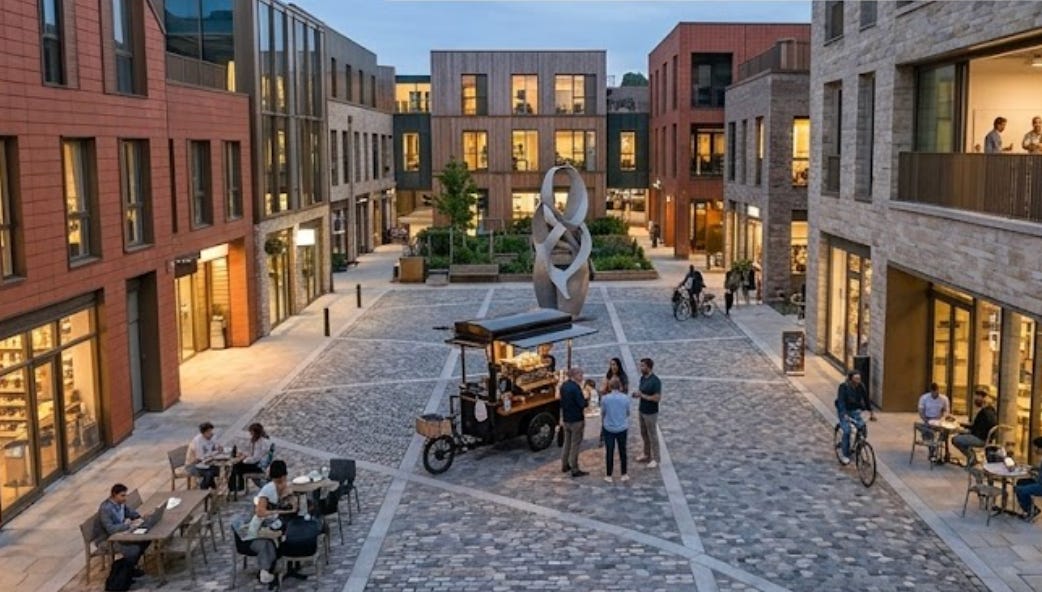
The old model of attracting business to a new town was to build an office park on the edge of it and hope companies would lease space there.
This approach produced some of the most depressing built environments in Britain and has largely failed to create genuine economic vitality.
Entrepreneurs, particularly the growing population of people running small businesses, freelancing, or building startups, need something different.
It is growing incredibly fast. With reports that 1 in 3 people in UK want to become entrepreneurs.
They need coworking spaces that are affordable, not London prices with a regional discount.
They need housing they can actually buy or rent on an irregular income.
They need to be near other entrepreneurs because proximity to peers matters more than proximity to a motorway.
One of the best ways to learn is with the right peers.
A new town that designed itself around this community would attract risk-takers, builders, and innovators, and investors.
These are exactly the people you want in a new town because they create employment for others rather than simply occupying it.
It would become self-sustaining very fast.
The low cost of land in a new town is a competitive advantage.
Use it to offer below-market workspace on long leases.
The returns will come indirectly, through the economic activity these people generate and the reputation the town builds.
AI, Robotics and Manufacturing
AI and Robotics Need Physical Space and Britain Is Not Building Enough of It
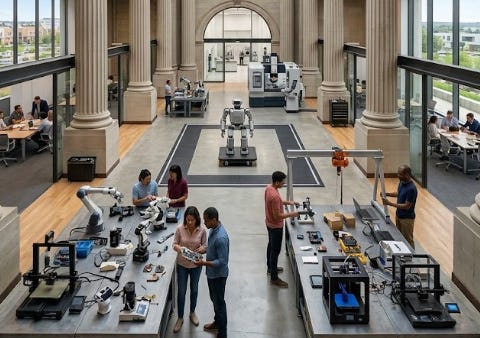
There is an emerging crisis in British AI and robotics research.
The talent exists.
The ambition exists. The physical infrastructure for companies that need to build and test physical systems, rather than purely write software, is scarce and expensive.
A new town could deliberately position itself as a home for this sector.
This means building labs, not just offices. It means tolerating the slightly chaotic, industrial-adjacent character of hardware development. It means building housing that researchers who are often mid-career, often with families, actually want to live in. It means creating the kind of place where someone would choose to locate a robotics company because it is genuinely easier to operate there than in Cambridge or London.
The government is already trying to build AI infrastructure.
Building it into a new town rather than dropping it into an existing overcrowded city is a logical extension of that ambition.
Health & Wellness
Health and Wellness is an Industry, Not Just a Lifestyle Choice
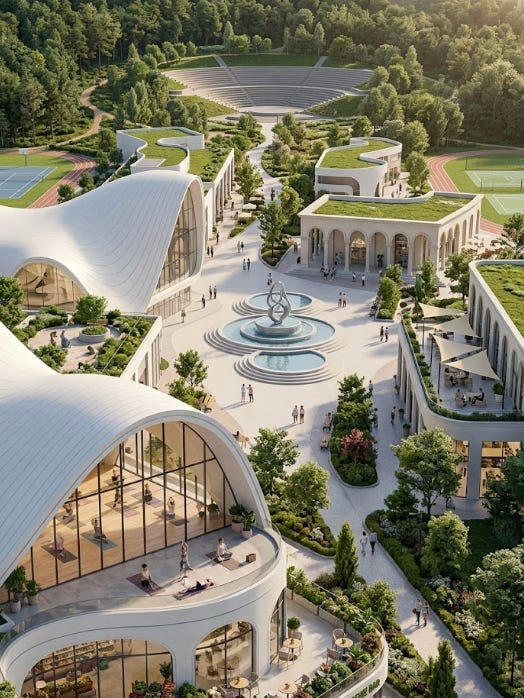
The wellness economy in Britain is worth tens of billions of pounds and is growing.
Yet new towns are planned as if residents’ health is an afterthought, with a leisure centre if they are lucky and a gym franchise if they are not.
A new town built around healthy living would have yoga studios, climbing walls, running trails that are actually designed for running rather than squeezed between car parks, outdoor fitness facilities, spaces for martial arts and dance. It would attract instructors and therapists and the businesses that cluster around active communities.
More importantly, it would attract a particular kind of resident.
People who prioritise their physical and mental health are, as a group, economically active, community-minded, and invested in where they live. They are precisely the demographic that turns a collection of houses into a place.
Sports
Sport Creates Identity and Identity is What New Towns Historically Lack
Milton Keynes has a hockey team.
It is not a coincidence that hockey has become part of the town’s identity in a way that few other things have.
Sport gives people something to belong to.
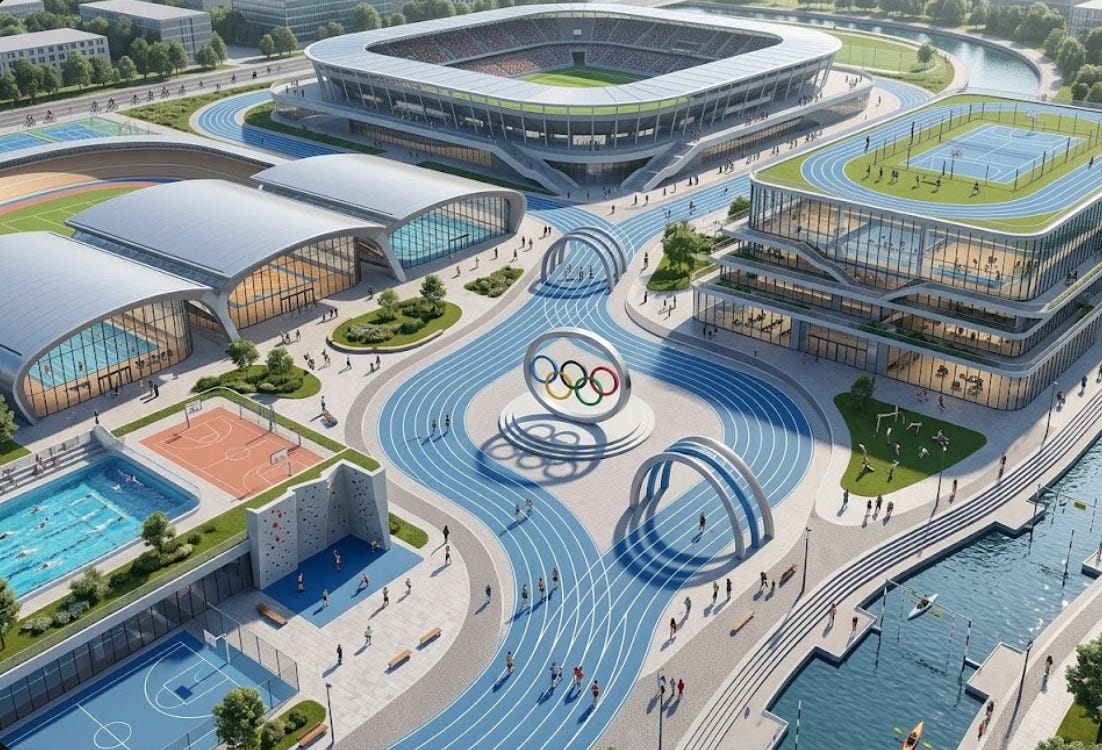
A new town that took sport seriously, not as a facility to tick a box but as a genuine civic institution, would be building identity from the ground up.
It would invest in training academy, a stadium or sports complex that could host competitive events and attract visitors.
It would build facilities for minority sports that are desperately underserved, things like cycling velodromes, athletics tracks, water sports facilities, outdoor climbing.
It would create elite pathways for young athletes and the coaching infrastructure around them.
Sport brings people together across every other demographic division. It creates local pride in towns that sometimes struggle to find anything to be proud of.
Not Another Commuter Town
Why All of This Is Better Than Building a Commuter Town
The commuter town model has a fundamental problem.
It makes the town entirely dependent on somewhere else.
If the jobs in the city change, if working patterns shift, if the rail connection deteriorates, the town has nothing of its own to fall back on.
It is a parasite on an economy it does not control.
Every one of the industries described above can exist within the town itself.
The creators create there. The artists work there. The musicians perform there. The entrepreneurs build businesses there. The researchers research there.
The town generates its own economic activity, its own culture, its own reasons to visit, its own identity.
They give back.
They attract talent from around the UK, and the world.
The commuter town model produces places that are efficiently dull.
The creative industries model produces places that become destinations.
There is also a housing argument here that is often missed.
People in creative and entrepreneurial careers often need housing that is flexible, that allows them to work from home, that does not require a two-hour commute to justify the mortgage.
Building for them means building places where life and work are integrated, which is a more humane and more economically resilient model than building suburbs that empty out every morning and fill up every evening.
Why Not?
The Objection and Why It Is Wrong
Someone will say that this is all very well for a certain kind of person but that most people need ordinary jobs, ordinary housing, ordinary amenities.
This is true. A new town needs supermarkets and schools and GP surgeries and all the rest of it.
But the creative industries model does not exclude any of that.
It adds to it. The yoga studio needs cleaners. The podcast studio needs administrators.
The performance hall needs security staff and catering and technicians.
Every creative business that locates in the town creates supply chains, service needs, and employment that reaches well beyond the creative sector itself.
It creates new jobs too.
The argument is not that everyone in the new town will be a podcaster.
And that might be a bit too much!
The argument is that building the town around a creative identity rather than around a train timetable will produce a more economically diverse, more resilient, and more genuinely desirable place to live for everyone who ends up there.
The Cost
It will cost too much?
No
And here is why that objection does not survive contact with the actual numbers.
A podcast studio is a soundproofed room with decent equipment. A coworking space is a building with desks and fast internet. A rehearsal room is four walls and acoustic panels. A yoga studio is a sprung floor and some natural light. This is not expensive infrastructure. It is cheaper than almost everything we already build in new towns without anyone calling it unaffordable.
We spend hundreds of millions on road junctions. We build retail parks that sit half empty within a decade. We construct leisure centres with swimming pools that councils cannot afford to heat five years later. We subsidise office parks that never fill. Nobody applies the cost objection to any of that. The objection is selective. It gets aimed at things that feel unconventional, not at the things that have demonstrably failed.
The government does not have to pay for most of this anyway. Zone land for a creator district, make the planning straightforward, keep rents affordable, and the private sector builds the studios. Create an entrepreneur quarter with below-market workspace and investors will back it because the demand is real and growing fast. The public sector creates the conditions. The market does the rest.
And consider the cost of the alternative. Every commuter town requires massive road and rail investment to connect it to somewhere else. It needs ongoing subsidy for public services in a place with no economic base of its own. Its residents work elsewhere, spend elsewhere, and feel no particular attachment to where they sleep. That model is expensive. It is just expensive across budgets and decades in a way that nobody adds up.
A town with its own identity generates business rates, generates employment, generates visitors who spend money there. It pays for itself. A commuter town structurally cannot do that.
The expensive mistake is not building with intention. It is building without it and spending the next fifty years wondering why nobody actually wants to be there.
Conclusion
We’re in a new era.
The big supercity is great, but its overflowing and house prices from money from high paying jobs are a barrier to the emerging creative industries.
All trying to compete.
Let’s build new cities and towns around specific identities, with intention.
One of the most powerful things you can do is put talent together.
People yearn to be with their tribe.
Britain is going to build new towns, (but not enough of them)
BUt nobody wants another commuter towns.
We can build more Milton Keyneses, competently planned, well connected.
And we can build more commuter towns.
Or we can build places with real identities, places where industries cluster because the conditions for them have been deliberately created, places that people choose rather than settle for.
The infrastructure of the creative economy is not expensive.
Podcast studios and coworking spaces and rehearsal rooms and yoga studios are cheap compared to road schemes and railway stations.
\What they require is not just money but identity, the willingness to ask what kind of place we are building and to answer that question before we pour the concrete.
We have not asked that question seriously before.
This is the moment to start.
