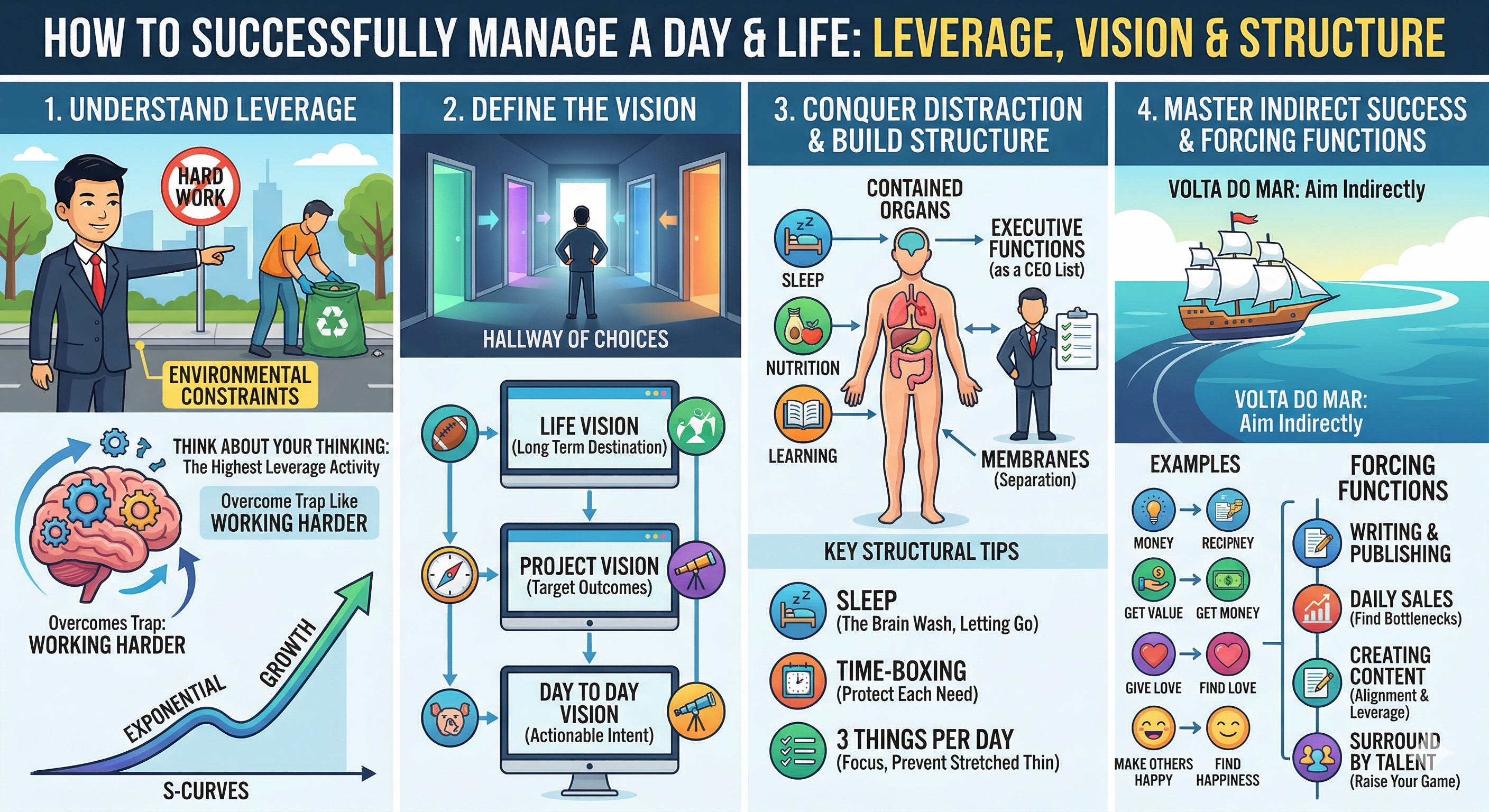
It’s clear that working harder is only going to get you so far, until you meet the constraints of your environment or structure. A Chinese businessman taught me that as we were eating lunch and gave the example of a person picking up recycling from the street. No amount of hard work is going to fix the limitations of a certain business model. That’s why understanding how the economy and leverage works is essential.
The highest leverage activity you can do is thinking about your thinking. You can reprogram your mind, you can overcome any limitation. But as we move to a higher level, there are other traps and limitations to overcome. The challenge is that many of these are counter-intuitive. That’s why they’re traps. Just like you’d think working harder should bring you greater success (as the most obvious one).
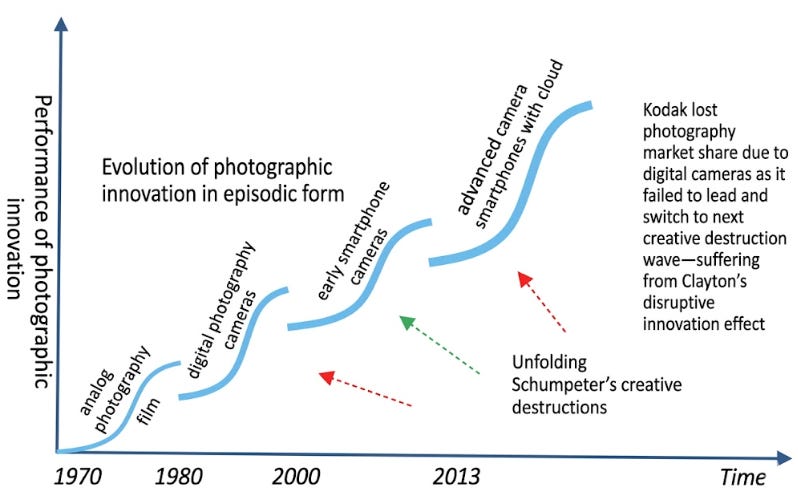
If you are not growing exponentially, there are either reasons that are blocking you, or you do not understand what is necessary for the next level. Progress - in technology, and language learning, and everything else, moves in a series of S curves.
There are these lessons all around. When the student is ready, the teacher will appear.
Define the Vision
It all starts with the vision of where you are going. There are infinite possibilities and choices.
It’s powerful because often the world around us gives the illusion of being permanent and real, but it is very temporary and was nearly completely created by your past self. You are the only person in the world experiencing your current reality, and it’s a result of what you visualised and created before. When you start interacting with it, you realise it’s not real, it's an illusion, it’s as if you are in a hallway with multiple doorways to your future visions.
In some way, your future visions are as real as your current reality. Both of them exist nearly completely in your mind as “hallucinations” and exist only by you. By focusing on your current reality you can re-create it, by focusing on your vision you can navigate current reality that is unfolding and create your vision.
So the question is, what is your vision? Out of all the possible options, which game are you trying to play?
We need multiple levels of visions. The long term life vision is one, but the vision for each project is another, and the vision for the day to day is another.
- Life Vision - future destination and future self
- Vision of Each Project
- Day to Day Vision
Build the Vision Muscle
There are several traps with learning how to create visions. The first is to not set any vision at all, to trust your current reality too much, to set visions that are too lofty and too far away, and be distracted by too many visions.
It’s an advantage to practice setting short term visions. Sports, such as football or rugby or cricket, are an excellent example of activating the vision muscle, because you are effectively acting in real time predicting, and visualising possible outcomes. It’s a great way to practice it quickly.
You can then extend that out to smaller projects, such as visualising your day, and visualising specific scenarios around you. You can then project this out for your life, career and each specific project and long term you are working on.
The key is to have a vision for everything. Wherever you put your attention, visualise where you see it going and where you want it to go. Practice and build that muscle. Build your intention.
Distraction
One of the biggest dangers is distraction. Distraction is something that either pulls in your attention or diverts you “any stimulus that consumes attention without yielding a return on investment”.
So having too many visions can be distracting if it pulls you away from making progress in any, or the most important ones.
There are also people who will attempt to divert you as you make progress. You need to overcome those.
So there is an art to understanding how many visions you can manage and limiting them so it’s easier to achieve the most important ones.
Structure Vs Creativity
There is a friction between structure and creativity. For me I’m someone who just has constantly new ideas about everything I’m working on. We need to have freedom and expansive time to create and grow and ideate and strategise and play, but we need structure to execute and operate.
There is a reason every organ of the body has a specific and clearly defined function. As you grow you are essentially moving from a simple single celled organism to a multi-cellular organism, to a person to a company to a society. At each stage you need different principles to grow. You also need to build more structure so you can support the growth. The heart focuses on blood pumping. Whereas in single celled organisms the organism has fewer needs and ability to specialise.
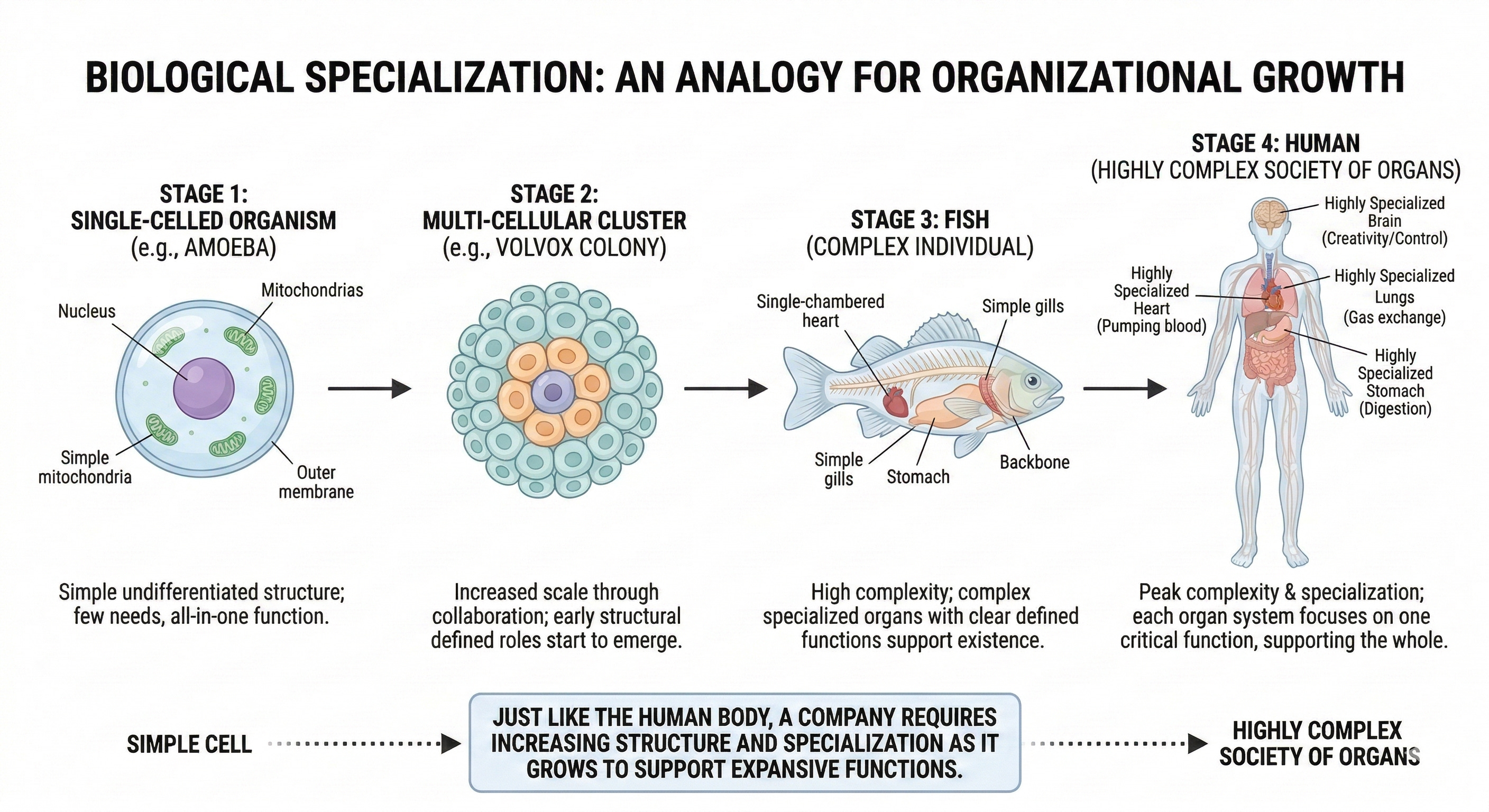
Just like a human body, we need a time and a space for creativity, and recreation, and excretion and cleaning and breathing, and rebuilding. And as we become more capable we need more specialisation and structure.
It’s important because often something that holds us back is that things bleed into each other. For example, we get anxious and don’t sleep, we think about ideas all day, we need to contain everything. When blood is not contained it fails to work and affects other parts of the system. The brain won’t work if it’s not contained. Muscles and bones need to be separate to work properly.
That’s where time boxing comes in, and curating and becoming more specialised at each part. That’s also why at each S curve and at each level of growth we need to re-create and re-imagine what we are from the ground up.
Building Structure
We need structure in every project we have, and in our own time and goal setting. Here are a few mental models to think about structure.
Each of our needs need to have their own structure that is protected and separate from the other. What are these? Sleep, nutrition, socialising, warmth, financials, learning, executive functions, health and repair.
In this I’m going to talk about executive functions. Being the CEO of ourselves.
Sleep
What is the function of sleep? It’s to wash out and clean our brain. This is something we need to protect to serve it’s function and optimise our day. That’s why it’s essential to turn off and become great at sleep to function well.
Sleep teaches us a valuable lesson. That of the value of letting go.
When we try to focus more on our goals and our sleep suffers, it makes it harder to operate well the next day. Letting go and having a less tight grip at the right time allows us do better and have a stronger grip the next day.
3 Things Per Day
A great tactic to plan the day is to just focus on the top 3 things to do each day. Out of all the 25+ things you can be working on. What are the top 3? This saves time, you don’t need to think about everything, and it ensures you don’t try to do too much - and get stretched too thin, and it enables you to focus better.
Time-Boxing
This is another structure that enables us to operate better by setting a task for each time block.
Achieve Success by Aiming for Something Else
Often the best way to achieve success in some area is indirectly - to focus on another area. The Portuguese learnt this by discovering the Volta do Mar.
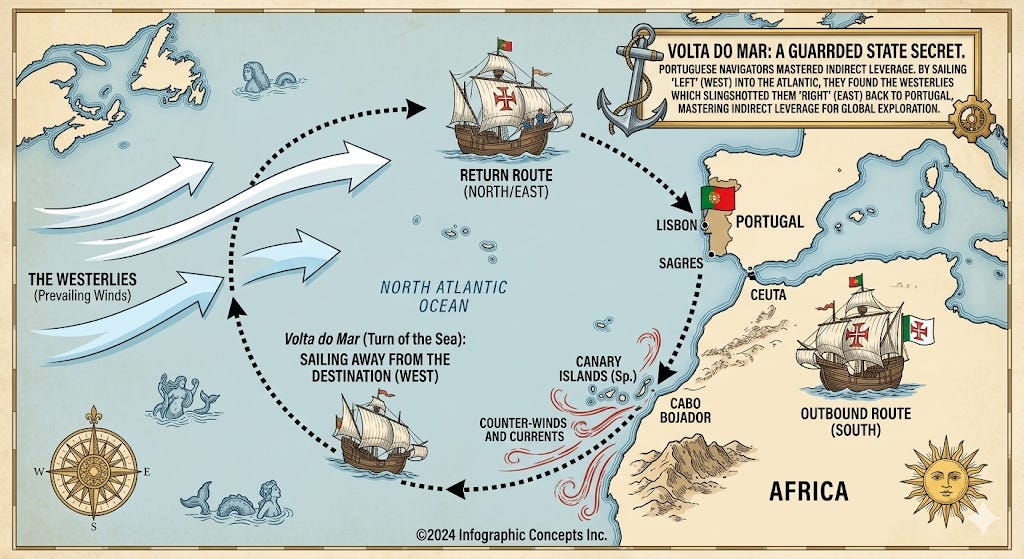
Nearly every path to success is a Volta Do Mar.
You don’t get money by getting money. You get it by building the best product and business and giving the most value. You don’t find love directly, you do it by being the best you can be and giving love. You don’t find happiness directly, you do it by making others happy. You can’t fall asleep by trying to sleep. You do it by relaxing or reading a book.
Forcing Functions
There are a number of forcing functions that work well as:
Writing ideas and publishing them, like this one is a great way to get your ideas out and develop them
By getting involved in sales everyday, it shows you were the bottleneck is.
Creating content is too also helps you to be aligned and it builds leverage.
Surrounding by talented people - it raises you up and improves your game.
How to Conquer Distraction and Level Up?
By understanding the system, by creating structure, by having a place for everything.