
If you’re out of ideas, go for a walk. It sounds like a cliché, but it works for a real reason: your brain runs in different modes, and some kinds of thinking only happen when you stop forcing them.
We’ve all been there. You sit at your desk trying to crack a problem and nothing comes. Then you’re in the shower, or halfway round the park, and the answer just arrives.
It’s funny how often the ideas come when you stop trying. Here’s what’s going on in your head when that happens, and how to use it.
Your brain has a focus mode and a wandering mode
Neuroscientists have mapped large networks in the brain that switch on for different kinds of thinking. Two matter most here.
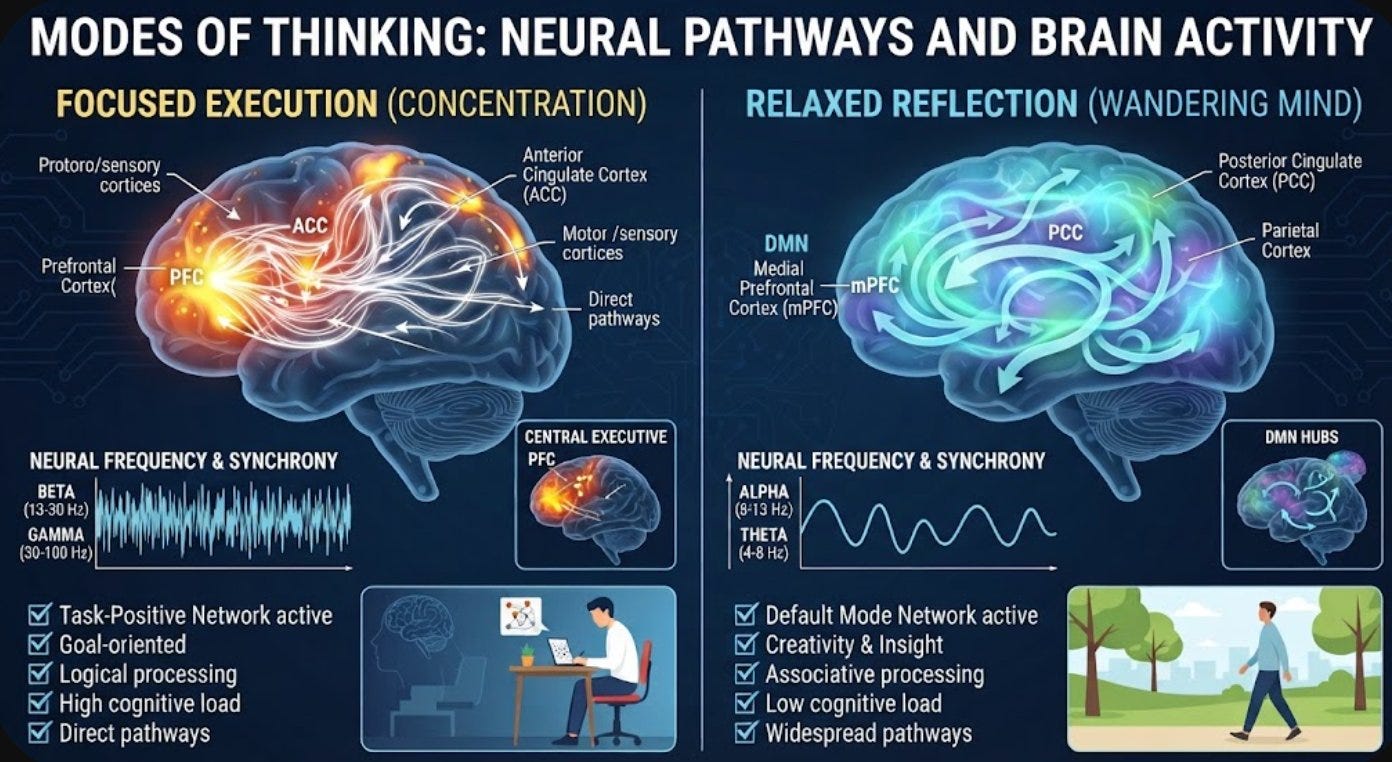
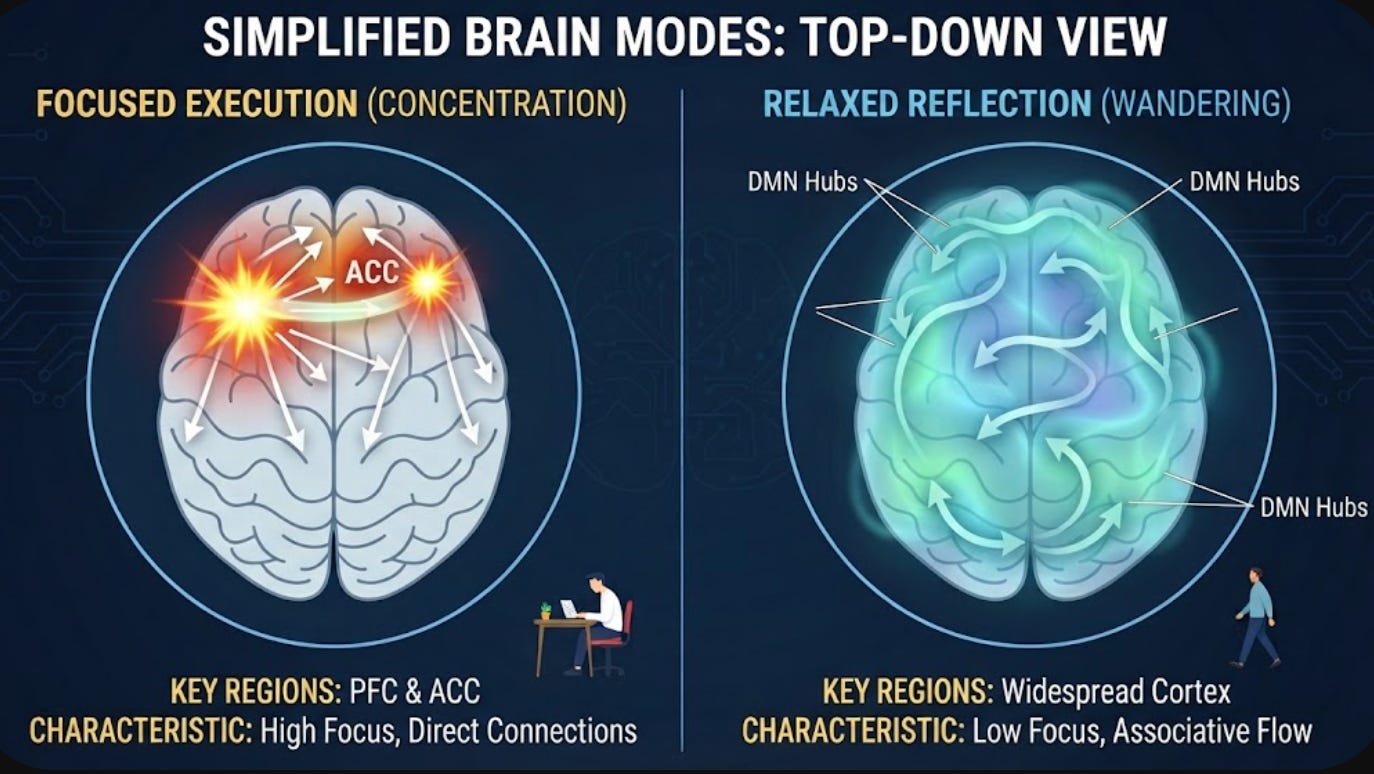
The default mode network is active when your mind wanders. It includes the medial prefrontal cortex (mPFC), the posterior cingulate cortex (PCC) and parts of the parietal cortex. It handles daydreaming, replaying memories, imagining the future and thinking about other people.
The executive control network takes over for focused, goal-directed work. It holds information in mind, follows steps and keeps you on task.
The two tend to suppress each other: when one is up, the other is down. That’s why you can’t daydream your way through a spreadsheet, and why it’s so hard to force a creative leap while grinding through a to-do list.
A third network, the salience network, decides what deserves your attention right now and helps switch between the other two. If your brain shifts gears, this is the clutch.
Why a walk works
Wandering mode isn’t idleness. It’s when your brain quietly recombines what it already knows, pulling up memories and linking ideas that never meet while you’re concentrating.
A walk is close to ideal for this. It takes little effort, it lifts your mood and it gets you away from the problem without switching your brain off. Researchers at Stanford found that people came up with noticeably more creative ideas while walking than while sitting.
There’s a catch, though. This effect, known as incubation, works best after you’ve already wrestled hard with the problem, because your brain needs the material loaded before it can work on it in the background. So the real advice isn’t “don’t try”. It’s “try hard, then let go”.
Creativity needs both modes working together
It’s tempting to conclude that creativity lives in the relaxed mode, but the research is more interesting than that. A 2015 review by Roger Beaty and colleagues found that during creative work, the wandering network and the focus network cooperate, even though they usually compete.
Their model is simple. The default network generates candidate ideas, mostly by pulling from memory. The executive network evaluates them and shapes them to fit what you’re trying to do.
The studies behind it are fun. When professional poets wrote new lines, the two networks pulled against each other; when they revised, the networks cooperated. Art students sketching book covers mostly used the wandering network to come up with ideas, then both networks together to judge them.
Highly creative people even show stronger links between the two networks when they’re doing nothing at all. Memory matters too: a short exercise in recalling specific details of a recent experience boosted how many ideas people produced afterwards. Your experiences are the raw material your wandering mind works with.
A few practical lessons fall out of this:
Separate brainstorming from editing. Generate loosely first, then judge. Critiquing every idea as it arrives jams the gears.
Use constraints. A clear goal or limitation brings the focus network in to steer your wandering mind.
Feed your memory. Varied experiences, reading and conversations give your brain more to recombine.
Mood shifts the gear too
Your mood changes which mode you’re in. Anxiety narrows your attention, which helps when you need to execute under pressure but makes creative leaps harder.
A relaxed, optimistic or excited mood does the opposite. It broadens your attention, so you’re more likely to notice distant connections and have those “aha” moments. That’s another reason a walk works: it lifts your mood as well as lightening the load.
Shift gears, don’t grind them
You can think of your brain as shifting gears. Working, socialising and exercising each engage you differently, and moving between them on purpose can leave you fresher than hours of one thing.
But there’s an important distinction. Constant switching, like checking messages in the middle of a task, makes you less productive, because part of your attention stays stuck on the last thing and slows you down on the next.
That’s why batching works so well. You group similar tasks together, stay in one gear long enough to do real work, then shift deliberately: a deep focus block, a walk, some time with people, then back to focus.
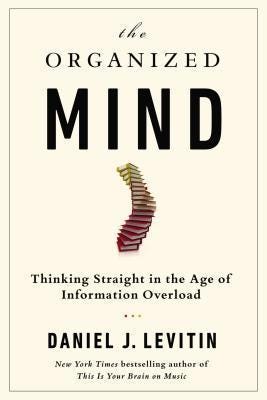
Daniel Levitin’s The Organized Mind is good on this. He describes the same two modes, a “central executive” and a “mind-wandering mode”, and argues that multitasking drains you while a natural back-and-forth between focusing and daydreaming restores you. Its opening chapters on attention and memory are the part to read closely.
Integrating the different parts of you
The same idea scales up beyond brain networks.
A mind works best not when one part dominates, but when the parts cooperate, and thinkers have been saying this for a very long time.
Plato described a just soul as one where reason, drive and appetite work in harmony, each doing its proper job. Aristotle distinguished the person who resists temptation through willpower from the truly virtuous person, who simply wants the right thing. The second has no inner fight left.
Carl Jung called the process individuation: becoming whole by integrating the parts of yourself you’d rather ignore, especially your “shadow”, the traits you deny or push away. For Jung, maturity isn’t becoming a better version of one part; it’s owning all of them.
Robert Kegan and Lisa Lahey bring it down to everyday goals. When you keep failing at a goal, they argue, it’s often because a hidden part of you holds a competing commitment.
You want to speak up more in meetings, but part of you is committed to never looking foolish. Once you see that conflict, you can start to resolve it and you feel at peace and can work much more efficiently.
You have enmeshment and can resolve it by strengthening your boundaries.
We can listen to how we are thinking, and when we feel bad or have conflict or strong emotions to point us to where we should rewrite our operating system to improve.
So next time you’re stuck
Load the problem properly, then walk away from it. Work in focused blocks and shift gears on purpose rather than grinding between them. And let the different parts of your mind, and of you, work together rather than against each other.
Further reading
Daniel Levitin, The Organized Mind: Thinking Straight in the Age of Information Overload (2014)
Roger Beaty, Mathias Benedek, Paul Silvia and Daniel Schacter, “Creative Cognition and Brain Network Dynamics”, Trends in Cognitive Sciences (2015)
Robert Kegan and Lisa Lahey, Immunity to Change (2009)