
An economy can’t claim the economy is growing by pointing to GDP growth whilst the population is in decline.
It’s not getting stronger, it’s not getting bigger.
It’s liquidating it’s most important asset
Humans.
GDP was introduced in 1934 and was never intended to be a target, but one of many measurements on the health of the economy. It is increasingly being questioned as it is having a perverse effect that distorts the economy.
As GDP is the measure of activity in the economy, it doesn’t differentiate between good activity and bad activity. For example an oil spill or a car crash will boost economic growth, as will raising costs of living. It actually incentivises extractive economics rather than value creation because it doesn’t differentiate between the two, and extractive economics is much easier and immediate. It incentivises liquidating the stock - including the human capital and infrastructure, and incentivising debt. All things that increase economic activity in the short term, but damage economic capacity, and growth in the long run.
It is the same as going to a doctor and saying: “I’m healthy, I ran 30km this week” but the doctor doesn’t look at heart rate variability, diet or general health, and just incentivises running more next week.
GDP acts as a master incentive on the economy. It guides government policy, which makes up almost 40% of the economy in most developed countries, and it incentivises policies from immigration to education and housing and infrastructure.
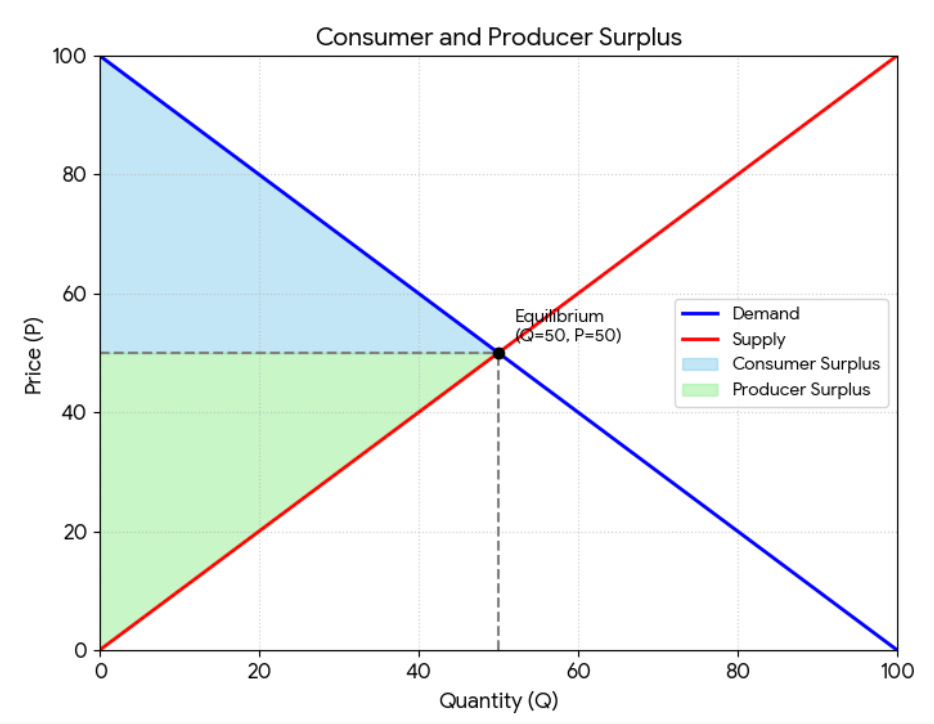
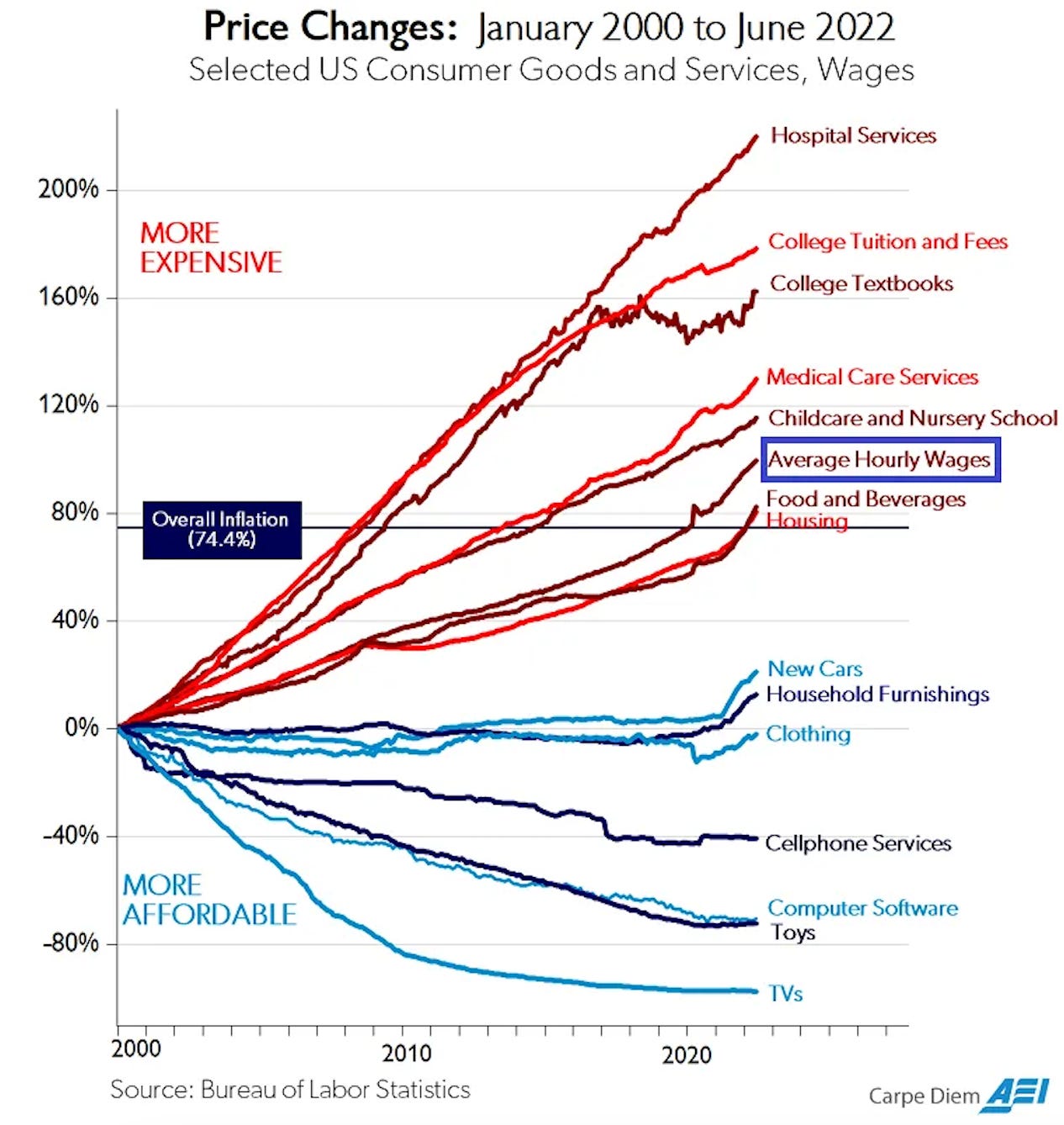
One of the ways to grow GDP is to eat away the consumer surplus. Consumer surplus is the difference between what you are willing to pay for something, and the price you do pay. By increasing prices on certain goods that are inelastic - housing, energy, education, healthcare it grows GDP.
And this is exactly what has been happening.
Another way we can increase GDP is by bringing more of our human exchanges into the transactive economy. If the state or market takes on more of these transactions - such as with onlyfans, tinder, and the welfare state, the GDP grows - is this a benefit for society?
The problem is that if the GDP is rising while our consumer surplus is falling, there is less left for the productive part of our economy. A healthy economy is one where the Surplus is maximized, not the Transaction Volume.
What should replace GDP? A host of KPI should be used, including possibly anonymised health, and birth rates can also be considered as a measure of consumer surplus and forward optimism. Also a balance sheet perspective which considers human capital, and infrastructure. Warren Buffet emphasizes analyzing balance sheets for a company’s true financial health, looking for low or no debt, high cash reserves, consistently growing retained earnings, and minimal preferred stock, as they are harder to manipulate than income statements and reveal a company’s long-term stability and competitive advantage (moat). The same should be the case for countries.
Moving to a balance sheet perspective would see us recognising and investing more in health, childcare, and put an economic value on life, where it is currently viewed as a cost.
What is Infrastructure?
Another point is that there are rising costs in housing, education and healthcare. But why is that?
Infrastructure is defined as:
the basic physical and organizational structures and facilities (e.g. buildings, roads, power supplies) needed for the operation of a society or enterprise.
Housing is artificially limited and this is to support GDP growth. They have become financialised and more of an investment asset than a place to live.
The problem is that as these costs rise, and GDP rises, they eat away at the consumer surplus, leaving less available for the productive economy.
Housing, education and healthcare are often framed as private benefits, but they actually fall under the above definition of infrastructure.
The debate is usually more about how should pay for it? The state or the market? Rather than recognising their value beyond price.
In order to grow our economy in the long run we need to move beyond GDP and recognise the value of infrastructure