
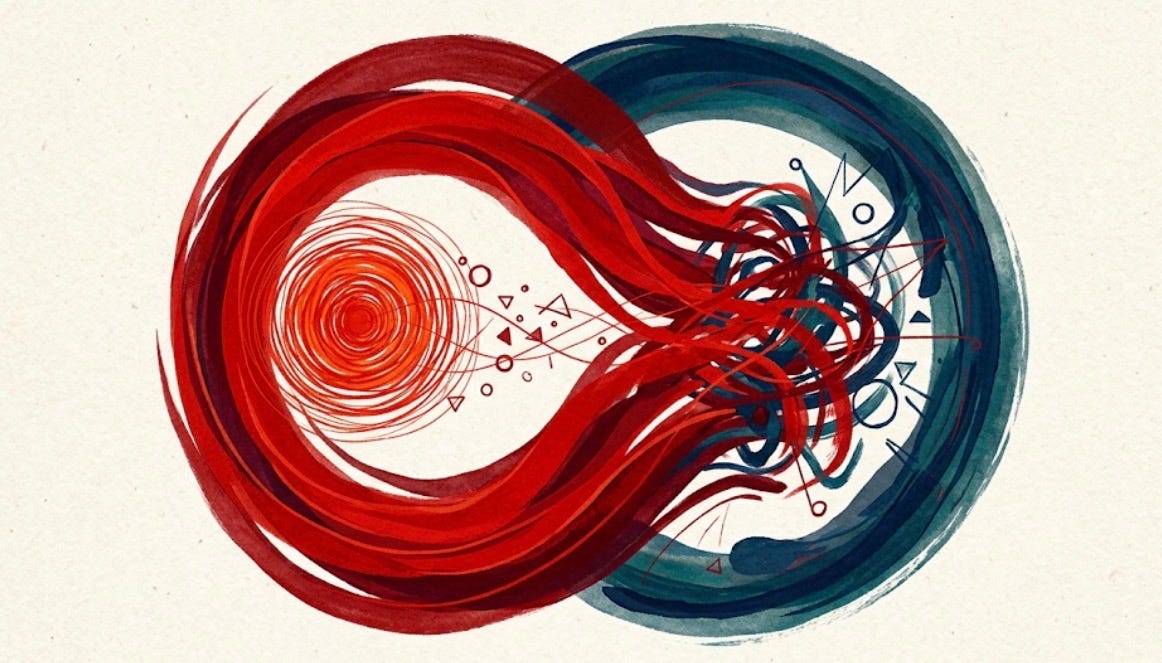
It impacts every other part of emergence
The core principle is that the act of observation is not separate from reality - it participates in it.
These are some of the different layers of emergence. Observation in all these parts has different impacts.
Biology Life is chemistry that learned to copy itself and adapt. The core principle is evolution by natural selection — things that reproduce better, survive. Everything in biology, from cells to ecosystems, is the result of billions of years of that single filter.
Chemistry Matter wants to reach its lowest energy state. Atoms combine, break, and rearrange to do that — and those rearrangements are chemical reactions. The core principle is that electrons are shared or transferred between atoms, and that determines almost everything about how substances behave.
Physics Reality follows mathematical laws, and those laws are the same everywhere in the universe. The core principle is that matter, energy, space, and time are all interconnected and governed by rules that don’t change — from a falling apple to a collapsing star.
Economics People make choices under scarcity. The core principle is that incentives drive behavior, and markets are the collective result of millions of individual decisions about what things are worth. Everything in economics flows from that tension between unlimited wants and limited resources.
Quantum Physics At the smallest scales, reality is fundamentally probabilistic and discrete. Things don’t have definite properties until measured, energy comes in chunks, and particles behave like waves. The core principle is that the act of observation is not separate from reality — it participates in it.
Politics Power is the ability to make others do what you want. The core principle is that humans must organize collective decisions, and politics is the endless negotiation over who decides, and who benefits. Every political system is a different answer to the question: how do we live together?
Sport Defined constraints create meaningful competition. The core principle is that rules, limits, and opponents reveal what a person or team is truly capable of. Sport is the only domain where you can measure human performance against a completely fair and equal standard.
Music Sound organized in time creates emotion and meaning. The core principle is tension and resolution — music sets up expectations and either fulfills or subverts them, and that relationship is what moves us. Every musical tradition in human history is built on that dynamic.
Astronomy The universe is unimaginably large, old, and mostly unknown. The core principle is that the same physics that governs Earth governs everything — and by reading light from distant objects we can reconstruct the history, structure, and fate of the cosmos.
Philosophy Everything we think we know rests on assumptions we haven’t examined. The core principle is rigorous questioning of foundations — of knowledge, reality, morality, and meaning. Philosophy is what every field does before it becomes a field.
Writing Language is the compression of experience into symbols another mind can reconstruct. The core principle is clarity of thought expressed through precise selection of words — every good writer is really a good thinker who has learned to make their thinking visible.
Civilisation Cooperation at scale requires trust, institutions, and shared story. The core principle is that humans can coordinate beyond the tribe by building systems — writing, law, currency, religion, cities — that allow strangers to work together. Civilisation is accumulated cooperative infrastructure.
Mathematics Pure structure, independent of physical reality. The core principle is that from a small set of assumptions, infinite true things can be derived by logic alone. Mathematics is the study of what must be true, regardless of what actually exists.
Psychology Behaviour makes sense once you understand the mind producing it. The core principle is that most of what drives us is hidden from our own awareness — our decisions, emotions, and beliefs are shaped by processes we don’t consciously control or even see.
History The present is the residue of the past. The core principle is that context explains everything — no event, person, or idea can be understood without understanding what came before it. History is the discipline of taking time seriously.
Sociology Individuals are shaped by invisible social forces. The core principle is that your beliefs, choices, and identity are far more collectively produced than they feel — class, culture, institutions, and norms operate on you whether you notice them or not.
Medicine The body is a system that can be understood and intervened in. The core principle is diagnosis before treatment — understanding what has gone wrong, and why, before attempting to fix it. Medicine is applied biology meeting individual human suffering.
Architecture Space shapes human experience. The core principle is that how a building is designed changes how people feel and behave inside it — architecture is the art of making space serve human life while remaining standing.
Law Rules only work if they’re enforced consistently. The core principle is that written, agreed-upon rules applied equally create predictability — and predictability allows trust, commerce, and peaceful coexistence. Law is the technology of fairness.
Religion Humans need meaning, community, and a framework for death. The core principle is that there is something beyond the visible world that gives this one significance — and ritual, story, and community are the vehicles for connecting to it.
Art Form carries feeling that language cannot. The core principle is that the arrangement of visual elements — colour, shape, light, composition — can communicate directly to a mind without passing through words. Art is meaning made visible.
Engineering Turn scientific principles into things that work. The core principle is constraints are the job — any solution must be safe, affordable, buildable, and functional. Engineering is physics with consequences.
Linguistics Language is not just communication — it’s the structure of thought itself. The core principle is that all human languages share deep underlying patterns, and the diversity of languages reveals how differently reality can be carved up and perceived.
The Participatory Universe Theory

This is incredibly empowering because the principle is that Newtonian universe is not correct - there is no A to B. It is not linear and you do not choose from a range of choices.