
I think a lot of people have some form of enmeshment and they don’t realise it. Some studies show that between 20-50% of people have some form of enmeshment.
Including myself, until I was 38, I just thought it was normal. Realising and overcoming this, was a massive unlock of my energy levels and a huge unlock of my growth. It solved my personal relationships and work relationships at the same time, freed me up a huge amount of energy and allowed me to focus at a much bigger level. I was no longer too involved in the details of what was something someone else should take care of.
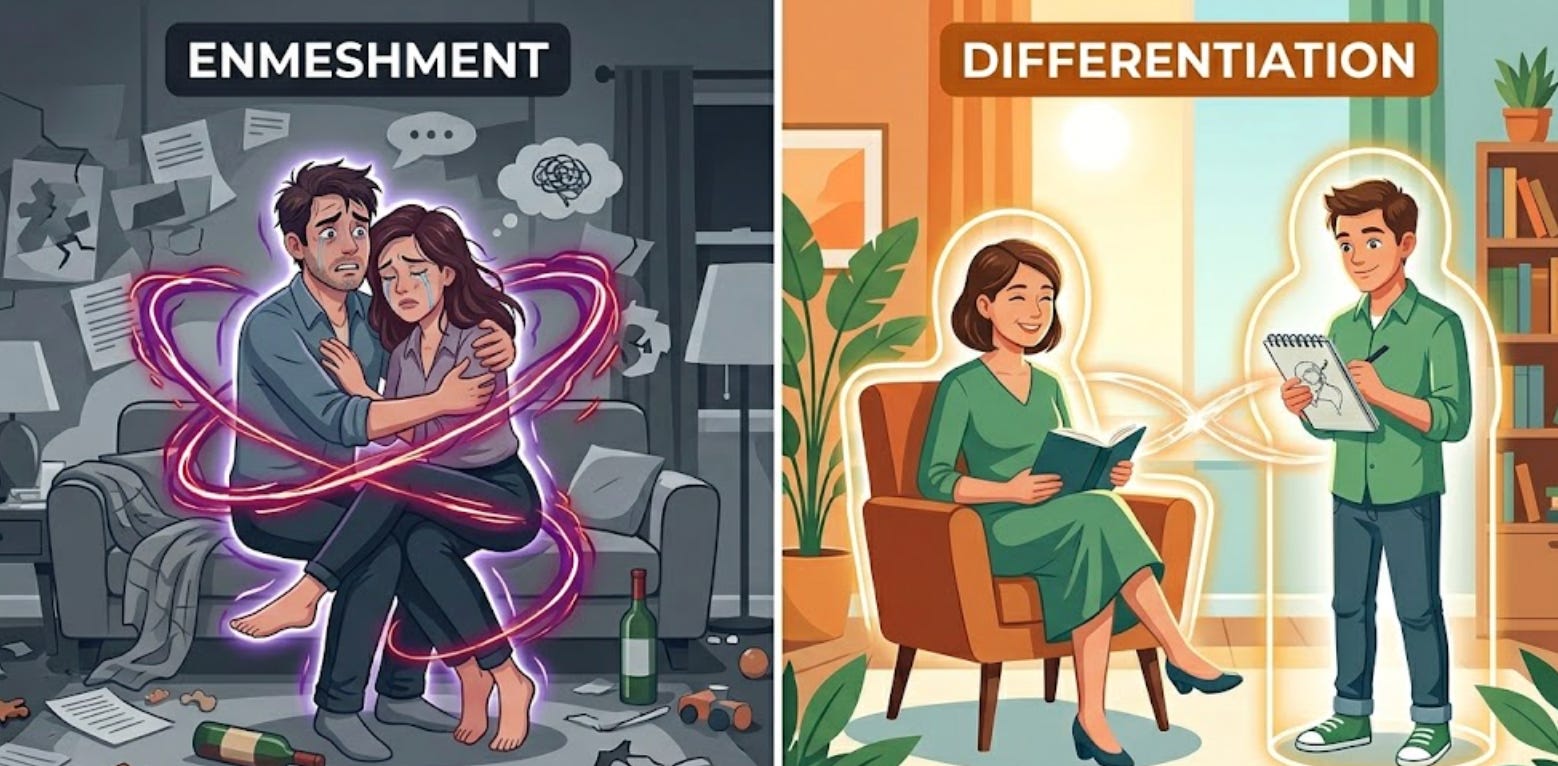
If you think you might be experiencing this, I’ll share more about it and how to identify if you have it, and how to overcome it.
Let’s start with the definitions.
DEFINITIONS
Enmeshment is when the boundaries between people - usually in families or close relationships - become so blurred that individuals lose their sense of separate identity. People in enmeshed relationships are overly involved in each other's emotions, decisions, and lives to the point where it's hard to tell where one person ends and another begins. For example, a parent who can't let their child make any independent decisions, or feels their child's emotions as if they were their own.
To people who are enmeshed, it feels totally normal. You might not know you are enmeshed until you identify it.
It seems extreme, but many people have it to a certain level. I’ll share more below after defining the terms.
Differentiation is the ability to stay fully yourself - with your own thoughts, feelings, and values - while remaining emotionally connected to others.
A well-differentiated person can:
Be close to someone without losing themselves in the relationship
Disagree with people they love without feeling like the relationship is falling apart
Manage their own emotions without needing others to regulate them
Let others have their own feelings without taking responsibility for fixing them
It’s basically the healthy middle ground between two unhealthy extremes:
Too little differentiation → Enmeshment You merge with others, lose your identity, can’t separate your feelings from theirs.
Too much differentiation → Emotional cutoff You wall yourself off completely, avoid intimacy, become emotionally isolated.
Boundaries are the limits a person sets around what they’re comfortable with - emotionally, physically, or in terms of time and energy. They define what’s okay and what’s not okay in how others treat you or engage with you. Healthy boundaries let you stay connected to others while still maintaining your own identity, needs, and wellbeing.
The Problem
Many people have enmeshment because they were brought up in a family where enmeshment happened either between the parents or otherwise. This is usually just the way things have been, and were passed down from generations above. It’s surprisingly common.
There is also a difference between cultures. Asian families tend to have a closer family structure and less differentiation which might seem like enmeshment in the West but considered healthy in Asia. It’s on a continuum and it’s subjective.
It results in a massive cost of energy and limitation and by overcoming enmeshment you can become much more free to grow and improve.
How to Know If You Are Enmeshed?
In your relationships with family/partners
You feel responsible for other people’s emotions — if they’re upset, it’s somehow your job to fix it
You feel guilty for having needs, opinions, or a life that differs from theirs
You struggle to make decisions without checking with someone first
Their mood dictates your mood — if they’re anxious, you become anxious
Saying no feels dangerous, like it will break the relationship
You over-explain or justify yourself constantly
In your sense of self
You’re not sure what you actually want, separate from what others want for you
Your self-worth depends heavily on whether others are pleased with you
You find it hard to be alone — solitude feels uncomfortable or even threatening
You don’t really know your own values, preferences, or opinions independently
The clearest internal signal
Ask yourself: “Can I disappoint someone I love and still feel okay?”
If the answer is no - or even a very uncomfortable yes - that’s worth paying attention to.
The tricky part is that enmeshment often feels like love. Closeness, loyalty, caring deeply. It takes some reflection to see where connection ends and loss of self begins.
The Importance of Space in Relationships
In relationships having separation and space to be your individual person is essential. If you can be a better version of you, you have more to give the other.
This isn’t about enmeshment but a foundational concept of relationships that we often forget. You often solve problems indirectly, by focusing on something else.
The Solution
Boundaries are essential because otherwise things bleed into each other. You are not able to operate efficiently. The reason your body has separate organs is because they perform tasks better by themselves. If your brain and your heart were one organ, it becomes messy and can’t operate well.
How to Overcome This?
Diagnosing it is the first step
For me - I just watched a load of Youtube videos about this to understand it https://www.youtube.com/results?search_query=enmeshment
You will gradually adapt your relationships by setting boundaries, stating what you want, and putting your needs first, without worrying about others. To your old self it seems not as nice. You have to overcome that barrier, but it’s actually just normal, and in the end you’ll unlock a massive level of productivity.
In more details
1. Awareness first
You can’t change what you can’t see. Just noticing — “oh, I’m taking responsibility for their feelings again” or “I just changed my opinion because they seemed uncomfortable” — is genuinely the first step. Don’t underestimate it.
2. Get to know yourself
This sounds simple but for enmeshed people it’s actually unfamiliar work.
What do you enjoy, separate from others?
What are your values?
What do you actually think — before you check what others think?
Journaling, therapy, or just spending time alone can surface a self that’s been quiet for a long time.
3. Tolerate the discomfort of differentness
Start small. Have a different opinion and don’t backtrack. Make a decision without asking for permission. Let someone be upset without rushing to fix it.
It will feel awful at first — guilt, anxiety, fear of abandonment. That feeling is not a sign you’re doing something wrong. It’s just your nervous system reacting to something unfamiliar.
4. Build boundaries gradually
Not as walls, but as honest expressions of where you are.
“I love you and I’m not able to do that”
“I see it differently”
“That’s yours to deal with, not mine”
Expect pushback. Enmeshed systems don’t let people leave easily. Guilt trips, anger, or the silent treatment are common responses — not because you’ve done something wrong, but because you’ve disrupted the pattern.
5. Grieve what you didn’t have
This is underrated. Part of the process is realising that what felt like closeness was sometimes control, and that you didn’t get to fully be yourself for a long time. That’s a real loss and it deserves acknowledgment.
Share Your Experiences
Are you going through this experience? I’m curious to learn more about it.