
Each level of emergence inherits all the constraints of the levels below, and then adds new principles that are its own. Those new principles can't be reduced back down - they only exist at that level.
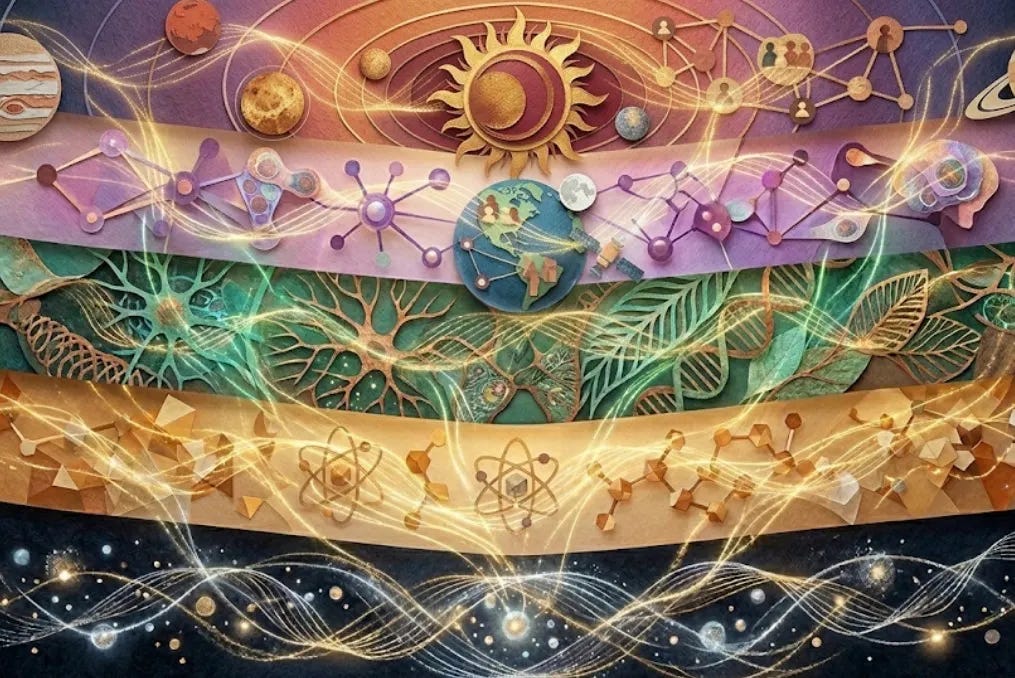
For example
Gravity
Physics — mass curves spacetime, objects follow that curvature
Biology — entirely shaped by gravity. Skeletons exist because of gravity. Hearts pump upward against it. Trees grow against it. Your entire body plan — bilateral symmetry, vertical orientation, bone density — is an evolutionary response to living in a gravitational field. Animals that evolved in water have completely different body structures because gravity is partially offset by buoyancy.
Chemistry — convection currents driven by gravity distribute heat and mix chemicals. Sedimentation — how particles settle — is gravity operating on molecules.
Civilisation — every building ever made is primarily an engineering solution to gravity. Agriculture, irrigation, city placement near rivers — all gravity shaped.
Economics — trade routes historically followed geography shaped by gravity — rivers flow downhill, harbours need flat land, mountains block movement.
Gravity never stopped. It just got joined by other principles at each level.
Thermodynamics (entropy — things move toward disorder)
This one is arguably the most universal principle across all layers.
Physics — heat flows from hot to cold, never spontaneously reversed. Entropy always increases in a closed system.
Chemistry — reactions proceed in the direction that increases entropy overall. Molecules spread out, energy disperses.
Biology — life is a local decrease in entropy, maintained by constantly consuming energy from outside. You stay ordered by eating ordered things (food) and releasing disorder (heat, waste). The moment energy stops flowing in — death — entropy takes over immediately. Biology is essentially a temporary, energy-powered fight against thermodynamics.
Economics — organisations, companies, and economies require constant energy input to maintain their structure. Left alone they decay — businesses fail, institutions corrupt, infrastructure crumbles. Entropy applies to human systems too, just more slowly.
Civilisation — civilisations that stop investing energy into their maintenance collapse. Rome didn’t fall in a day — it entropically decayed over centuries as energy stopped flowing into its institutions.
Electromagnetism
Physics — charged particles attract and repel, light is an electromagnetic wave
Chemistry — almost entirely electromagnetic. Chemical bonds are electromagnetic interactions between electrons and nuclei. Every reaction you’ve ever seen is electromagnetism at work.
Biology — your neurons fire via electromagnetic ion flows. Your heart beats via electrical signals. Vision is electromagnetic wave detection. Every sensory experience you’ve ever had is your body detecting and converting electromagnetic information.
Technology — everything electronic is applied electromagnetism. Every screen, every wire, every radio signal.
The implications are that the principles of quantum physics apply to every higher level of emergence too.
Physical principles don't stop applying just because a new level of emergence appears. They get joined by new principles, but they never switch off.
Therefore the core principles of quantum physics must apply at every higher level of emergence too.
1. Wave-Particle Duality Everything — electrons, photons, atoms — behaves as both a wave and a particle depending on how you observe it. It isn’t one or the other. It’s both, until you look.
2. Quantization Energy doesn’t flow continuously — it comes in discrete fixed packets called quanta. You can’t have half a quantum. This is where the name comes from — Max Planck, 1900.
3. The Uncertainty Principle You can never simultaneously know the exact position and momentum of a particle. The more precisely you pin down one, the more the other blurs. This isn’t a measurement problem — it’s built into reality itself.
4. Superposition A particle exists in multiple states at once until observed. Observation doesn’t reveal the state — it creates it. Before measurement, the question “which state is it in” has no answer.
5. Entanglement Two particles can be correlated such that measuring one instantly determines the other — regardless of distance. Einstein called it “spooky action at a distance” and hated it. Experiments have confirmed it’s real.
6. Pauli Exclusion Principle No two identical particles can occupy the same quantum state simultaneously. This is why matter is solid — electrons can’t all collapse into the same state, so atoms hold their structure.
7. Probabilistic Nature Quantum mechanics doesn’t tell you what will happen — only the probability of each possible outcome. Randomness isn’t a gap in our knowledge. It appears to be fundamental.
The single sentence that captures all of it:
At the smallest scales, reality is not a collection of definite things doing definite things — it is a field of possibilities that become definite only through interaction.
The principles underneath quantum mechanics:
That systems exist in multiple possible states until interaction forces resolution
That observation participates in creating reality
That things are fundamentally probabilistic not deterministic
That apparent opposites can both be true simultaneously
These are abstract enough that they may genuinely operate at higher levels in forms we don’t yet recognise.
Reality is not fixed, definite, and pre-determined.
It is open, participatory, probabilistic, and paradoxical - at the quantum level, and possibly all the way up.
How Does Observation Change Something in Physics?
You don’t observe the world — you and the world observe each other, and in that mutual observation, both are changed.
A quantum particle has no definite state until it physically interacts with something. Not because we don’t know its state — but because there is no definite state yet. The position, the spin, the momentum — these don’t exist as facts until interaction creates them. The double slit experiment proves this directly — the same electron behaves completely differently depending purely on whether a record of its path exists. Observation doesn’t reveal reality. It participates in creating it.
In Life — The Four Key Levels
People — you don’t encounter a fixed person. Your interaction participates in which version of them actualises. People become more confident when treated as confident, more hostile when treated as threatening. You are co-creating the people around you through how you see them.
Conversation — a thought before articulation exists in multiple possible forms. Putting it into words with another person collapses it into specific meaning — and that meaning depends on who you’re talking to. The listener co-creates what you meant.
Identity — who you are isn’t fixed and pre-existing. Different relationships and contexts resolve different versions of you. The question “who am I really” may have no fixed answer — like asking where a particle really is before measurement.
Meaning — understanding, culture, art, ideas — none of it is pre-existing and discovered. It is created in the interaction between minds.
Reality has an objective layer that constrains what’s possible - and a participatory layer where interaction, attention, expectation, and meaning genuinely shape what actualises within those constraints.
What It Actually Means For How You Live
If you are co-creating reality — then several things follow that are practically significant:
What you pay attention to matters constitutively — not just instrumentally.
Not just because attention helps you act better. But because attention literally shapes which aspects of reality become more defined and real in your life. The problems you look for, you find. The possibilities you look for, you find. Not because you’re deluding yourself — but because attention participates in actualising one set of potentials over another.
How you see people is an act with consequences you can’t opt out of.
You are always already shaping the people around you through your perception of them. There is no neutral observation. The only question is whether you do it consciously or unconsciously.
Your beliefs are not just descriptions of reality — they are inputs into it.
A person who believes they are capable approaches situations differently, which produces different interactions, which produces different outcomes. The belief participates in creating the reality it describes. This isn’t wishful thinking — it’s the observer effect operating at the psychological level.
Meaning is not found — it is made.
There is no pre-existing meaning waiting to be discovered in events, relationships, or a life. Meaning is co-created in the interaction between a mind and its experience. Which means the question isn’t “what does this mean” as if there’s a fixed answer — but “what meaning am I participating in creating here.”
If reality at every level is participatory rather than pre-existing -
Then how you show up is not a response to reality. It is a contribution to it.
Every interaction, every conversation, every relationship, every act of attention is not you reacting to a fixed world. It is you participating in the ongoing creation of which world actualises.
What The Shift Actually Involves
Moving from the Newtonian worldview to the participatory one isn’t just an intellectual update. It changes everything about how you relate to experience.
Newtonian worldview:
Reality is fixed and objective
You are a separate observer of it
Facts exist independently of who looks
Your job is to figure out how things are
Meaning is discovered
The self is a fixed thing with fixed properties
Cause and effect are linear and deterministic
Participatory worldview:
Reality has an objective layer and a co-created layer
You are a participant in what actualises
Observation shapes what becomes definite
Your job is to engage with how things might become
Meaning is made
The self is a dynamic process constituted through relationship
Causation is probabilistic, nonlinear, and mutual
Classical economics asks: how do we allocate scarce resources efficiently?
That’s a Newtonian question — it assumes resources are fixed, scarcity is given, and efficiency is the optimisation target.
A participatory economics would ask: what kind of economic interactions co-create the conditions for human and ecological flourishing?
For The Individual
Your attention is your most powerful causal force.
Not your effort. Not your talent. Your attention.
Whatever you consistently attend to — you participate in making more real, more defined, more present in your life. Problems you focus on expand. Possibilities you focus on become more available. This isn’t positive thinking mysticism. It’s the observer effect operating at the psychological level.
Most people treat attention as passive — they notice what’s there. The participatory framework says attention is active and generative — it participates in determining what’s there to notice.
Your beliefs are not descriptions of reality — they are inputs into it.
A person who believes they are capable approaches situations differently. Those approaches generate different interactions. Those interactions produce different outcomes. The belief participated in creating the reality it described.
This means examining your beliefs isn’t just psychological hygiene. It’s reality engineering. The beliefs you carry are quietly co-creating your experience of the world right now, largely without your awareness.
Your identity is not fixed — it’s a ongoing participatory process.
You are not discovering who you are. You are continuously co-creating who you are through your interactions, choices, and the stories you tell about yourself.
This means identity is not a constraint — it’s a creative act. The question isn’t “who am I” as if there’s a fixed answer to uncover. It’s “who am I participating in becoming through how I show up.”
Most people treat identity as fixed and then act accordingly. The participatory framework says the acting comes first — and the identity is what crystallises from it.
For Relationships
Every relationship is a co-creative system.
You are not encountering a fixed person. You are entering into a participatory process that co-creates which version of them actualises — and which version of you actualises — in that relationship.
This means there are no neutral relationships. Every sustained interaction is continuously shaping both people. The question isn’t whether you’re affecting the people around you. You always are. The question is whether you’re doing it consciously.
How you see someone participates in creating who they become.
This is empirically established — teacher expectation studies, psychological priming, attachment research. But the implications are almost never drawn out fully.
If how you see someone participates in who they become — then seeing people as who they could be rather than only who they are is not naive optimism. It is a participatory act with real consequences.
The most powerful thing you can do for another person may not be advice, resources, or help. It may be holding a vision of their potential that they can’t yet hold for themselves — and letting that vision participate in drawing them toward it.
Conflict is participatory too.
Every conflict exists in a superposition of possible resolutions. The interaction — how each party shows up, what they attend to, what meaning they assign — participates in which resolution actualises.
This means you are never just responding to a conflict. You are co-creating its trajectory. The question in any conflict isn’t just “who’s right” but “what am I participating in creating through how I’m engaging with this.”
For Organisations and Leadership
Culture is a participatory field.
An organisation’s culture isn’t a set of rules or values written on a wall. It’s the collective participation of everyone in it — the shared attention, expectations, meanings, and interactions that co-create what’s possible within that system.
This means culture can’t be imposed from outside. It can only be participated into existence. Leaders who understand this don’t try to control culture. They participate consciously in co-creating it — through what they attend to, what they reward, what questions they ask, what they make meaningful.
Leadership is participatory observation.
What a leader pays attention to becomes what the organisation pays attention to. What a leader treats as meaningful becomes meaningful. What a leader expects tends to actualise — not through magic but through the cascading effect of participatory co-creation through every level of the system.
The most powerful leaders aren’t the ones with the best strategies. They’re the ones whose quality of attention and expectation participates in drawing out possibilities that wouldn’t otherwise actualise.
Strategy needs to become participatory.
Classical strategy is Newtonian — analyse the fixed landscape, determine the optimal path, execute. It assumes a deterministic environment that can be predicted and controlled.
Participatory strategy recognises that the act of strategic attention changes the landscape being attended to. Competitors respond. Markets shift. New possibilities open. The environment is not fixed — it co-evolves with the strategy being applied to it.
This doesn’t make strategy impossible. It makes it more like jazz than chess — disciplined improvisation within constraints rather than predetermined moves executed mechanically.
For Education
Learning is participatory co-creation — not information transfer.
The Newtonian model of education treats knowledge as a fixed object that gets transmitted from teacher to student. The teacher has it. The student doesn’t. The teacher transfers it. The student stores it.
This model is wrong at every level.
Knowledge is not fixed — it’s a living, evolving, contested set of frameworks. Understanding is not stored — it’s reconstructed in each mind through active participation. Teaching is not transfer — it’s the creation of conditions in which meaning can be co-constructed.
The most powerful educational interactions are genuinely participatory — where the teacher’s questions draw out understanding the student didn’t know they had, where the student’s questions open up territory the teacher hadn’t mapped, where something genuinely new emerges in the interaction that neither brought into the room.
This is what Socrates was doing 2,500 years ago. We’ve mostly forgotten it and replaced it with information delivery.
What you expect of students participates in what they become.
The research on this is overwhelming. Students who are expected to be capable become more capable. Students who are treated as limited become more limited. The expectation participates in the outcome — not just through motivation but through the subtle participatory dynamics of every interaction.
An education system that understood this would treat expectation as its primary pedagogical tool — and would be obsessively careful about the implicit expectations it encodes in every aspect of its structure.
For Medicine and Health
The meaning of an experience participates in its biological outcome.
Placebo research has established this beyond doubt. The meaning a patient assigns to their treatment — whether they believe it will work, whether they feel cared for, whether the treatment makes sense within their understanding of themselves — produces measurable biological changes.
This isn’t the whole story of medicine. Pathogens are real. Tumours are real. Broken bones are real. The objective layer is non-negotiable.
But within the constraints of the objective layer — which possibilities actualise, how quickly, how completely — is genuinely shaped by meaning, expectation, relationship, and attention.
The doctor-patient relationship is a participatory system.
How a doctor sees a patient participates in what’s possible for that patient. A doctor who sees a patient as a set of symptoms to be managed is co-creating a different reality than one who sees the patient as a whole person with the capacity to heal.
This isn’t soft. It shows up in outcomes. The therapeutic relationship is not just psychologically supportive — it is biologically active.
For Society and Civilisation
Collective narrative participates in collective reality.
The stories a society tells about itself — who it is, what it’s capable of, what it deserves, what’s possible — participate in what that society actualises.
This is not just inspiration or morale. It is a participatory mechanism. The collective attention, expectation, and meaning of millions of people interacting within a shared narrative co-creates the social reality they inhabit.
Societies that collectively believe they are capable of transformation — undergo transformation. Societies that collectively believe nothing can change — don’t. Not because belief is magic but because collective belief shapes collective attention, which shapes collective action, which shapes outcomes.
The most powerful political act is participation in collective meaning-making.
Not voting — though that matters. Not protest — though that matters. The deepest political act is participating in what stories become possible — what futures become thinkable, what possibilities become imaginable, what expectations become collective.
This is what great political leaders, artists, philosophers, and movements do. They don’t just respond to existing reality. They participate in creating new realities by making new possibilities imaginable.
Lincoln. Gandhi. Mandela. The suffragettes. The civil rights movement. These weren’t just political movements. They were collective acts of participatory reality creation — making actual a reality that had previously been only potential.
Institutions are participatory fields — not machines.
A democracy is not a voting mechanism. It’s a participatory field of shared attention, expectation, and meaning that continuously co-creates what democracy means and what it’s capable of.
When people disengage — stop participating, stop believing, stop attending — the participatory field weakens and the institution decays. Not because the rules changed but because the participation that animates it withdrew.
This is why institutional decay is so hard to see coming and so hard to reverse. It’s not mechanical failure. It’s participatory withdrawal — and rebuilding it requires re-engaging millions of people in co-creating meaning together.
For Our Relationship With the Natural World
This may be the most important implication of all — and the most ignored.
The Newtonian framework treats nature as a fixed resource — an objective layer of stuff to be extracted, managed, and optimised. Nature is out there. We are in here. Our job is to figure out how it works and use it efficiently.
The participatory framework suggests something completely different.
We are not separate from natural systems — we are participants in them.
Every human action participates in co-creating what natural systems do. Not just through the mechanical effects of pollution, deforestation, and climate change — though those are real and urgent.
But through something deeper — the meaning we assign to natural systems participates in what those systems become in relation to us.
Indigenous knowledge traditions have understood this for millennia. Not as mysticism — as practical participatory knowledge. The way you attend to a forest, the meaning you assign to it, the relationship you enter into with it — participates in what the forest does and what it becomes.
We have almost no scientific framework for this because the Newtonian worldview makes it literally unthinkable. Nature is object. We are subject. Subjects observe objects. Objects don’t respond to being observed.
But if the participatory principle travels up through all levels of emergence — ecosystems are participatory systems. The attention, meaning, and relational quality we bring to our engagement with natural systems participates in what those systems do.
We may be co-creating ecological collapse not just through mechanical extraction — but through the participatory withdrawal of meaning, attention, and relationship from the natural world. And the restoration may require not just technological fixes — but a restoration of participatory relationship.
The Single Most Profound Implication
Everything above matters. But they all flow from one thing.
The Newtonian worldview produces passive observers. The participatory worldview produces active co-creators.
In the Newtonian world — reality is fixed, you respond to it, your job is to figure out how things are and adapt accordingly. Power belongs to whoever controls the fixed resources and mechanisms.
In the participatory world — reality is continuously being co-created, you are always already participating in that creation whether you know it or not, and the question is whether you participate consciously or unconsciously.
Unconscious participation defaults to replicating existing patterns.
If you don’t know you’re co-creating — you participate in whatever patterns are already running. The cultural defaults. The institutional inertia. The collective stories that are already in circulation. You participate in reproducing the existing reality because you don’t know you could participate in creating a different one.
Conscious participation opens the possibility of genuine novelty.
When you understand that your attention, expectation, meaning, and quality of presence are causal forces — not just psychological states but actual inputs into what reality becomes — you begin to participate differently.
Not with the naive belief that you can think anything into existence. The objective layer is real and constraining. Gravity doesn’t care. Cancer doesn’t care. Poverty doesn’t care.
But within those constraints — which possibilities actualise, which potentials become actual, which futures emerge from the superposition of what’s possible — that is genuinely open. And it is being continuously shaped by the quality of participation of everyone involved.
Why This Matters More Now Than Ever
What’s needed is not just better mechanisms. It’s a civilisational upgrade in how people understand their own participation in reality.
It says within the real constraints that exist — which are non-negotiable — what actualises is not predetermined. And your participation genuinely matters in shaping what emerges.
Most people are participating in co-creating reality unconsciously — running on inherited assumptions, cultural defaults, unexamined beliefs, habitual patterns of attention.
That unconscious participation accumulates. It’s what produces the world as it currently is — with all its beauty and all its problems.
Conscious participation is rarer. And therefore more powerful.
Arguments rarely shift worldviews.
If someone’s operating on Newtonian assumptions — presenting them with participatory evidence usually triggers defence rather than openness. The new information gets filtered through the existing framework and rejected or distorted to fit. This is called confirmation bias and it’s almost universal.
Experiences shift worldviews.
When someone has an experience that their existing framework cannot account for — that’s when genuine openness appears. The framework cracks. Something new can enter.
Questions shift worldviews more than answers.
A good question creates an experience of not-knowing — a moment where the existing framework doesn’t have a ready answer. That’s participatory territory. That’s where new seeing becomes possible.
Relationships shift worldviews most of all.
Sustained contact with someone who sees differently — and who embodies that different seeing in how they show up — is the most powerful worldview-shifting force there is. Not because they argue better. Because their quality of presence participates in creating a different kind of interaction — one that makes new ways of seeing available through direct experience.
THerefore under what pricniples should you choose?
2. Choose Toward Aliveness Not Toward Safety
The Newtonian framework optimises for security — the best guaranteed outcome given fixed conditions. It chooses to minimise downside risk.
But in a participatory reality — the future is genuinely open. There is no guaranteed outcome. The act of choosing participates in creating outcomes that don’t yet exist.
Which means optimising for safety is optimising against participation. You’re trying to secure a future that isn’t fixed — which means you’re actually just narrowing the range of possibilities you’re willing to participate in creating.
The question that cuts through this — a question philosopher and psychologist Eugene Gendlin pointed toward — is:
Which choice feels more alive?
Not more comfortable. Not safer. Not more logical. More alive.
Aliveness is a signal. It’s pointing at where your genuine participation is available — where you can bring real attention, real presence, real engagement. Where the participatory layer is most active in you.
Dead choices — the safe, logical, optimised ones that leave you flat — produce partial participation. Which produces diminished realities regardless of how good the option looked on paper.
Alive choices — even risky, uncertain, harder ones — produce full participation. Which participates in creating realities the safe choice couldn’t reach.
This doesn’t mean be reckless. The objective layer is real. Constraints matter. But within the constraints — follow aliveness over safety.