
Build a company, learn a language, write software, or tend a garden, and you’ll see the same shape again and again: a fast start, a stubborn plateau, and then a step backward before the next climb.
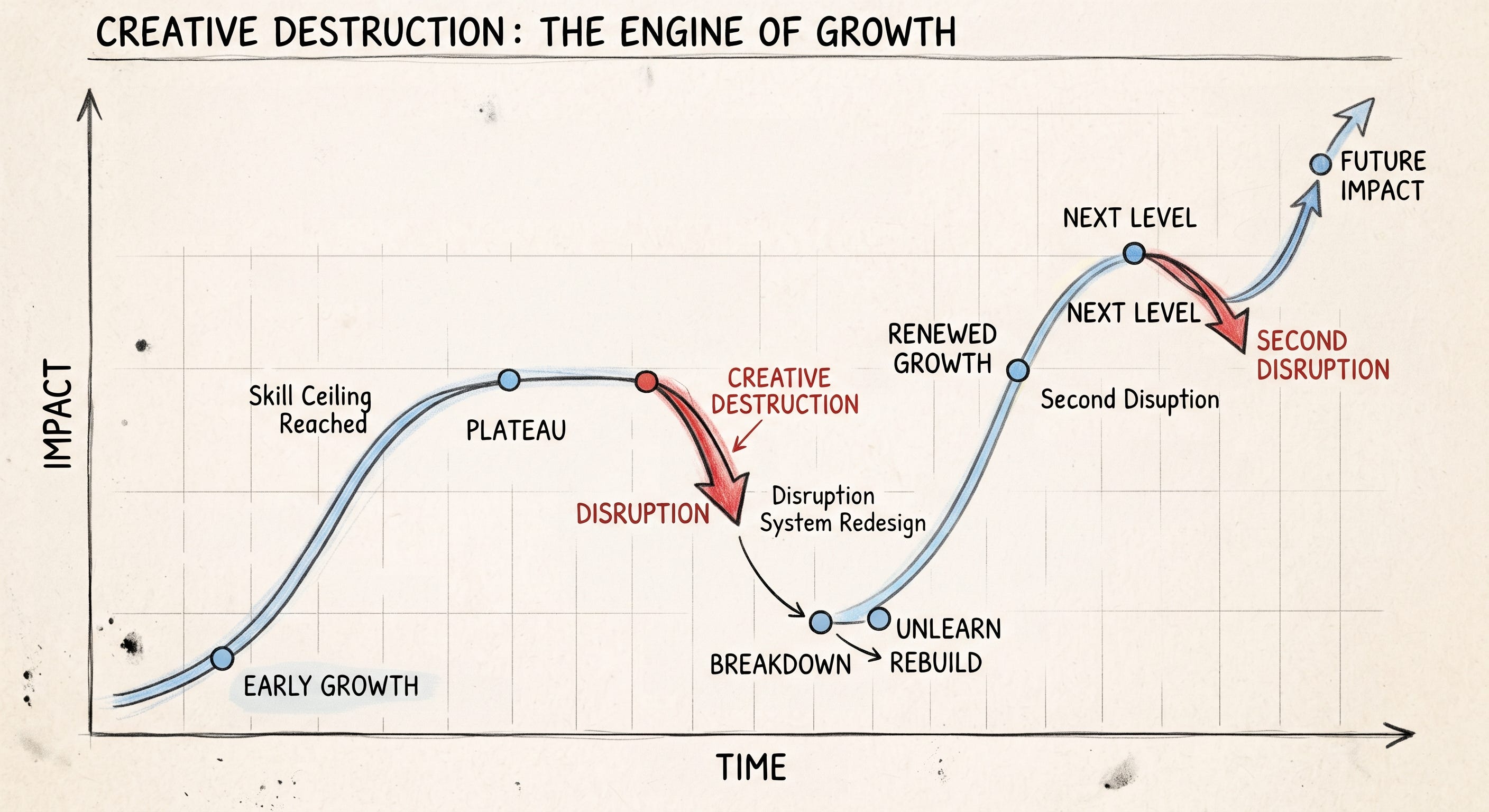
Line several of those cycles up and you get a staircase of S-curves. Each curve starts higher than the last, but only because of the step backward in between.
That step backward is where most people stall, because it looks like failure. It isn’t. It’s the engine. And recognizing it is a form of leverage, because most wasted effort isn’t spent climbing or rebuilding. It’s spent stuck on a plateau, pushing harder on an approach that has stopped working.
Phase 1: The Surge and the Ceiling
Every new endeavor starts with a surge. In the first months of a language, a new tech stack, or a new company, gains come fast. Every hour you put in shows up as visible progress.
The trap is assuming that early slope will continue. It can’t, because the easy gains get used up. Eventually every approach hits its ceiling:
Language learning: you reach the intermediate plateau. You can get by, but your vocabulary stalls and native nuance stays out of reach.
Software: shortcuts pile up as technical debt until each new feature takes longer to ship than the last.
Company building: the product, team structure, or processes that got you to your first milestone become the bottleneck to the next one.
Gardening: a plant left alone grows tall and leggy, pouring its energy into a few long stems instead of a strong structure.
The plateau is where friction lives. It’s also where wasted potential hides: months or years of effort poured into an approach that has quietly stopped paying off.
Phase 2: Creative Destruction, or Going Backward on Purpose
The natural response to a plateau is to push harder. But you can’t brute-force your way past the limits of your own method. More hours on the same approach mostly buy more of the same result.
Breaking through means dismantling part of what got you here. The economist Joseph Schumpeter called this creative destruction: economies grow as new industries tear down old ones. The same logic applies to people, teams, and systems.
In software and companies: rewriting a legacy system, restructuring a team, or rethinking the product. Velocity drops in the short term so the foundation can handle the next order of magnitude.
In learning: unlearning bad habits and rebuilding mental models from first principles. Children learning English show this beautifully. They say “went,” then start saying “goed,” then return to “went.” The temporary mistake means they’ve grasped the general rule and are reorganizing around it. Researchers call this U-shaped learning.
In gardening: pruning. Cutting off a stem’s growing tip removes the hormone signal that suppresses side shoots, so the plant branches out and grows bushier and stronger. You remove growth to get more growth.
Going backward feels painful because it looks like regression. In reality, it’s a tactical retreat that sets up the breakthrough.
Phase 3: The Higher Climb
Get through the reset, and you jump to a new S-curve. This one climbs faster and goes higher than the first.
The reason is what the step backward doesn’t take away. You lose performance for a while, but you keep your capacity. The pruned plant keeps its roots. The founder who restructures keeps her judgment, her customers, and her hard-won sense of what doesn’t work. The language learner who rebuilds her grammar keeps every word she already knows.
So the next curve doesn’t start from zero. It starts from everything you kept, built on a better structure. That’s why progress compounds: each cycle adds new capability on top of what survived the last one.
Prune, Don’t Burn
There’s a risk in this idea. If breakdown is the engine, it’s tempting to tear things down whenever growth slows. That’s usually a mistake.
Not every plateau calls for destruction. Some are consolidation periods, where new skills and systems are settling in before the next gain. And total rebuilds are dangerous: Netscape famously spent years rewriting its browser from scratch while competitors pulled ahead.
The skill is telling the two apart. A few questions help:
Is more effort still producing results, just slower? Then you may only need patience. If extra effort produces nothing, the method itself has hit its limit.
Can you name the specific constraint? Good creative destruction targets the bottleneck, such as one legacy system or one ingrained habit, not everything at once.
What will you keep? If you can’t answer that, you’re not pruning. You’re starting over.
A good gardener doesn’t hack the whole plant down. They cut just above the bud where they want the next growth to come from.
The Breakdown Is the Engine
Progress isn’t about avoiding plateaus or fearing breakdowns. Both are built into the shape of growth. What matters is knowing which phase you’re in, cutting back what has stopped working, and protecting what will carry you up the next curve.
The plateau isn’t the end of growth. It’s the signal to change how you grow.