
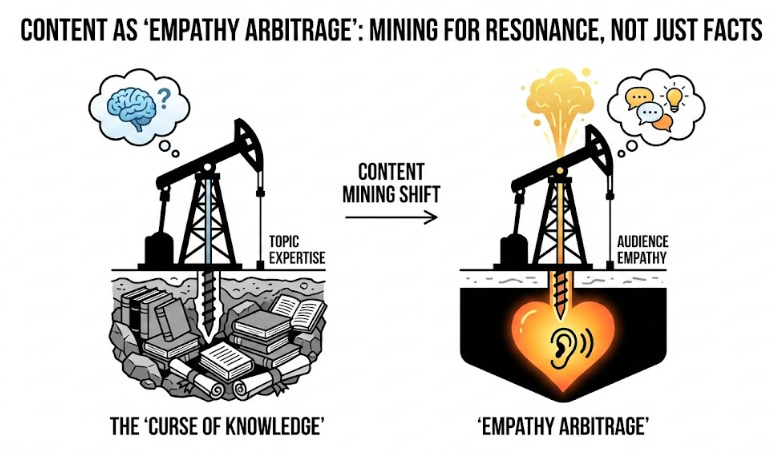
I see content creation as similar to mining for oil. Each piece of content is a poke in the ground to see if you hit a pool of gas.
The internet is not full of a big load of individual people, it’s a load of different markets and interest groups. Each person is in multiple different groups.

When an article or content hits some gas, it means you are onto something. You can keep exploring that topic, going deeper, getting better, or keep exploring for different topics.
I can write excellent articles about studying in China and scholarships in China, not just because I understand the topic deeply, but because I can understand the audience deeply. I know every question they have, because I’ve seen them in my comments and in emails.
How do I get a scholarship
Which one is suitable for me
Which documents are needed?
I know them before I ever start writing, and that means I’m already writing for someone in mind.
Creating content is not so much about understanding the topic as it is understanding the audience and presenting it in the way that they care about.
When writing a topic we often miss out the most important part - understanding the audience. And this makes a huge difference - between presenting information, and really tailoring it to the target and what they care about - because we have all the questions they’ve asked us in their mind before.
This is the same for business and politics. It’s essential to understand all the different subgroups and what they care about.
“Empathy Arbitrage” is a concept that turns the traditional idea of “authority” on its head. It’s based on the observation that in the digital world, the person who understands the user’s struggle often beats the person who holds the PhD. Most “talented” people fail at content because they are too close to their subject. They suffer from the “Curse of Knowledge.”
Too often people research content, facts and data, and not enough time spent studying people.
Don’t be the expert who understands the topic the most, be the person who understands the audience the best.
So which audience do you want to serve?
Then seek to understand everything about them, what they read now, what questions they have and concerns and doubts and dreams and tailor the content to them. Finding the specific questions is less about being a writer and more about being a Digital Detective.
It’s often easier to target smaller, under-served niche groups and then expand outwards, as there is less competition. Or even newly formed groups for which there is a lack of content.
For me - ambitious people who love learning and improving.
So here’s a prompt you can use. Copy and paste this article into AI, and ask:"
”Give me 5 persona’s of people I’d like to make content for”
”Based on the theory of Empathy Arbitrage, identify 5 high-pressure sub-groups I am uniquely qualified to serve, and tell me the one question they are too embarrassed to ask an 'Expert'.”
How to understand them?
Reddit Search Operators: Use
site:reddit.com "how do I" [Topic]orsite:reddit.com "scared" [Topic]. This filters for intent and emotion. Look for the “Rant” or “Help” flairs.The “Zero-Reply” Filter: Look for threads on Reddit or Niche Forums with many upvotes but zero or poor replies. That is an untapped pool of gas. The community wants the answer, but the “Experts” haven’t provided a good one yet.
Quora “Answer Wanted”: Go to Quora and look at the “Requests” or “Unanswered” sections for your topic. Look for questions with a high “Follower” count but no authoritative answer.
Search engines are the world’s largest confessional booths. People tell Google things they are too embarrassed to tell a friend.
The Asterisk Technique: Go to a Google search bar and type:
[Topic] is *orHow to * [Topic] without *.Example:
Scholarships are *might reveal “Scholarships are scams” or “Scholarships are impossible for [Group].” That’s your empathy hook.
AnswerThePublic / AlsoAsked: These tools aggregate the “People Also Ask” boxes from Google. They reveal the branching logic of an audience’s confusion.
YouTube Comment Mining: Go to the most popular video in your niche. Filter by “Newest First.” Look for the phrase “But what about...” or “I’m still confused by...” These are the cracks in the expert’s armor.
Use the “Signal-to-Noise” Filter
Once you find 50 questions, you need to know which one is the “gas pool.”
High Volume + High Emotion = Gas. * If people are asking the question with words like “terrified,” “confused,” “honestly,” or “please,” you have hit the vein.
So, if you got to the end of this article, please tell me something about yourself and what you care about.
I actually converted this article into an article that was written directly for my audience. You can read more here.
