
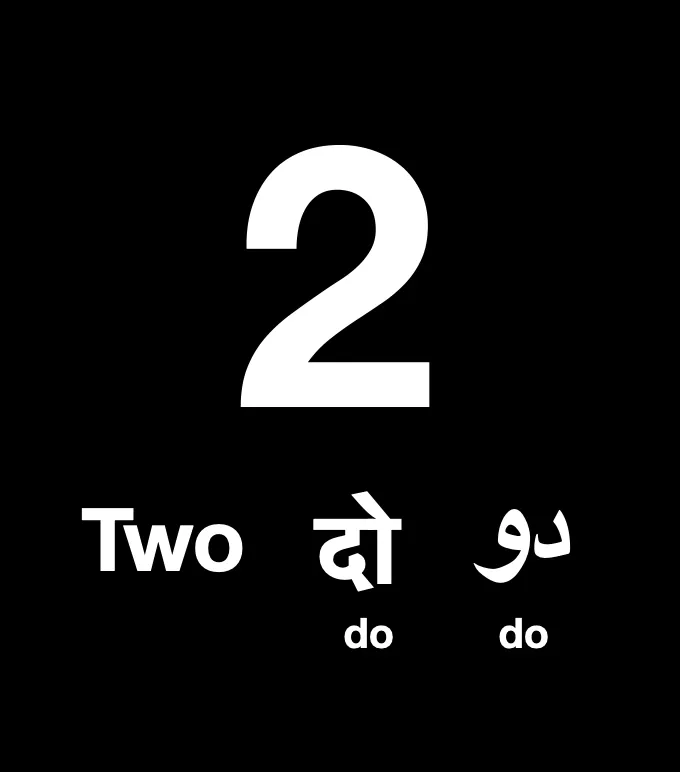
After getting 3 mistaken for many times in Dubai, I’ve just started saying “do” for two which is how it’s pronounced in Hindustani (the spoken language in India and Pakistan) written दो in Hindi, دو in Urdu.
English and Hindustani pronounce th differently, so “three” often sounds closer to “tree”. The English th sound is quite rare across the world’s languages, and most European ones don’t have it either.
Funnily enough, “two” and “do” aren’t just similar-sounding. They’re the same word.
English and Hindustani both descend from a common ancestor spoken several thousand years ago, which was pronounced dwoh and the number words are among the most stable vocabulary we have. Two, do, Persian do, Russian dva, Latin duo - all the same root, worn down differently over a very long time.
You can see it in other everyday words:
Mother — माता mātā
Father — पिता pitā
New — नया nayā
Name — नाम nām
Door — द्वार dwaar
English picked up a second set from Latin and Greek much later: duo, duet, dual, duplicate, deuce, doubt (two minds), diploma (a document folded in two). So English ended up with the same ancient word twice - once inherited, once borrowed.
So by giving up and saying “do” instead of two, we’re speaking the same language as our ancestors!
English has doublets everywhere in the language where the original language arrived through germanic and latin.
Examples such as:
Paternal / Father
Tooth and dental,
Foot and pedal,
heart and cordial,
two and dual.
There are a bunch of words in English that come from Hindustani, But these are more recent.
Shampoo - चाँपो chā̃po (from चाँपना chā̃pnā, to press or massage)
Pyjamas - पायजामा pāyjāmā
Bungalow - बंगला banglā
Pundit - पंडित paṇḍit
Bandanna - बांधना bāndhnā (to tie) / बंधनी bandhnī (tie-dye cloth)
Cummerbund - कमरबंद kamarband
Dinghy - डोंगी ḍoṅgī
Dungarees - डूंगरी ḍūṅgrī