
The UN recently voted to adopt a new world map which better reflects the true size of Africa. It’s impossible to perfectly map a sphere onto a flat surface. The previous one was adopted because it better reflected coordination and navigation. The new one more accurately displays sizes.
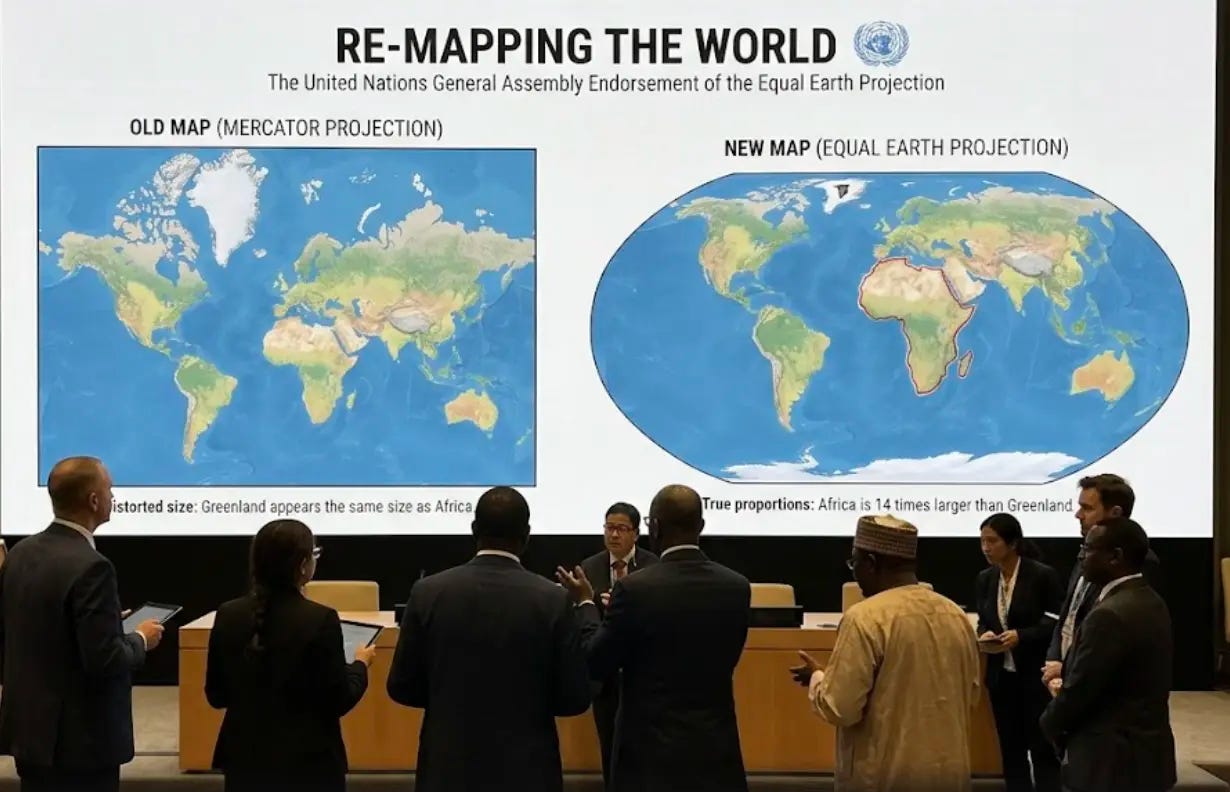
China sees the world differently and maps in China place China at the center of the world. Different maps serve different goals.
None of them are perfect, they all have trade-offs, but the question is - is it useful? We accept these trade-offs in maps. The real world is complex and a simple model helps us to operate quickly some serve our goals better than others. The mistake is to forget that.
It’s not just maps where we see these simplifications - the entire field of economics is a set of maps and mental models with simplifications and trade-offs. Think it’s hard to map the world onto a flat piece of paper? It’s even more impossible to perfectly model the complicated nature of our economy onto a simple chart. We accept these simplifications and trade-offs so we can make quicker decisions and operate in a complex world. It makes everything easier. It is a mistake to forget that. It’s also a mistake to forget that sometimes the fundamental nature of the world and our economy changes, and our models become outdated. Like maps of the world, our economic maps and models are chosen largely to serve political goals, and have trade-offs and inaccuracies.
We are undergoing a economic transition right now as we move to a more digitised economy. I will introduce the ways our current model of the economy is inaccurate and increasingly outdated and some mental models to resolve this contradiction.
In Brief
The current tension in brief is that:
There are three core incentives that we have
GDP growth as a measure of economic growth
To minimise government debt to GDP
To minimise or cap the ability of the state
This has resulted in largely mortgage and asset led economic growth which we mistake for real growth, while at the same time having negative effects on raising costs and reducing productivity in the economy .
The solution is that we need to have a new map:
GDP growth is not an accurate measure of economic growth - we should consider a balance sheet including the future.
That all debt in the economy should be considered as one number.
The state should not be either bigger or smaller but act more like a platform building and maintaining the infrastructure for the dynamic market layer to function.
All growth is not good growth - we need to attract and direct the economy into productive areas and away from extractive areas. Away from property, into efficient equities, start-ups, education, healthcare innovation.
1) The Limits of GDP Led Growth
GDP is seen as the core measure of how fast our economy is growing but it has an increasing number of critics. It was never meant to be a target, but a measure. When we start measuring and seeking to optimise the number it changes how we act and our policies change. Goodhart’s law states that when a measure becomes a target, it ceases to be a good measure. GDP incentivises borrowing - taking money from the future and using it now, and it doesn’t account for any value in the future - it’s a backward looking number. Saving? Not good for GDP. It doesn’t differentiate between good and bad growth - just activity. Years of education? Culture? Your actual strength? It optimises for maximising the return on current capital or institutions.
2) Limiting Government Debt
Government debt is seen as undesirable and many countries have fiscal rules to limit it. But private debt in the form of mortgages is seen as different. When a government defaults, it can trigger a currency crisis, freeze the state's ability to function, and take down the banking system that holds its bonds. But when a mortgage defaults, they can just take the house and sell it.
Because in a credit-based economy, new lending creates new money and spending, so debt growth tends to drive GDP growth - more credit means more transactions, more activity, a higher number. This mismatch between government debt being limited and seen as undesirable and mortgage growth being seen as more benign has resulted in a rapid increase in mortgage debt.
What the growth figures don’t capture is that credit flowing into a fixed asset like land doesn’t expand output - it just bids up the price. And rising asset prices act as a drag: they divert household income into mortgages and rent, and they pull capital away from productive investment and toward speculation on land. The economy looks like it’s growing, but it’s inflating, not producing.
Higher housing costs divert income into servicing mortgages and rent - money that goes to existing asset-holders and lenders rather than into productive spending or investment.
Capital that could have funded productive investment (businesses, R&D, capacity) instead chases land, because land appreciation is the easier return.
High house prices reduce labour mobility (people can't move to where the productive jobs are), lowering aggregate productivity.
3) Limiting the Power of the State
Another unusual thing that has happened in western democracies is that as state has been getting bigger in terms of spending its productive capacity and willingness to invest and build shrank.
In the 1970s there was stagflation as the economy become slower from a large post-war state. The result was to turn to the free market.
There was Milton Friedman's monetarism and the broader free-market revival. Reagan and Thatcher are downstream of this: the old model broke, and they offered the replacement.
Thatcher sold off , and a similar thing happened in US.
The ideological enemy was a state-planned economy - the Soviet Union. This gave "more state = the road to tyranny/inefficiency" enormous rhetorical and emotional force.
But the correction overshot. It didn’t just make the state smaller - it made it unable to decide or build. The state was loaded with veto points: layers of process, consultation, legal challenge, and permitting that let almost anyone block an action, while no one retained the power to drive one. The result is a state that is strong at saying no and weak at saying yes - able to obstruct, unable to build. That’s why, when housing and infrastructure were needed, the state couldn’t provide them itself, and private credit rushed in to fill the gap.
The Solutions
The solution is to basically counter each of the above issues, but when we dig into each of these issues, we realise that there are other interconnected issues.
If we want to fix the property markets, for example, we need to create other attractive investments and liberalise and incentivise capital markets, and do it slowly to protect pensions.
Rising Above GDP Growth - a Vision and Indicators
GDP growth is not an accurate measure of economic growth - we should consider a balance sheet including the future, but not even to really consider it as more than one indicator among many. A state should set a vision that is powerful and then has a set of indicators. The indicators that matter would change depending on the goal, for example, the amount of savings or net wealth each person would have is a good goal for individuals and therefore the country to have because it gives people security and options but it directly competes with GDP which incentivises consumer spending and debt.
The reason that they don’t is that many leaders are limited by how long they are in power. It is not natural to think longer than 4 years when the average leader is less than that. Undertaking the big meaningful changes that are long term in nature might never be attempted.
Attract the Most Talented
Some options are to increase pay for those in power to attract more talented people that are in line with the private sector - a more competitive , and longer terms. This model could be learnt from singapore.
Improving Media & Education
At the same time to increase the quality of debate and education so people understand the issues better. Scial media is having the negative impact of creating echo chambers and tribalism, and competes for attention away from media outlets. The incentives of modern media 0 attention monetisation, algorithmic optimisation for engagement, continuous volume - reward alarm and outrage in a way that's historically distinctive, whatever the baseline was. which turns things into a short term tug of war and popularity contest rather than collectively working together to go in the best direction.
A solution to this could be better discussion groups and podcasts about the core issues that is a mixture of podcasts and house of commons - for example getting multiple people in the room together to discuss.
Reducing Mortgage Debt
If we were to look at the economy away from GDP we could see that mortgage debt causes assets to rise which decreases the ability for young people to buy houses. It’s actually undesirable to have more expenses houses - cheaper, abundant houses would be more desirable.
Imagine if was as easy to get a startup loan as it was a mortgage. Startups employ others, and create activity, experiments, innovation and learning and are far more desirable than increasing property prices.
Experimental Zones
One thing I’ve learnt from China, UAE, and technology companies is the value of micro experiments. China will often test new policies in certain zones to see the effect before rolling it out to the rest of the country. This is smart as a way to accelerate learning. If multiple people have different solutions, why not try them out? Those that like certain policies can even move to those zones. Which brings me onto the resolution of the power of the state.
The Platform State
The platform state is the idea that it’s not about the state being bigger or smaller, but about what it does and doesn’t do. It’s role is to be a platform for the economy to flourish on top of it. Like the garden - creating the environment and infrastructure for the flowers - businesses, families, people to flourish.
The state should create the infrastructure and regulations and guide the market.

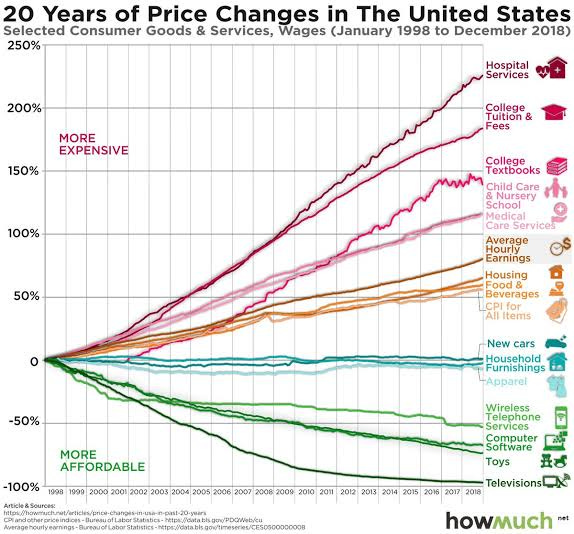
When we look at much of the increase prices in the economy has been because the state has not adequately set up the conditions for that to thrive - it’s a platform failure.
Infrastructure is anything needed for society to function. By that definition healthcare, education, roads, transport, energy and housing are all forms of infrastructure. Failure in those areas or the prices increasing are a result of the state not performing its role. It doesn’t adequately provide the infrastructure, and limits the ability of the private sector to provide it.
Directing the Economy
All growth is not good growth - we need to attract and direct the economy into productive areas and away from extractive areas. Away from property, into efficient equities, start-ups, education, healthcare innovation. This is entirely a platform state idea - for the platform state to provide it or to enable the free market to provide it and not limit the ability.
The Limits of The Mortgage-Growth Economy
Governments want growth but also want to cut spending - so they lean on cheap credit instead of investment in infrastructure. Cheap credit flows into land and housing, because that's what banks lend against. The result is real GDP growth that's largely mortgage- and asset-price-led rather than productivity-led. That kind of growth is extractive, not generative: it inflates the price of a fixed asset, transfers wealth to incumbents, crowds out productive investment, and loads the economy with debt and fragility. We've been mistaking asset inflation for prosperity.
The New Low Cost Productive Abundant Economy
A new abundant economy is one where price of the essential needs fall, while the overall economy grows, and people become better off. There is abundant low cost housing, and infrastructure, high quality education and healthcare. That frees up people and capital to flow into innovation and startups thrive. This gives that economy a major global competitive advantage of being well-run. This is the ultimate economic advantage. The ability to outproduce, outcompete others.
Why not?
The reason it hasn't happened isn't that no one thought of it; it's that the incumbents benefiting from the current arrangement are exactly the ones with the power to block the change. Retirees benefit from having a house that increases with inflation, so does much of the economy from the current set up.
Also between here and there is not an easy road, it takes time and would likely have economic challenges as the economy shifts. It would need to take 5-10 years to restructure an economy like this.
An economy with low infrastructure costs would have a massive competitive advantage over others, but that advantage is long term and compounding, while the benefits of the existing arrangement are immediate.
A big spender with more debt may have actually have an advantage before the debt becomes due. The question is whether that’s being spent on the right things.
Questions
Spending on housing, healthcare, education is the economy - so if it falls, won’t the economy hollow out and shrink?
Part of why it feels like the economy would shrink is that GDP counts the waste as output. Overpriced rent, bloated healthcare admin, credential inflation — these all show up as GDP right now. So if you strip out the extraction, measured GDP might even fall in those categories, and by the GDP map it would look like loss.
But that's precisely the map being wrong - you'd be removing activity that was extractive, not generative. The economy would be better off (people richer in real terms, more productive investment) while the number that miscounts waste as value might not reflect it.
Money spent on inflated rent or an overpriced degree isn't creating value equal to its price - a large chunk of it is transfer (going to a landowner, an incumbent) and deadweight (pure waste from the distortion). When that spending falls, that value doesn't vanish from the economy. It gets released to go somewhere else.
The economy becomes made of whatever people actually want once they're not forced to overpay for the basics - which historically is: more innovation, more services, more culture, more leisure, more new business formation, higher-quality versions of everything.
It also attracts talent, companies to be based there.