
We are taught to treat economics as a hard science, akin to physics, where laws like “supply and demand” operate with mathematical certainty.
In reality, economics is a tool of political intent rather than objective discovery. Unlike a lab experiment in chemistry, economic assumptions are notoriously difficult to test because you cannot run a “control” version of a national society.
At its root, the field was never meant to be a cold spreadsheet.
When Adam Smith wrote The Wealth of Nations in 1776, it was a work of moral philosophy. It was about designing a system that aligned with human nature to create a specific outcome: national productive capacity.
Economics as a content-free science is a delusion. It is a branch of wisdom that must start with the human person, not the dollar.” - E.F. Schumacher
The global adoption of GDP as the singular metric of success is an example of the stifled institutional innovation.
Politicians choose the school of thought that best justifies their policy goals, and they also defer their economic thought to economists, which creates a loop where nobody knows what they are doing.
Politicians do not find the “truth” in economics; they choose the school of thought that best justifies their policy goals.
Academia is No Longer the Frontier
Academia has become trapped by a structural need for consensus-seeking.
The Triangulation Trap: Academic success relies on triangulating one’s work with current leading thinkers to gain approval. This creates a “safe” but stagnant middle ground that prizes peer-reviewed agreement over radical experimentation.
The quest for consensus is the enemy of the quest for truth. Progress requires the freedom to be wrong in isolation before being right in public.” - David Deutsch
In academia we have silo’d disciplines into their own departments. This is positive for depth, but it is not the nature of knowledge. All disciplines are parts of the same tree of knowledge, they compete and overlap and influence each other.
Economists are also rarely questioning the underlying assumptions and the need for renew, testing and how it is changing.
Another problem is that if anyone is smart enough to pick up a bug or problem in economics they are more likely to go into the market to make huge wealth. Adam Smith was paid as an academic which is far less than the potential of able financiers like Stephe Schwarzman.
The true frontier of economic thought has moved online.
In the digital sphere, thinkers are free to write in “productive isolation” and in new philosophies, communities and technologies, - unburdened by the need for institutional consensus.
Experiments and Free Zones
Economics should be viewed as an interdisciplinary design project that is arguable just as schools of philosophy. It is a beautiful blend of philosophy, finance, psychology and biology and engineering used to build the society we actually want.
We need Free Zones and autonomous “experimental labs” where different economic models can be tested in parallel, mirroring the learnings of China, or micro-states or network states.
Only by running multiple, competing experiments can we find an “operating system” that values human capital on a balance sheet rather than just tracking its liquidation on an income statement.
What is Economics?
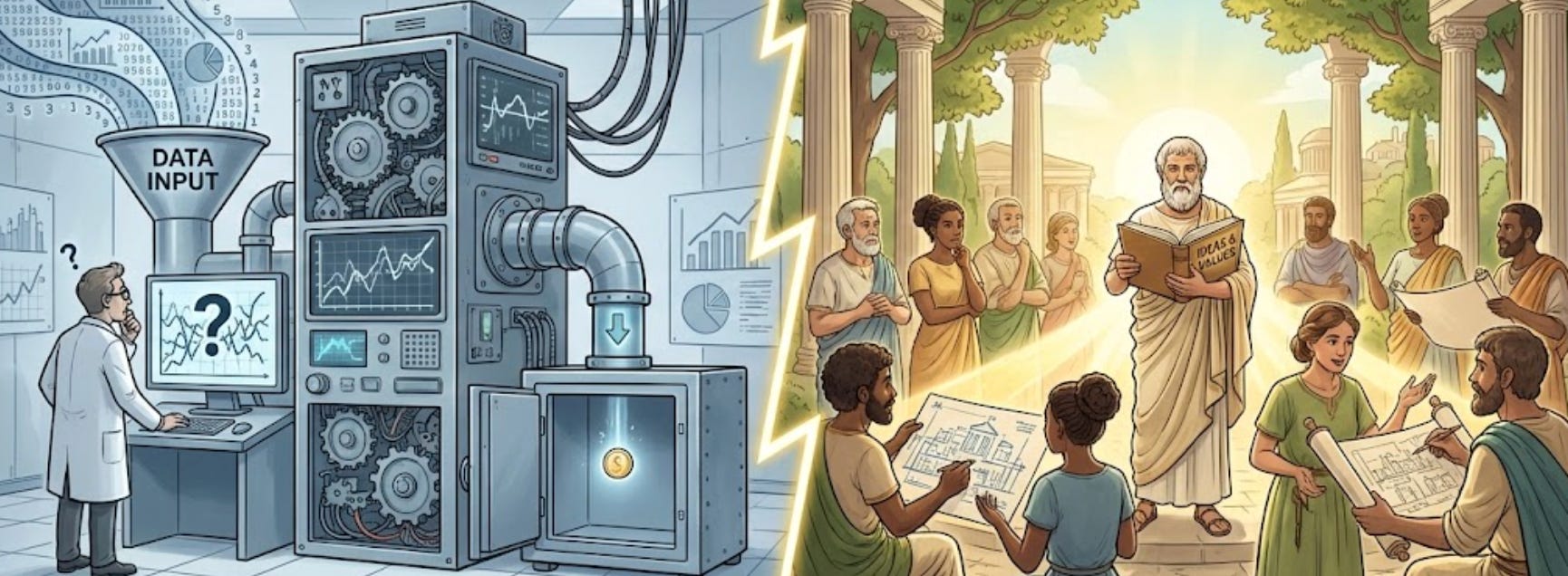
Economics is not the weather that we measure and the data, it’s about the ideas, the architecture and framework and that we build around the society we desire.
It starts with the question - what kind of society and economy do we want to build?
Further Reading
Schumacher - Small Is Beautiful on Bookshop.org
Schumacher Center for a New Economics
David Deutsch
Economics by Aristotle. - Ancient Greece: For thinkers like Aristotle and Xenophon, economics was never about growth. It was about the virtue of the citizens. Aristotle famously distinguished between oikonomia (natural wealth for living well) and chrematistics (the unnatural pursuit of money for its own sake).
Aristotle lists 4 Types of Economy - All the economies have one principle in common. No matter what is done, expenditures cannot exceed income. This is given as an important issue, fundamental to the notion of ‘economy.’
This considered fundamental to the notion of “economy” because it mirrors the First Law of Thermodynamics: you cannot create something from nothing. In a closed system, an economy that consumes more than it produces is essentially in a state of decay, liquidating its assets to maintain a facade of growth.