
This week I’ve been going deeper and deeper into economics. I have revisited some of the classics from my university days - Keynes, and Adam Smith, two of the great economists. Its fascinating to reread them while so much of the economy has changed. It seems as though these ideas are out of date and need updating. It would be fascinating to have a conversation with those great thinkers now, to see what they would make of our current economy and what new ideas they would come up with to explain it.
Adam Smith explained the Industrial Age. Keynes helped us recover from collapse. But neither could explain the world we're entering now - the Intelligence Age.
Here are some of my ideas.
These two great books were written at times of economic shifts. Those thinkers synthesized and explained how the economics were changing.
Adam Smith wrote his book the wealth of nations at what was a shift from mercantilism to industrial economy. Before Adam Smith, countries were basically hoarding gold, and trade was seen as zero-sum. Wealth of nations explained how trade can be win-win. It was a successful book because it captured some truths about how the world was changing as we entered the industrial age, but also because it was politically useful and advantageous to the British. The concepts became the economic reality.
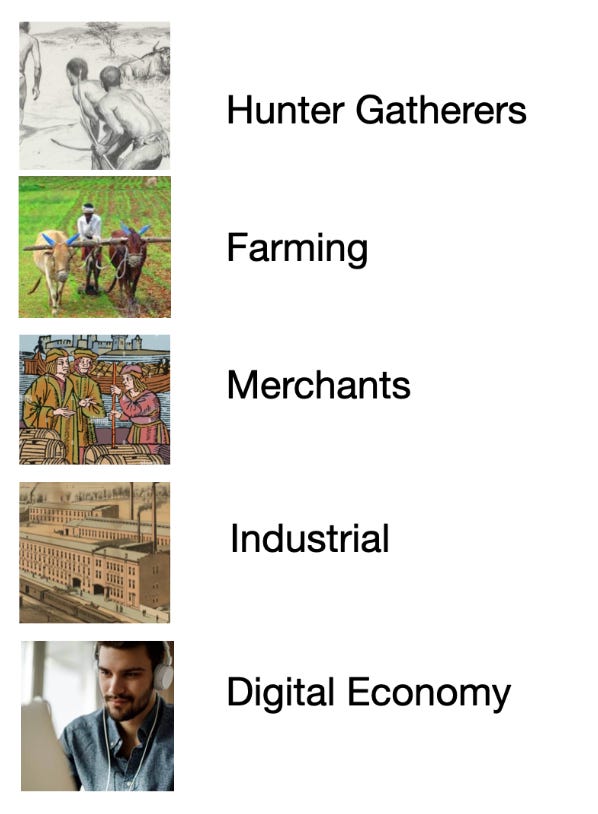
We are going through a similar economic shift now, as we enter the intelligence age. Some of the concepts are now completely different.
Division of labour is one of the core concepts of the industrial age. When people worked together to organised and specialised in one specific part of the product, they could produce far more. Many of these concepts now no longer apply. Leverage and the efficient use of tools is now much more powerful. 100 people who specialise in various parts of the production line are just not competitive compared to one who can effectively use code or content for example.
In the industrial era, the core factors of production were land, labour and capital. They were the productive parts of the economy. Land and labour and capital produced goods. In the digital age, land and labour have changed.
Land could be used to include domain, server space, resources. But the economy is less about “production” as it was in the industrial age which was the era of production, but more about “leverage”, if we are looking at it from our perspective. Labour is less physical, and less about time and using physical tools, but more coneptual, and it’s about how we use the wider range of tools we now have available to enhance our mental performance and multiply our efforts in the world.
There are two types of leverage - internal and external forms. The above four are external forms, but the internal ones are just as important. Learning is the meta leverage, that is the most important, because the economy is evolving and these tools are changing. How we direct our attention and focus, energy, and master ourselves are other internal forms of leverage.
I am not so much going to explain how each concept is different, but rather, some of the concepts I am seeing and explain them from a blank slate.
John Maynard Keynes wrote General Theory of Employment, Interest and Money in 1930s in a unique time. We were just recovering from the great recession, and so his goals were heavily influenced by this pain. There was too much labour and not enough demand. His theory helped to fix that, and did it well. These ideas were helpful to fix the demand side of the economy, and they helped to explain why the state should have more control over the economy. The problem is that the medicine for this problem has been overused. It’s like taking antibiotics for any illness. We need new tools for other problems, and if you take it too much, it can cause other problems, and it can become ineffective.

Economics is increasingly important. How we arrange things and how we design systems can be a competitive advantage in the digital age. As our economy becomes more complex, how we coordinate, motivate, and train end educate, and the stories and concepts we tell ourselves becomes more important. When we are hunting, or picking berrys, these things just don’t matter as much.
“The End of the Industrial Framework”
“The New Levers of Value”
“Rethinking Infrastructure”
“Housing as a Systemic Friction”
“A Platform Model for the Intelligence Age”
The Economics of the Intelligence Age
There is often a debate in our economic system about which part of the economy should be managed by the state and which part by the private economy. One side argues for a smaller state, the other for redistribution. This is usually framed around the idea of creating a more dynamic and capitalist economy vs a more equal one. With capitalist and productive people against socialist ones.
But I think it should be framed in another way.
Platform Economics
There are two core parts of the economy. The infrastructure, and the dynamic part of the economy.
The infrastructure is defined as the basic physical and organizational structures and facilities (e.g. buildings, roads, power supplies) needed for the operation of a society or enterprise.
When we look at the economy like this. Infrastructure should include the parts of the economy that are essential for it to function. This should be managed, or regulated by the state with a different economic goal than the dynamic economy.
When I say that it should be managed by the state, I mean that it should not be managed by the capitalist economy. We should not be seeking to profit off of infrastructure that is essential for our economy to function. If we do this, we are just distorting our economy. We are shooting ourselves in the foot.
The goal of infrastructure should not be profit maximise, but to maximise the consumer surplus. The cost of infrastructure should be as cheap as it possibly can. We should seek to do this by privatising, subsidising, increasing competition, regulation, taxes, or whatever means are necessary.
Like a gardener prepares the soil and irrigates the land (platform) so plants (dynamic economy) can grow.
If you agree with the above, then I would like to explain that before my next point, its essential to forget about our previous debates between socialism and capitalism which I think can be clouding our judgement and look at this with an open blank canvas.
Healthcare and education, are both forms of infrastructure, and so is housing.
It determines where people can live, work, and raise families.
It directly affects economic mobility, birth rates, productivity, and even mental health.
Its scarcity or unaffordability imposes systemic friction across the economy.
If you can’t live near the job, can’t afford to have children - how is that different from not having access to roads or water?
When housing is treated primarily as an asset class, not shelter:
Prices rise faster than wages
Investors outbid families
Cities hollow out (San Francisco, London, etc.)
Young people delay families, moving, risk-taking
This is equivalent to monopolizing roads and charging people £500 to leave their driveway.
Its not something that is harmful to the population, but its harmful to everyone. Higher property prices, drives up prices of goods, because so much of the economy is based on labour. It is a systematic disadvantage for that economy, when it could be an advantage, and drives companies to invest elsewhere.
Higher living costs, leads to higher building costs which leads to limited housing and it can become self-reinforcing if we limit building of new housing. When young people have to save for 10-20 years just to buy a house, that is basically extracting all their value into something that is not productive. Instead, if housing could be as affordable as possible, say, 10-20% of their annual income, they could have much more wealth to buy goods and use in the dynamic economy, which makes us all much better off.
Why is this important?
Why is it important that our platform and infrastructure should be cheaper? Because the economics of the digital age are fundamentally different. Intelligence is becoming cheaper and cheaper and
Yet the economics of housing relies on increasing costs. This puts humans at a disadvantage in an age where we need every advantage we can get.
A country where it’s easy to live, start a family, and operate a business has a structural edge in the global economy.
Cheap housing, good healthcare, and free-flowing education are not welfare -
they are essential productivity infrastructure, just like fiber-optic cables or clean ports.
If AI compounds exponentially, but humans are stuck saving for 25 years to buy shelter, you’ve created an economy that is asymmetric and unsustainable.
Another reason is that it widens inequality, it reduces social mobility. This is not good for the economy, if large parts are not able to compete.
Housing as Infrastructure
It is easy to say that housing should be infrastructure, but it’s incredibly hard for someone to roll back and destroy so much wealth. It would be unpopular for voters to lower house prices and could be a drag on the economy, so its not an easy thing to fix. There is a continual upward pressure on housing, and so resolving this tension would need some gradual policies and to be done slowly.
If we were to change the economic nature of housing, but we could just pilot something, by creating pilot zones, relax housing constraints, or give tax incentives for young people more affordable housing, and make it actually affordable. We could also tax empty property and do this slowly over a series of years, where the economic benefits of lower houses can also be gradually felt.
The Economics of the Olympics
I was at the 2008 Beijing Olympics, and the 2012 London Olympics.
One of the things I’ve noticed is how fast and effective governments can act when there is a clear deadline, short goal, excitement, and the whole world is watching. Cost benefit analysis and the multiplier effects of producing a big stadium that can be used by the community and generate parts of the city, the prestige and fun for the team who drives that forward.
We need to bring that approach to building and fixing infrastructure for residents, to solve long term systematic problems, because it is essential for economies to function.
Housing should and could be cheap, if we wanted it to be. Bricks cost hardly anything, and labour is just a measure of how much someone is prepared to work, which is largely a factor of their living expenses.
The problem is that we just build a whole industry that profits from ever increasing prices. Banks gain interest, property developers, governments collect more tax revenue, homeowners, all benefit when prices go up. They feel wealthier, they can take out a loan on their home to buy more, it can produce wealth through debt, but this is an illusion. We are creating wealth out of an industry that is not benefiting society.
The problem is that it comes from inflated assets, not real productivity. We’ve created an economic flywheel that rewards extraction over contribution. And it’s slowing everything else down. This is partly because of our emphasis and incentives to focus on GDP growth.