
Everyone has seen this.
It arrives as a compliment, a complaint, or a shrug, and it always sounds like an explanation: Asians are just good at maths. It is one of those statements that feels too obvious to interrogate - the league tables seem to prove it, and a stereotype that flatters its subject rarely gets challenged.
But spend two decades inside the Chinese education system, as I have, and the sentence starts to look less like an explanation than a place where several different, much more interesting explanations have been buried.
Pull it apart and almost none of the reasons turn out to be about being Asian.
They’re about geography, money, language, and the unglamorous craft of beating a multiple-choice test.
Here are eight of them.
1. The number at the top of the table isn’t measuring “China”
When the four Chinese entries last topped the PISA maths rankings - in 2018, before COVID knocked their 2022 round out = they weren’t representing China. They were representing four provincial-level units: Beijing, Shanghai, Jiangsu, and Zhejiang. Those are among the five wealthiest jurisdictions in the country, clustered along the prosperous eastern seaboard. Together they hold around 13% of the population, and because the hukou household-registration system pushes many migrant children out of city schools before the test age, the share actually sitting the exam is smaller still - closer to one in eleven.
So “China tops the world in maths” is a sentence with a missing footnote. It would be like ranking Britain using only Kensington and Cambridge, and then writing think-pieces about the British genius for learning. The data is real; the subject of the sentence is a fiction.
2. The real variable is the city, not the country
Strip away the flag and what’s left is a story about urban density. Cities give you two things simultaneously. The first is resources: money, educated parents, and a thick supply of good schools and cram schools - 补习班 (bǔxíbān). The second is competition, because everyone around you has the same access. That combination is not a calm environment that produces high scores. It’s a positional arms race.
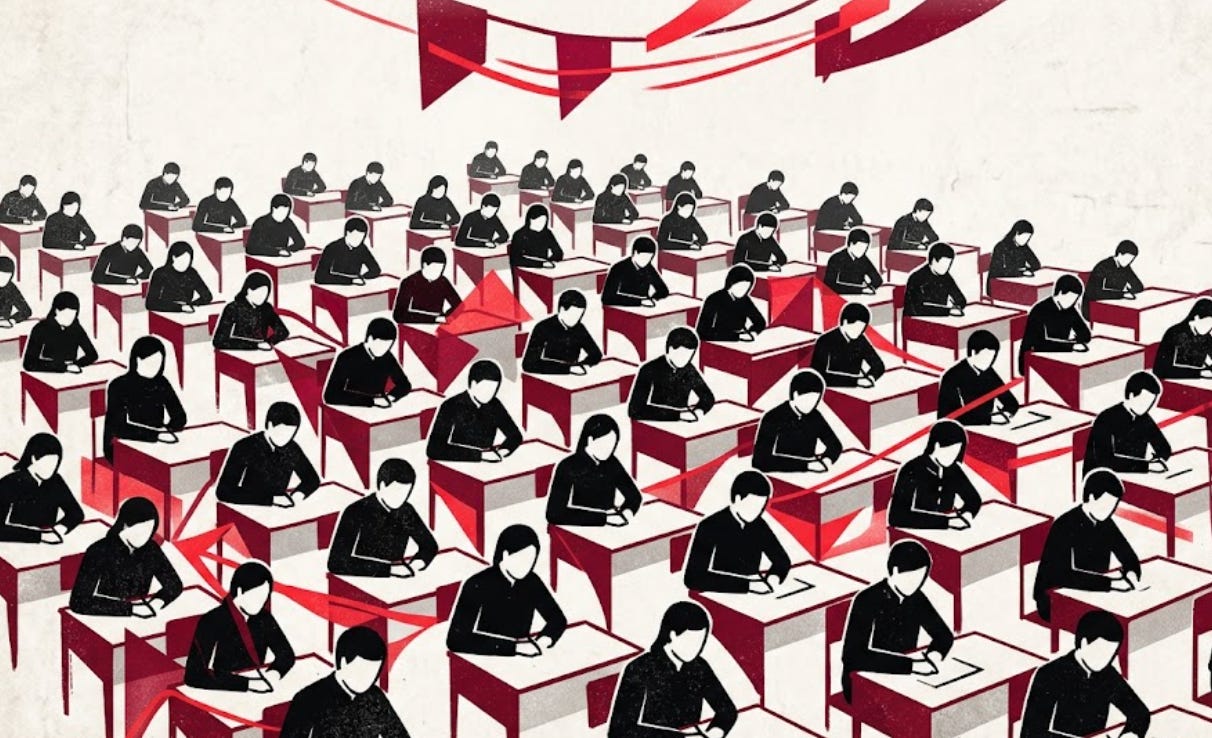
Chinese even has a word for the parenting style it breeds: 鸡娃 (jīwá), literally “chicken-ing” your child - pumping them full of drills, classes, and tutoring to stay ahead of the kid next door. Urban children aren’t relaxing into top marks. They’re being ground into them. The score is an output of pressure, not of some inherited facility for numbers - which is why the same pressure-cooker effect shows up in Seoul, Singapore, and Hong Kong regardless of what’s being taught.
3. The exam factory and the fertility cliff are the same machine
Here is the part the proud version of the story never mentions. The cities that manufacture the world’s best test scores - Shanghai, Seoul, Hong Kong, Singapore - also post the lowest birth rates on Earth.
That is not a coincidence; it’s the same mechanism viewed from two angles.
The intensity that produces the results is precisely what makes a second child unaffordable in time, money, and parental sanity. When raising one child to be competitive consumes a decade of evenings and a small fortune in tutoring, raising two becomes irrational. The league table and the fertility collapse are two needles on the same gauge. We admire the first reading and panic about the second without noticing they’re driven by one engine.
4. Chinese number words are shorter - so working memory holds more of them
Now we get to the genuinely linguistic reasons, which are real but mundane. The first is almost mechanical. In Chinese, the words for digits are short, mostly single syllables: yī, èr, sān, sì. The phonological loop — the bit of working memory that briefly holds sound - stores roughly two seconds of speech. Shorter words mean more numbers fit inside that two-second window, which is why Chinese-speaking children tend to manage a longer digit span than English speakers. It’s not deeper cognition; it’s compression. The same brain holds a longer string simply because each item costs fewer syllables.
I notice it in myself: doing mental arithmetic, I often switch to counting in Chinese - èr, sān - because it’s just faster to run.
5. The number words are also more transparent -so place value is built in
The second linguistic edge is structural. English numbers between ten and twenty are a minefield of exceptions: eleven, twelve, thirteen tell a child nothing about what they’re made of. Chinese says it plainly — eleven is 十一 (shí-yī), “ten-one”; twenty-one is 二十一, “two-ten-one.” The decimal structure is baked into the words themselves.
A Chinese-speaking child learning to count is, without realising it, also learning place value. An English-speaking child has to learn the counting words and later learn the hidden grammar of tens and units as a separate, harder lesson. Same maths, different starting line.
6. Chinese maths vocabulary means something; English maths vocabulary is fossils
This is the layer most people sense but can’t articulate: why sine and cosine look forbidding in English but conceptually legible in Chinese. The reason is etymological archaeology.
English maths vocabulary is a graveyard of opaque loanwords. “Sine” means nothing to an English speaker because it’s a chain of mistranslations. Indian mathematicians called the chord of an arc jyā - their word for bowstring. Arabic scribes transliterated it phonetically; a later reader misread those consonants as jaib, “bay” or “fold”; the Latin translator rendered that as sinus, a bay or bosom. English inherited the corrupted version. The word literally points to the wrong concept. “Hypotenuse,” “tangent,” “logarithm,” “parabola” - all Greek and Latin fossils whose meanings are sealed off from the learner.
Chinese built its modern maths vocabulary much later, in the 19th century, through translators like Li Shanlan and Alexander Wylie, and they built it as meaning-calques — semantically transparent compounds. So:
正弦 / 余弦 (sine / cosine) = “principal chord” / “complementary chord.” And 弦 (xián) is the bowstring — the exact thing jyā originally named before Europe lost it in translation. Chinese recovered the geometric meaning that English mangled.
分子 / 分母 (numerator / denominator) = “son of the fraction” / “mother of the fraction.”
微积分 (calculus) = “tiny-accumulate-divide,” resolving neatly into 微分 (differential) and 积分 (integral).
对数 (logarithm) = “corresponding number.”
A Chinese student reading 正弦 sees a description. An English student reading “sine” sees a password. The bow, it turns out, was the authentic root all along - and only one of the two languages kept it.
7. Years of practice acquiring a giant symbol system
There’s a quieter cognitive dividend to literacy in Chinese. Learning to read means internalising and retaining thousands of distinct characters — years of tolerance-building for acquiring and holding large symbol systems. Mathematical notation makes exactly that demand: a flood of new symbols you must absorb and keep. For someone whose entire schooling has trained that muscle, the symbolic alphabet of algebra and calculus sits on familiar ground rather than arriving as something alien. It doesn’t make the maths easier; it makes the notation feel less foreign.
8. Exam Hacking - A lot of it is just knowing how the exam works
The least romantic reason is probably the most decisive: exam-craft. A large slice of any standardised maths score comes not from solving problems but from understanding the format - its shortcuts, its traps, and its tells.
Take a multiple-choice question asking for 11,812,837 × 382. You don’t need to multiply. The last digit of any product depends only on the last digits of the factors: 7 × 2 = 14, so the answer must end in 4. If only one option ends in 4, you’ve answered in two seconds without doing the sum. Layer that with order-of-magnitude estimation (kill the answers that are wildly too big or small), parity checks (must it be odd or even?), and plugging the options back in rather than solving forward, and you have a student taking a fundamentally different- and faster - exam from the one who learned only to compute.
This is the part that travels least with ethnicity and most with coaching. A culture saturated in high-stakes testing transmits these tactics the way other cultures transmit table manners. It isn’t that the students think differently about numbers. It’s that they’ve been taught to think about the test.
Put the eight together and the original sentence dissolves. What looks like “Asians are good at maths” turns out to be: a handful of rich provinces standing in for a nation; an urban arms race that’s also quietly ending the family; two modest gifts of a well-engineered language; and a great deal of practice at gaming an exam. Every one of those is portable. None of them is in the blood.
Which is a useful conclusion, if you’re on the other side of the table trying to compete: the advantage isn’t a trait to envy. It’s a set of conditions and techniques to copy.
At China Admissions we are also launching a CSCA Training Program to help international students prepare. If you’re preparing to study in China - you can learn more and sign up here.