
After living in China and UAE, I feel a growing frustration.
China can build miles of roads and buildings. UAE can build roads and the world’s tallest building, and even hires British people to do some of it.
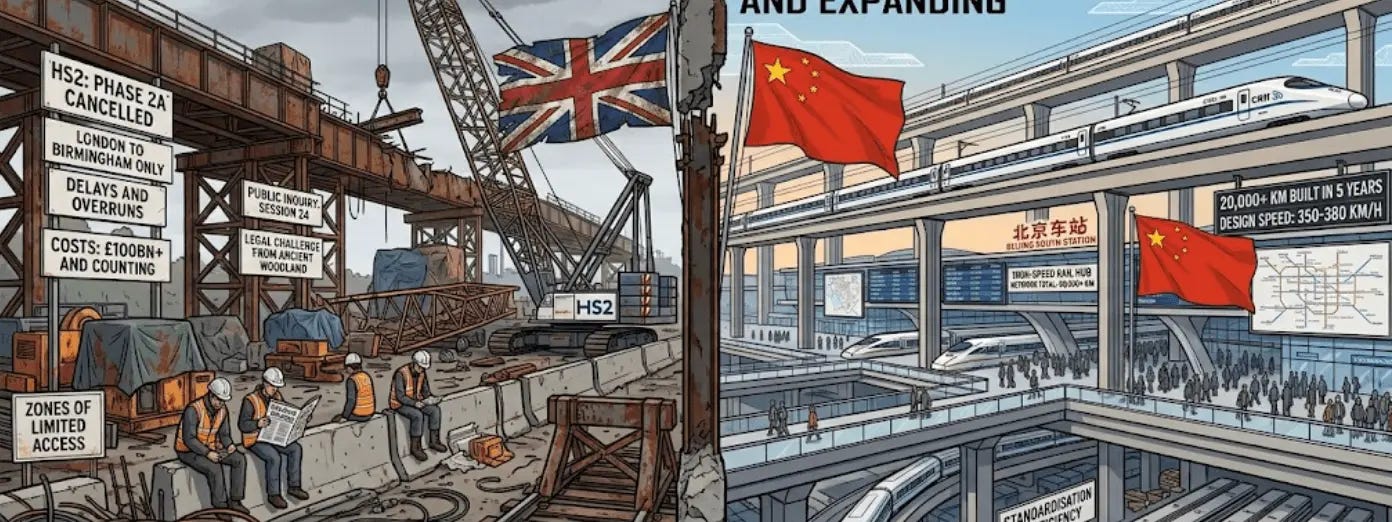
Yet, Britain, home to some of the best universities in the world, talented people, used to be one of the most competent states in the world, is stuck.
Is it not possible for a mid-size democracy to have a functional state that is competent?
I believe it is possible, and not only possible, but essential.
Don’t mistake the slow nature of this problem to one that might be fixed.
The nature of declining civilisations is not sudden, it’s a slow burn, where the old, educated, ambitious, talented people - the David Starkeys, the David Attenboroughs, they age quietly.
The young educated leave for better opportunities elsewhere, or they have fewer children, they have their income absorbed by rising costs and inefficiencies rather than invested in growth and education.
Look at Istanbul or Rome now, and it’s clearly far from it’s Zenth.
It’s not too late for London and Britain.
From the country that invented economics, it needs a rethink.
It’s my belief that Britain’s best days are ahead of it.
Why Britain Can’t Build
After WW2 Britain had no money left. It had exhausted resources to defeat Nazi Germany, and was borrowing money. The pound crashed by 30%.
In 1956 Britain was unable to defend the Suez without the US help, often stated as a defining moment where the baton was passed to US as the world’s largest economy, most capable, and strongest currency.
With a large population accustomed to being looked after by the state, returning from the war, to defend and meet the need of demand for greater socialism and being looked after - to satisfy what voters wanted, Britain’s state grew. The welfare state, the NHS.
The British disease is the stagnation of the 1970s. Low growth.
What followed was Margaret Thatcher’s reforms to shift away from the state to the private sector.
The state was concerned with debt by the state, and in order to satisfy economic growth and GDP, it followed a housing debt model - people took on the debt as private lending, mortgages funded the economic growth.
Britain came to rely on rising asset values (mostly housing) as a substitute for productive investment, which created a huge incumbent class whose wealth depends on scarcity, which then entrenches the can't-build paralysis.
Britain now has some of the highest amount of value in the economy in housing, but this is effectively dead money. It’s not money that leads to growth, but is money that grows by scarcity.
The state, wary of its own borrowing, engineered growth through private debt instead - mortgages - so household borrowing against ever-rising house prices became the substitute for real productivity.
What happened is that house prices grew from 1950, and much of Britain’s growth was growth on paper - property priced led growth.
For the last 40 years the best investment for a Brit was in their house, and now we have a generation of people for who’s pension is their house, seeking to protect that value.
But the problem is that putting money under your mattress doesn’t do anything valuable, it doesn’t multiply. It restricts.
But housing wealth is worse than a mattress - it isn't only dead money, it's actively extractive - it relies on scarcity so others can’t afford it. It’s a transfer of those who don’t own to those who do own. it grows by restricting supply, transferring wealth from the young and productive to incumbents. It doesn't just fail to multiply; it multiplies by taking.
This looks good on paper, people feel richer, they have access to debt, until it reaches it’s limit - and there’s no new money or buyer able to buy.
We can’t make housing a good investment that grows faster than income, while making housing affordable - those are two conflicting goals and that’s the heart of Britain’s economic stagnation.
That’s where we are now.
So Whats the solution?
Education - so property owners can understand the economic implications and people can understand each other to solve it rather than it being a tug of war, and young people, and those with rising expenses can associate this artificial scarcity with their pain.
Alternative places to put money that can grow. e can’t just allow retirees to lose their wealth, we need to do it gradually and enable alternative investments over years. We need more attractive places to put money - by moving money away from property, it will enable lower costs and Britain to be more competitive in the future.
Limiting the ability to borrow for houses is also a good idea - as housing gradually deflates the prices will be more market based.
Freeing up planning permission - zoning rather than asking for permission to build houses - scarcity is what makes housing a good investment, planning restriction is what manufactures the scarcity, so freeing planning is what breaks the investment case and makes housing affordable.
A new model and expectation of a competent state.