
I was recently having a debate with a family member.
I asked them to define the terms “modern”, “normal” and “well-respected”
These are concepts that were central to their argument.
Their struggle to clearly define these words is far too common.
We bedrock of our lives and reality is on words that we often don’t really understand what they mean.
This is a huge barrier to clear thinking.
In this article, I’ll argue why
Clear definitions are the essential first principle for clear thought
Why you should spend time clearly defining the barriers to words - understanding them, and deciding what they mean to you.
Why that can give you a huge advantage.
I’ll introduce the four types of Words you must master to become an elite thinker.
Evaluator Words
Primitive Words
Compound Words, and
Amorphous words
A quick search online, and often the words we find in online dictionaries are very simplistic, and even include the words themselves.
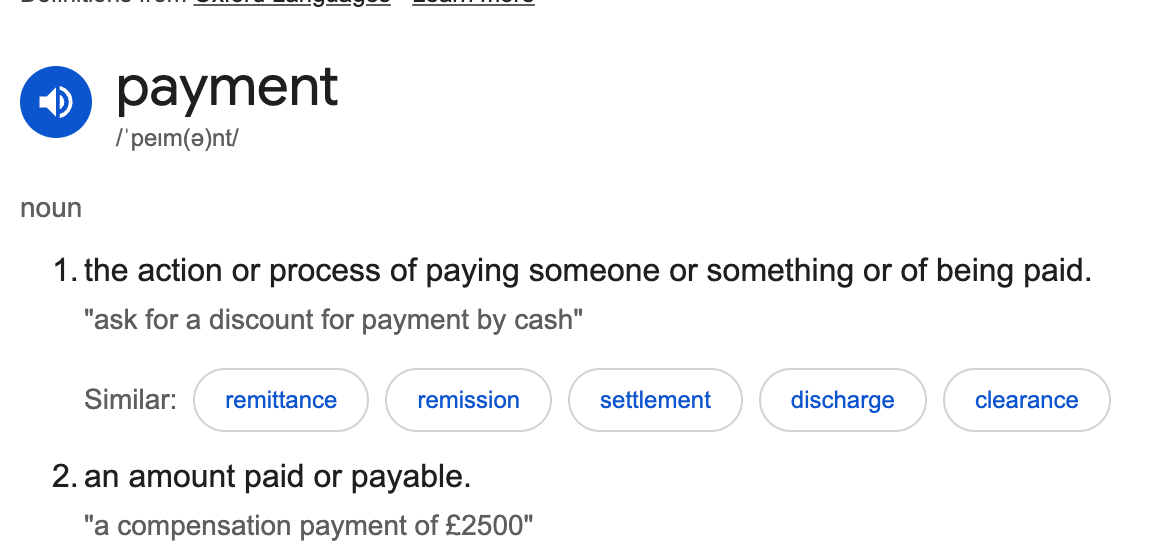
To elevate economic thought it’s essential to take some time to really define words.
This is first principles thinking.
It’s like reconstructing or organising your reality.
When you go deep on this, it’s like understanding mathematics and you’ll have a deeper understanding of the nature of reality. It gives you an incredible sense of peace, and clarity.
Here are the four types of words and my four rules.
1) Evaluator words - Cut these out entirely
“Bad, good, big, small, difficulty, better, worse, expensive”.
Any word that you can say: “Compared to what?”
”Modern, normal, and well-respected” are also evaluator words.
They are are relative to something that is usually not stated.
If they are being used, then it’s essential to include what they are compared to.
Realise that when they are used without referring to what they are being compared to, they often actually say more about the communicator than the object.
Avoiding these forces clarity.
2) Primitive Words - Define these clearly
“Time, pain, resource, goal”
These can have vague meanings.
These are the building blocks of reality.
Defining them gives you clarity.
All of these words need to have clear boundaries.
What is and what is not this word.
3) Compound / Composite words - Understand These
“Hardship, disaster, justice, hurrying, working, beautiful”
These are the majority of our words, and understanding these is more about putting together the building blocks of our reality and their relations with each other.
It’s almost like studying Physics.
For “hardship” now you’ve got to define “pain”, and how hardships relates to this.
You have a deeper understanding of what this actually means.
Without understanding primitive words such as pain or evaluator words, we can’t fully understand these words.
4) Amorphous words - fill these with what they mean to you
“Success, happy, love”. Realise that these are empty containers. If you don’t fill them with your own specific definitions (using primitive words), society will fill them for you - usually with things you don’t really want. These are vague words that mean different things to different people, that can lead to lazy and unclear thinking - if we don’t define them our communication and language deteriorates.
Defining words becomes even more important as we increasingly use AI for analysis. If we don’t define words, then our terms resort to the average, a mixture of different definitions, and our thinking becomes sloppy, rather resorting to emotional dialogue.
Here are some words I’ve defined recently that are different to online, official definitions, and how most people define it.
And hopefully this article will have given the benefits of clearly defining words and confidence to define them for yourself and challenge others.
______________________________________
Some of My Definitions
Pain - The subjective interpretation of a biological signal indicating that a threshold has been crossed, limit has been reached, or boundary has been breached.
Distraction - any stimulus or activity that takes you further away from your goals.
Focus - the act of putting something into your field of view at the exclusion of everything else.
Relationship - the consistent and mutually agreed upon exchange of value between two people or entities by clearly defined behavioural standards and boundaries.
Leader - a person who sets a mutually advantageous vision and persuades and aligns the interests of others to achieve that vision, continually, until it is realised.
Trust - the firm belief in the reliability, truth, ability, and integrity of a person, entity, or object and the willingness to be vulnerable to the actions of another party because you expect that they will perform a particular action important to you, without the need to monitor or control them.
Purpose - The fundamental reason for which something is done or created, or for which something exists.
Clarity - The quality of being coherent, intelligible, and free from ambiguity.
Simplicity - the state where the unessential has been removed so that an entity can better perform its purpose.
Elegant - simple in an attractive, refined or sophisticated way.
Refined - removing the non-essential parts, or carrying out some specific process, to make it more elegant.
Authentic- The state of alignment where internal beliefs, external words, and visible actions are identical.
Vulnerability - The intentional lowering of defenses (armour) at risk of pain or loss to increase the chance of some benefit (often connection).
Engagement - The connection between two entities where attention and energy are successfully transferred.
Boredom - The painful psychological state of low arousal and lack of external stimulation, due to excess potential, or lack of meaning, which forces the brain to seek new goals or activity.
In the following article I share more about writing and how it’s changed my life.