
Everyone is asking whether AI is moving too fast. Whether we should pause, regulate, slow it down before it gets away from us. I understand the instinct. But it’s the wrong question. AI is not going to slow down - and the countries and people who wait for permission to adapt will simply be left behind. The real question is not how we slow the machine. It’s how fast we can upgrade ourselves to keep up with it.
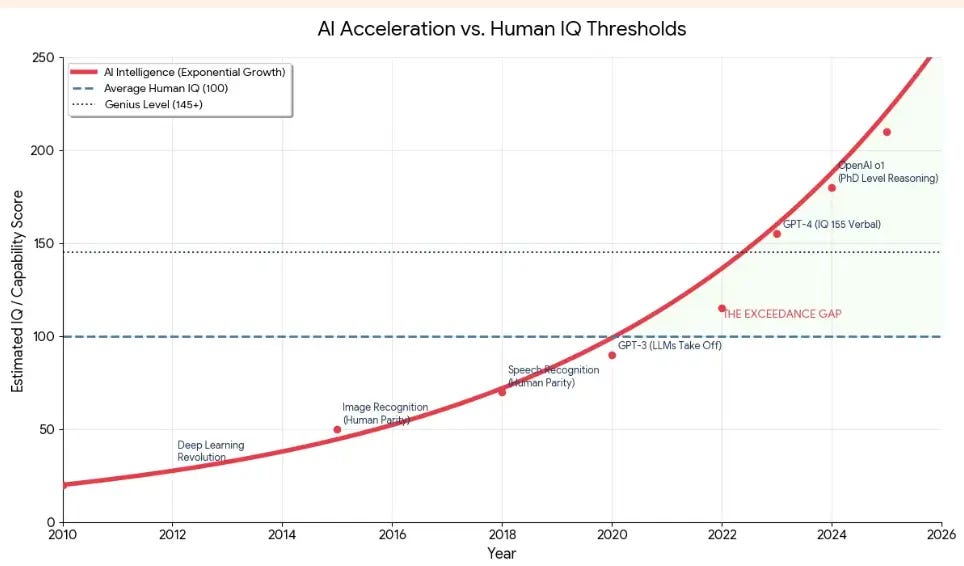
We are currently witnessing the biggest societal disruption since the Industrial Revolution.
I’ve been thinking a lot about what a curriculum for the future should look like, and written about that here
If knowledge and AI tutors are now abundant, what and how should people learn?
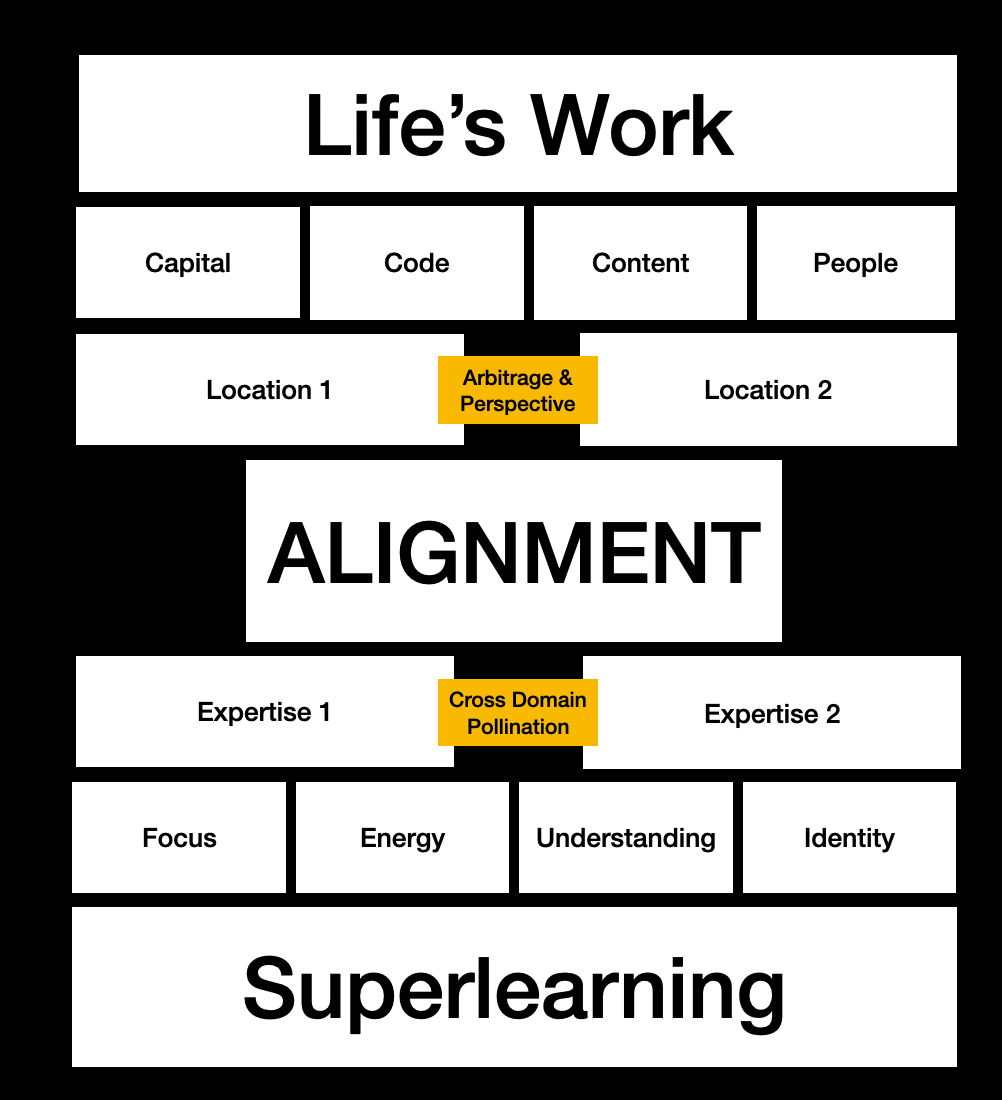
The Superhuman Core
One of the critical ideas of this curriculum is the importance of individual agency to choose and design and become the architect of your life. It starts with a superhuman core.

And the desire to build your dream life.

Exponential is the Natural Way
I strongly believe that we should be growing exponentially, otherwise there is something in the way. We often hit some ceiling of growth, such as through a low leverage loop trap.

Super Learning
This is the critical skill and foundation. We need to learn how to learn so that they can bootload any number of skills or knowledge at any time.

How? AI coaching, mentors, content, feedback loops. Fast iteration, reflection, mirrors, synthesis, and direction.
Above that we have the 4 internal tools of leverage
4 Internal Tools of Leverage
Focus
Energy
Understanding and
Identity
These are critical skills and tools to develop to be able to operate. There are more practical skills. While they may seem basic, they are far more important now. If we lose focus or can’t manage our energy, we are not able to produce or create. They are critical to get right to perform at the highest level.
Focus is all about direction and goal setting, clarity and executive power.
One of the ways to improve clarity is to review definitions and your own internal philosophy.

Energy is about energy and time management - diet, sleep, daily rhythm, scheduling. This includes fitness and health.
Understanding is one of the deepest and biggest ones. Understanding is about awareness, emotional regulation, and resilience. It also encompasses a deep comprehension of how the world actually works - market dynamics, human incentives, and geopolitical shifts - which could almost be another curriculum of itself.
Identity and narrative is all about upgrading the internal story to achieve goals, being aware of it and rewriting.

Focus and energy may seem basic but they are pillars that are absolutely necessary. Some deep understanding is necessary to understand how the world works, and most people do not have complete understanding because we are in a new world.
Multiple Domain Expertise
These are two (or more) fields, skills or industries. Such as learning petroleum engineering and writing, or learning management and engineering.
One of the problems we have is that much of our world exists in silos. In the industrial age, it was necessary to have specialisation like in Adam Smith’s pin factory. In this new age the specialist suffers from lack of perspective and narrowing of view. To counter this, it’s necessary to study two or more unrelated industries. This can help, especially in a siloed world, because there are often similarities and connections that can be made between fields that are not obvious. All of knowledge is connected in a tree of knowledge and there are relationships and patterns between everything.
The synthesis and cross domain pollination happens naturally when people understand two domains deeply.
It is also very necessary to have two or more fields of expertise. These are fields in which to apply oneself, as we will come onto later
I’ve written more about that here.


Alignment
This is one of the most important parts of the framework and it’s at the center. This is the alignment of yourself, the market, the knowledge and the world. It’s spiritual, it’s about lining everything up. Without alignment, you are simply moving fast toward the wrong destination.
This becomes extremely important to be aligned in the right direction. Philosophy, ethics and community are part of it.

In the Intelligence Age, we use the 4 Levers (Code, Content, Capital, and People) to amplify our efforts. These levers act as force multipliers. If your direction is off by even 1°, that deviation is magnified exponentially by the power of the tools you use.
The Three Spheres of Alignment
To achieve this, you must synchronize three distinct areas:
Internal Alignment (The Self): This is the “Spiritual” component. It is the marriage of your unique talents, your internal narrative, and your genuine curiosity. When you work on something you are naturally obsessed with, “work” feels like “play.”
External Alignment (The Market): You must align your output with what the world actually needs. High-leverage skills applied to a dead market result in zero wealth. Alignment means finding the “Product-Market Fit” for your soul.
Temporal Alignment (The World): This is about timing. Are you building for the world of 1990 or 2030? Alignment requires a deep understanding of geopolitical shifts, technological cycles, and where the “puck” is going.
You no longer have to "force" yourself to be disciplined because your actions are a natural byproduct of your identity. You aren't just "doing" work; you are expressing your "Life’s Work." In this state, your use of Leverage becomes effortless and your compounding becomes exponential.
Aligning yourself with the principle of emergence.
Opportunities Are Emergence

TLDR: Opportunities are emergence, the entrepreneur is the catalyst, emergence literacy is the core skill
Multiple Geographies
Many people are brought up in one location. The advantage is to have a deep understanding and ability to navigate two or more geographies. This breaks free from the culture and life of one and allows you to have greater perspective, but also arbitrage between them. You can choose the one that is best, and usually out of all the choices, the one you choose is likely to be better in some way to the one you were “spawned” in.
You can read more about choosing and building your geographical stack here.
Leverage
In the industrial era, you traded your time for money. In the Intelligence Age, you use Leverage to trade results for wealth and impact. Leverage is the “Force Multiplier” / amplifier that allows one person to do the work of thousands.

It’s necessary to understand them all but specialise in one or two that you are best suited at.
1. Capital
Capital is the most traditional form of leverage, but it requires the highest level of judgment to master.
Cultivate logical judgment about where to allocate resources.
Build real financial literacy - budgeting, forecasting, and cash flow mastery.
Understand risk deeply - not to avoid it, but to price it accurately.
Practice capital allocation - placing bets where the upside outweighs the downside.
2. Code
Code is the most “permissionless” lever. It is a digital army of robots working for you while you sleep.
Think in architecture and systems - write for scale, not one-time use.
Understand tools, stacks, and ecosystems - what you build on shapes how you build.
Train your logic and communication - code is read more than it’s written.
Apply prioritization, decision-making, and feedback loops - great code is iterative and lean.
3. Content
Content is how you scale your perspective and influence. Like code, it works for you 24/7 without needing your presence.
Master expression and storytelling - it’s not what you say, it’s how it lands.
Study psychology, markets, and audience behavior - relevance beats creativity.
Learn the tools and platforms of distribution - virality is algorithmic.
Aim for clarity and precision - be understood, not just heard.

4. People
Leading people is the oldest and highest-stakes form of leverage. It requires a “Superhuman” level of emotional intelligence and clarity.
Develop talent judgment - know who to bet on, and when to let go.
Cast a bold vision, lead with energy, and inspire with purpose.
Design systems with smart incentives and KPIs - what gets measured and rewarded, gets done.
Build culture and trust - not through perks, but through truth, care, and high standards.
Life’s Work
Through combining all the above we get some output. This is the creation of whatever it is we are aligned to create. Life’s work is essential to practice, to improve, to show your expertise and to improve, and to build what you want.
This then feeds back into the system, so it exists as an organism that is constantly refining and improving, and if all is aligned, it compounds exponentially.
Explore more about work in the AI age here.
How to learn it?
The curriculum is now much more advanced than it was before because the tools are much more powerful, and so are our abilities. The whole model is a curriculum but it’s also a map for what to learn. You just build each part and they all exist as a system. You’re always learning, you’re always seeking greater alignment, you’re always creating work.
The curriculum of the future is a map, not a set of textbooks. You don’t “finish” it; you install it.
The first stages are for building the foundations. Then you should focus on the three parts - superlearning, alignment and life’s work, as all the other parts exist as part of the foundation already that just need maintenance.
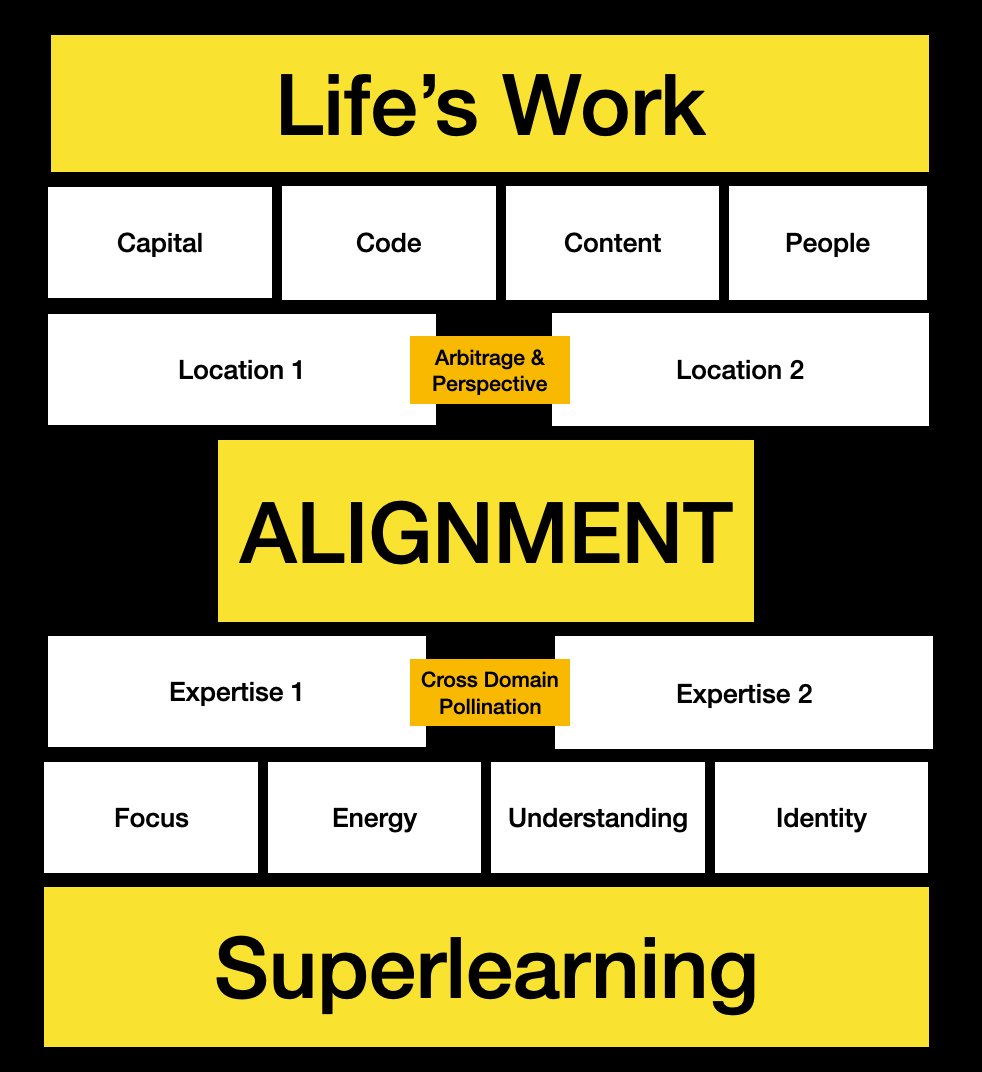
Then we can achieve another level of transcendance and human flourishing.
If you find this interesting and you’d like to learn more about The Superhuman Curriculum and how to upgrade. You can learn more and join the waiting list here.
The Emergence Curriculum
I’ve also created another kind of curriculum that goes together with this, and that’s the emergence curriculum.
This is based on the idea that we are made of the sum of our inputs, but we become something greater - so we should identify and curate the best resources and learn from them to incorporate them into us.
The Emergence Curriculum is more like a source material philosophy: it argues that what you become is the sum of your inputs, so you should curate the highest-quality ones possible. It's the raw material that feeds the architecture.
The Emergence Curriculum

Emergence is the idea that something new and unexpected arises from simpler parts coming together - and the new thing has properties that none of the individual parts have on their own.
I discussed this a bit on how to prepare a career for the new age
How to build a successful career in the AI age?

TLDR: The labour market has changed. Students need to take education into their own hands. Here is a curriculum and way of thinking about which skills to build that can withstand the evolving job market. There are two tracks: 1) Leverage, and 2) Human Super-Skills. The curriculum should be tailored to each person.
In this article I’m going to go deeper in how to prepare and build your education to succeed in this age.
Asking how schools and universities should transform is a valid question, but we should first zoom in and zoom out: What should the optimum human learn? And how should society look? Those are the two questions we must answer before we ask how universities should adapt.
I’ve written more about that here

Here’s the more detailed framework
What does it mean to be human?

In this new age we must consciously decide and define what it means to be human, and that is the idea of the Superhuman. This is what this curriculum is about.
