
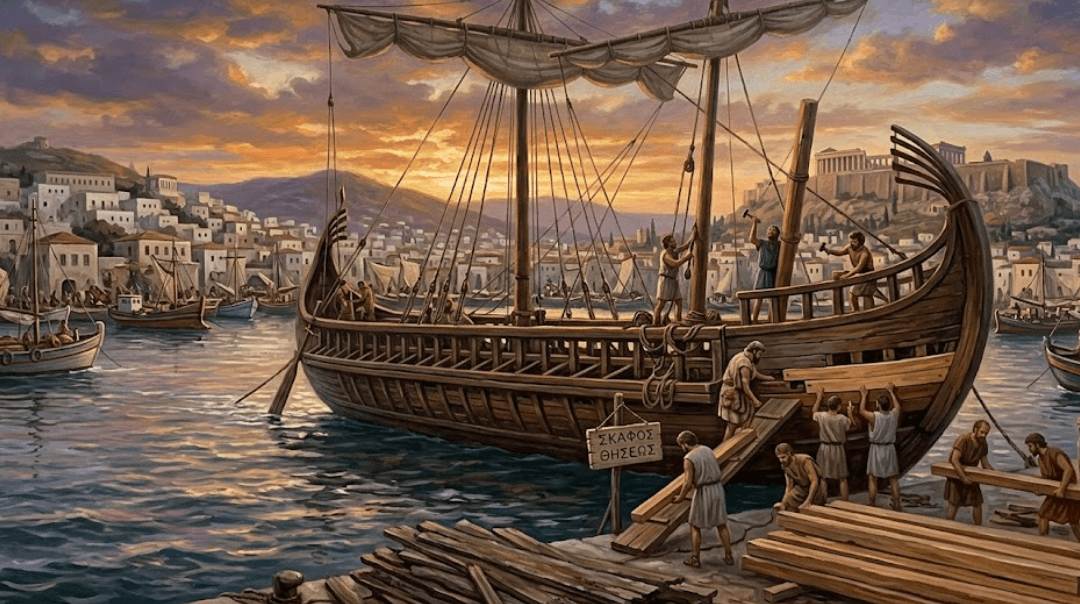
The Ship of Theseus is an old thought experiment. Theseus returns from battle. His ship is preserved as a monument. Over time, planks rot and are replaced — one by one - until every single piece of original wood is gone.
The question: is it still the same ship?
Philosophers have been arguing about this for centuries. But they’ve been asking the wrong question.
Form Vs Matter
Aristotle gave us the tools to think about this clearly. Everything that exists has two aspects: matter (the stuff it’s made of) and form (the pattern, the arrangement, the idea of the thing). The wood is the matter. The ship is the form.
The matter is replaceable. It always was. A ship is not a pile of wood — it is wood arranged in a specific way, for a specific purpose, carrying a specific history. When you replace a plank, the matter changes. The form continues.
But here’s what’s more interesting. Take all those original planks - the ones removed and replaced - and rebuild a second ship from them. Now you have two ships. The old matter. The continuing form. Which is the real Ship of Theseus?
The pile of original planks is not a ship. It is wood.
The combination is what makes it a ship.
Emergence
Emergence is what happens when a system produces something its parts cannot explain. Water is wet -but no individual H₂O molecule is wet. Consciousness arises from neurons - but no single neuron is conscious. A city has a culture - but no individual building has culture. Put wood together in a certain combination and it becomes a ship.
The whole is not just the sum of its parts. It is something the parts could not have predicted.
The Ship of Theseus is the same. The ship - as a ship - has properties no individual plank possesses. It floats. It sails. It carries meaning, history, identity. None of those properties live in the wood. They emerge from the arrangement.
The Ship Is Emergence
So what persists when every plank is replaced? Not the matter. The form. The pattern. The idea of the ship - made real through arrangement, held together by function and meaning.
The Ship of Theseus is not a paradox about replacement. It is a demonstration that identity is emergent. It doesn’t live in the parts. It lives in the relationship between the parts. In the structure. In the pattern that persists.
This is why the second ship - rebuilt from original planks but disassembled and scattered - is not really the Ship of Theseus. It has the original matter. But the form was broken. The emergence collapsed. The ship ceased.
What exists is not the matter.
What exists is the pattern the matter makes possible.
This applies to you. Your cells replace themselves. Your opinions change. Your memories reshape. And yet - you persist. Because you are not your matter. You are something that emerged from it. A pattern. A form. An idea, made continuous through time.
That’s why if you clone you and upload your mind, it’s not you.
Institutions and civilisations
A company, a country, a culture — these are emergent patterns too. Rome didn’t fall when a battle was lost. It fell when the pattern collapsed — the shared idea, the organising structure, the emergent identity. This reframes how we think about institutional survival. You can replace every person in an organisation and it persists. Or you can keep the same people and lose the thing entirely.
The deepest implication
Ideas themselves are emergent patterns with no fixed matter. This article exists as patterns of ink, pixels, electrical signals, neural firing. The matter keeps changing. The idea persists -or doesn’t - based on whether the pattern is preserved and transmitted.
Which means the Ship of Theseus isn’t just a metaphor for identity. It’s a model for everything that exists and persists through time.
Opportunities and Emergence

TLDR: Opportunities are emergence, the entrepreneur is the catalyst, emergence literacy is the core skill