
Many governments are looking at ways to reverse population decline with various policies.
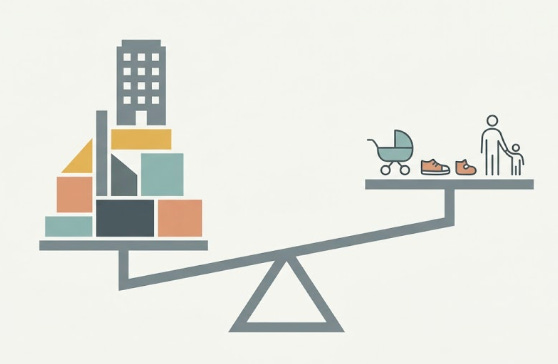
TL;DR: The “GDP Trap” and the Rational Choice Not to Have Children
Current policies to reverse population decline fail because they treat the symptoms, not the cause. Birth rates are falling because, in a fully monetized economy, children have transitioned from a shared social benefit to an individual financial burden that no longer makes “rational sense” for many parents.
The Core Issue: We are in a “GDP Trap” where economic growth is prioritized at the expense of people. To keep GDP rising, we’ve incentivized dual-income households and the “atomization” of the family, leaving parents with less time and a smaller “consumer surplus” to spend on children.
The Housing Stalemate: In many countries (notably the UK and East Asia), housing has ceased to be a functional utility and has become a primary store of wealth and a “pension.” This creates a conflict: protecting the house prices of current owners effectively acts as a wealth transfer from the young, making family formation unaffordable.
The Solution: We must shift from a GDP-focused model to a “balance sheet” perspective. This requires breaking the political stalemate to build abundant housing, intentionally deflating housing as an investment class to move capital into productive sectors, and returning the economic surplus to potential parents.
Key Concepts & Definitions
GDP (Gross Domestic Product): Traditionally the total value of all goods and services produced in a country. In this article, it is viewed as a “master incentive” that prioritizes immediate economic activity (cash flow) over long-term societal health.
The GDP Trap: A cycle where a country pursues short-term growth by exhausting its primary resource - people. This includes pushing both parents into the workforce and increasing debt, which boosts current GDP but makes the “cost of production” for the next generation (having children) prohibitively expensive.
Consumer Surplus: The “extra” value or money left over for a person after they pay for their needs. Previously, parents kept this surplus and invested it into larger families; today, that surplus is being “captured” by rising housing costs and debt.
Monetization of the Economy: The process of turning activities that used to happen for free within families or communities (like childcare or home cooking) into paid services. While this increases GDP, it drains the financial resources of the household.
Atomization: A marketing and economic trend that encourages people to live and consume as isolated individuals rather than as families or communities. This “atomization” creates more demand for products (e.g., two small apartments instead of one family home) but destroys the social support needed to raise children.
Housing as a Store of Wealth: When property is treated like a bank account or a pension fund rather than a functional place to live. This creates a conflict where high prices are “good” for owners but “bad” for the survival of the population.
Balance Sheet Perspective: A proposed shift in governance that looks at a country’s long-term assets (like a young, healthy population) and liabilities (like debt and declining birth rates), rather than just looking at the yearly “income” (GDP).
Introduction
I keep coming across videos and resources which say that people don’t understand why birth rates are falling, such as this one
It seems inevitable that when a country gets wealthier birth rates decline.
I see a massive contradiction between the policies to reverse birth rate decline, and I can understand why they are declining, and how to reverse it.
The core reason they are declining is because it is becoming more expensive to have children, and these costs are paid by the parents. In many cases it doesn’t make rational sense for them to have children.
The reason this is becoming so much more clear now is that
1) the economy is becoming more and more monetised, and
2) housing
It’s a related housing and an economic problem.

From what I’ve learnt from problem solving, many problems are interrelated, and need to be untangled.
GDP incentivises monetising more and more of the economy. It acts as the master incentive on the economy, which has incentivised things like 1) both parents working, 2) companies marketing to atomise and isolate, 3) more of the economy, 4) rising debt such as with housing, 4) prices to rise to reduce the consumer surplus.
Previously that consumer surplus was kept with parents, and they could use it to raise more children, but now they have less of it.
We’re at a late stage of the consumer economy, where many of incentives for GDP growth are at the cost of people - people have become the primary resource.
This can be seen in housing where in China and asian cities such as Korea for example, housing acts more of a store of wealth, prices have risen through lending and bank loans, and new developments are limited. Cities have incentives to reduce the population in cities while not building out of town suburbs, because there is limited space, people continue to live in tower blocks in cities. People buy housing at a later age. Housing is increasingly seen as peoples pensions which creates a conflict. In order for the economy to do well, and voters to be happy, housing must continue to be limited and rise in prices, which is a transfer of wealth from those who are looking to buy to those who already own.
I’ve written some articles here

So the solutions to this are not about giving young people subsidies which are like putting a bandaid on the problem. It needs to be resolved from the inside.
Abundant housing is built, the housing is gradually deflated and no longer a store of wealth but its functional use case, while moving that wealth into other, more productive parts of the economy,.
Building more abundant housing and living out of cities or in the countryside or towns. Asian cities are reluctant because of the population numbers and cultures and this is a huge disadvantage if cities have reached the limit of their population growth.
The economy is shifted away from a GDP model to a balance sheet perspective which incentivises building, and takes into account surplus.
In UK for example, labour has attempted to solve this problem by trying to incentivise more housing, but there are a number of stakeholders.
The big problem in UK is that many people put money into housing as a pension, as it has been a very strong investment before. It is very difficult for any politician to do anything about house prices otherwise it would lose the voting power, and it would also impact the economy.
Housing regulation has been effectively frozen because nobody wants to allow housing development near by which devalues their house prices.
So I think in UK there is a stalemate which risks stalling the economy.
In the short term its good for the economy because as prices rise, people spend more and they need to work. And thats the GDP trap that needs to be overcome.
It needs effective leadership and coordination and rapid infrastructure and building.
About me
I studied Economics at university in UK and have a clear understanding. I’ve lived in China, and understand Chinese and economics. I’ve built an online platform for students to study abroad and so I understand the reasons people in different countries ares making decisions about where to study.
I’ve put some ideas in a video here
And here