
Most people are living on someone else's frequency and have no idea.
Signal is any input or action that has compounded value or high-leverage impact. It usually feels quiet, and meaningful and non-disposable.
Noise is the average, background, entropy. Noise is high-volume, low-value information that creates the illusion of progress. It’s anything that has no signal.
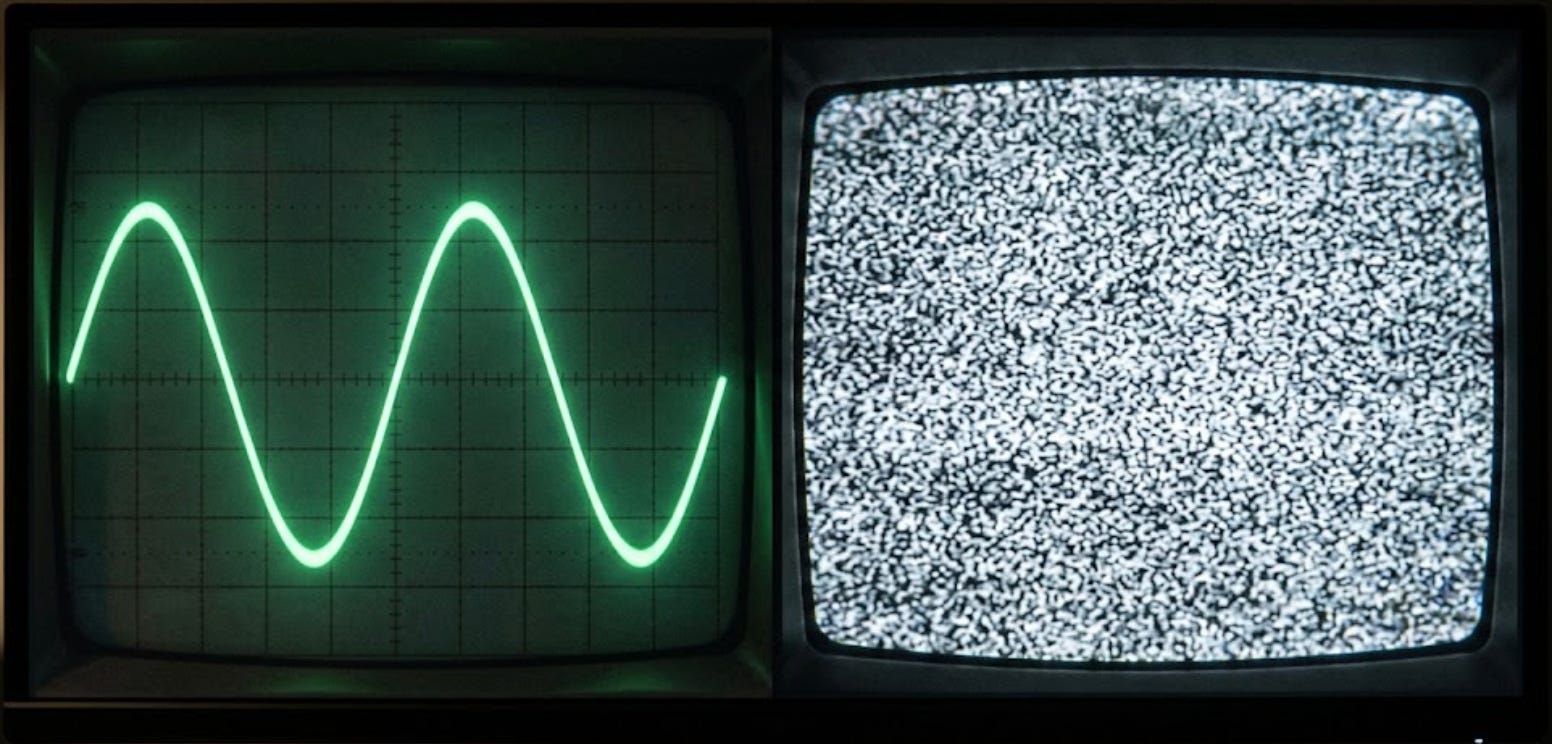
Noise isn't always bad or wrong, it's just the default state.
These are relative to you and your journey. One persons signal can be another persons noise. The opposite of noise is therefore not silence, it's intentionality.
You can find more signal by doing less. Removing the noise. Solitude and doing fewer things more deeply.
Resonance
Resonance - is anything that connects and vibrates - establishing a pathway.
It’s what happens when two signals align.
You read a book and it feels like it was written for you. You meet someone and the conversation goes deep immediately. You hear an idea and it clicks something open that you didn’t even know was closed.
This is also what happens when content goes viral. The idea may have already been half-formed in millions of people's heads. Someone articulates it clearly and it spreads like a tuning fork striking the right note. Everyone recognises something they already felt but couldn't say.
The key thing about resonance is that you can’t force it. You can only create the conditions for it. Which is why noise is its enemy - when you’re surrounded by noise, resonance can’t happen because your signal is buried.
In practical terms resonance is:
The conversation that changes your thinking
The book that arrives at exactly the right moment
The person who reflects something back to you that you couldn’t see yourself
The idea that connects two things you knew separately into something new
Resonance is why signal is important.
Why It Matters
The Value of Signal
Signal detection is the difference between being a "player" and being "background noise.
If you don’t want to fade into the background.
If you want to have agency, to be an active player in the game.
To navigate the world and achieve something, you need to be able to navigate signal from noise.
The Background (NPCs): People who react to whatever noise is loudest (news cycles, notifications, social pressure). They have no “tuning,” so they have no agency.

It’s like those people who are walking in the background of this game. They are the NPC. They have no agency, reacting to whatever happens around them.
The Players: People who have a high Signal-to-Noise Ratio (SNR). That’s you. They do less, but what they do has “gravity.”
It’s like main character energy.
Being the hero in your own story.
If you are afraid to be yourself. To do the things you want.
You’re not a player, you’re a non-playable character.
The Density & Power of Signal
Density is what gives signal its weight. And weight, at scale, creates gravity.
Signal is dense because it uncovers a pattern, or a deeper truth. The idea that explains ten other things at once, that leads to something new, to progress. The conversation that reframes something you thought you already understood. That’s what makes it non-disposable, and valuable. That’s also what makes resonance feel almost eerie sometimes, with resonance - it’s not new information, it’s recognition of something that was already true.
It’s why when a leader speaks with signal, you can feel the resonance. It’s an epiphany, a wow moment. It’s being excited, energised, and aligned.
Density is about how strong the signal is. Gravity is about how attractive it is.
Gravity of Signal
When someone has a high signal-to-noise ratio - when they do less but more intentionally - they develop a kind of gravitational pull. Things come to them. Opportunities, people, ideas seem to find them disproportionately.
Because:
They’re clear on what they want so they recognise opportunities others miss
They’re memorable because they stand for something specific
They’re trusted because they don’t say yes to everything
They have bandwidth because they’ve eliminated noise
The paradox is that doing less creates more gravity. Most people think visibility comes from volume - more posts, more meetings, more activity. But the people with real gravity are often the ones you hear from rarely but remember always.
It’s the difference between a star and static. Static is everywhere and means nothing. A star is specific, directional and navigable.
Identify Your Tuning
Identify Your Tuning: Since signal is relative, you have to be clear on your “frequency.” If your goal is to build an autonomous organization, a conversation about AI architecture is high signal. If your goal was to be a chef, that same conversation is noise. Know yourself.
Solitude is the "low-noise floor" that allows you to hear your internal resonance. You can't find the signal in a crowd because the crowd's frequency is too loud. But it’s much more than that, that’s just one example.
Silence and isolation isn’t the goal; Intentionality is.
But there are a lot of mistaken beliefs about solitude and signal. It’s not that it’s better to experience more solitude, and cut off people, it’s that the default is to experience very little.
The Barbell of Going Deeper
But there are values at the ends - A barbell strategy.
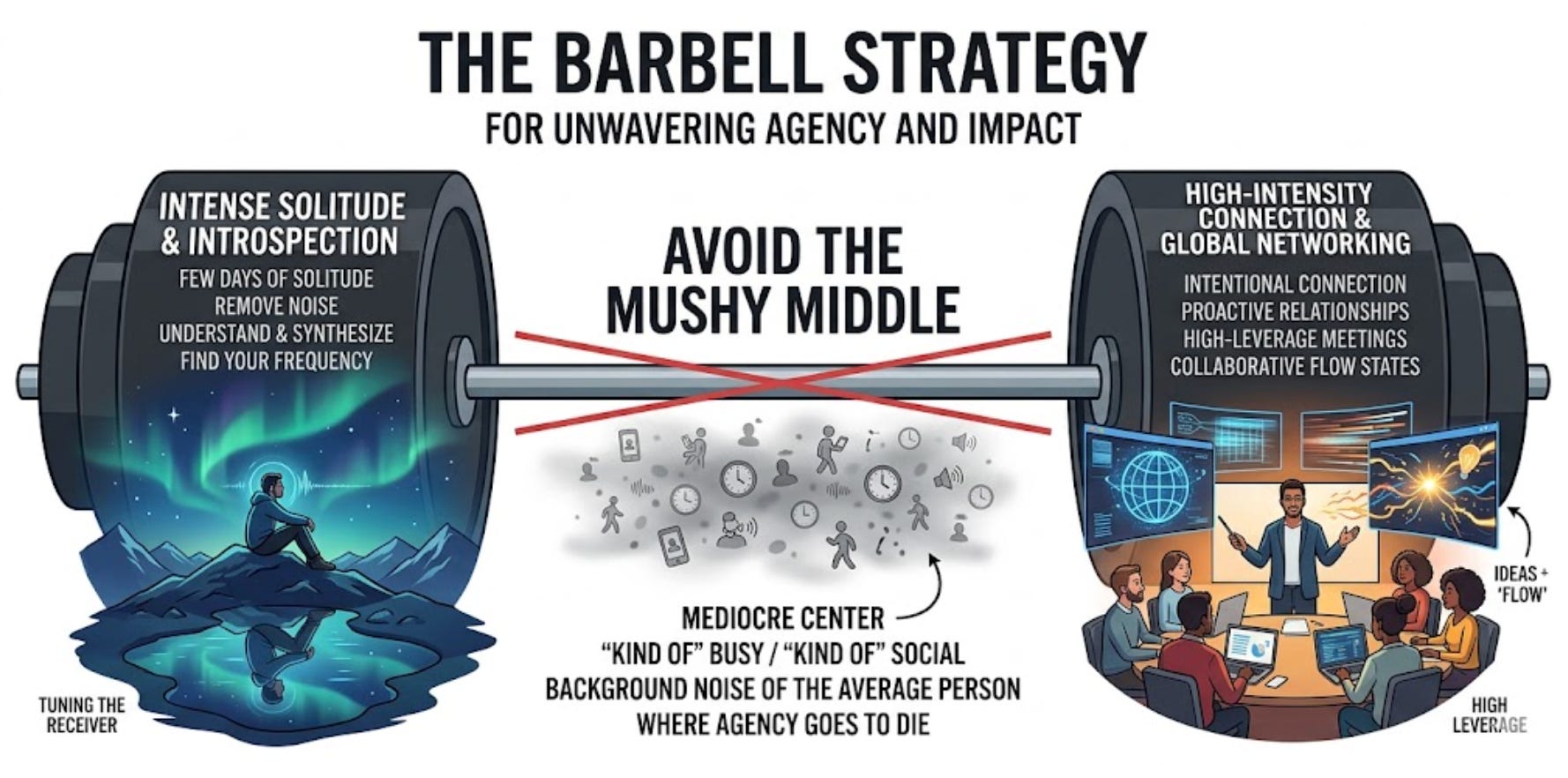
A few days of solitude allows you to resonate, and remove the noise to understand and synthesize, but many people never experience the necessary solitude.
This is like Monk Mode.
The other side of that is the connection. Much more intentional and real high-Intensity Connection. Developing relationships proactively. Globally, intentionally reaching out. This isn't "hanging out"; it's deep rapport, high-leverage meetings, or collaborative "flow states."
The thing is that they actually go together much better.
Most people spend their time doing neither. People suggest a balanced life. But the barbell - avoids the “mushy middle” - the mediocre center where most people spend their lives.
By avoiding the “mushy middle,” you avoid the “background noise” of the average person. The “mushy middle” is where most people’s agency goes to die - it’s the land of “kind of” busy, “kind of” social, and “kind of” focused, and it’s everywhere.
Take small talk for example. Small talk is useful - it’s how you warm up a conversation, build rapport, find common ground before going deeper. The cost isn’t the small talk, it’s when it never goes anywhere. When it stays at weather and pleasantries and you both walk away having revealed nothing and learned nothing. That’s noise.
Most people's frequency is actually polluted by external input - what their parents wanted, what society rewards, what their peers are doing.
Frequency Pollution
The dangerous thing about frequency pollution is that it feels like your own thoughts. It’s not obviously external like someone telling you what to do. It’s been internalised so deeply it feels like your own voice. Which is why so many people spend decades pursuing things that never quite satisfy - they’re optimising for someone else’s frequency while believing it’s their own.
Solitude is essentially clean air. It doesn’t give you the signal - it just removes enough pollution that you can finally hear what was always there.
This is the ultimate hack of the Intelligence Age- if you don't tune your own frequency, the algorithm will ghost-write your life as an NPC.
Developing Your Own Frequency
How do you listen to your own signal?
“Listening to your own signal” assumes your internal signal is already clear and trustworthy. But sometimes your internal signal is itself distorted - by fear, conditioning, ego, trauma.
So part of tuning is also cleaning the receiver, not just listening harder, by igniting the flame within you, and nurturing your own signal, and allowing it to grow and develop, and explore.
How do you tune your frequency?
You tune your frequency when you have calibrated yourself internally. You are the source and creator and decider of your life - not what others say and think, or what you think you should want.
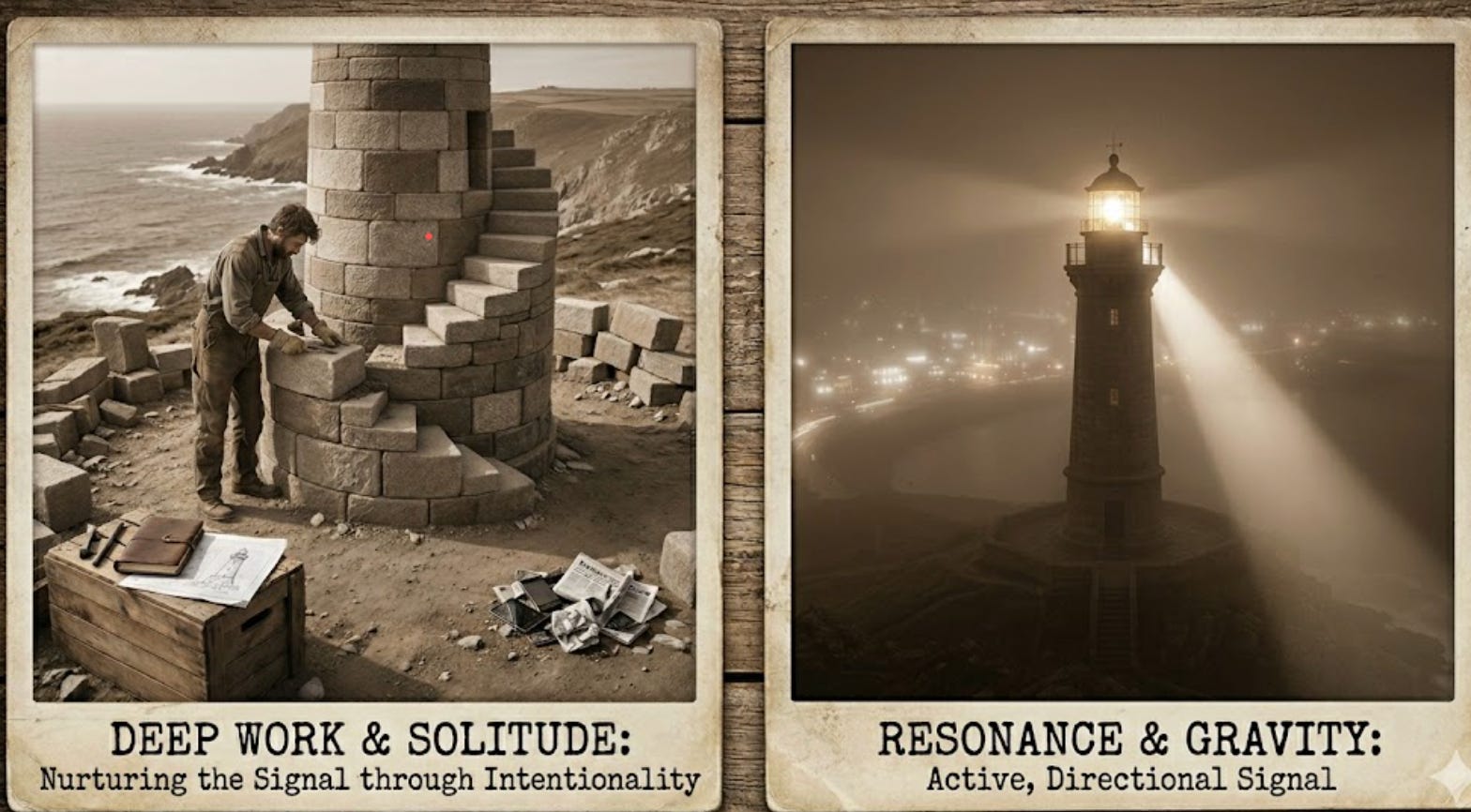
It’s like building a lighthouse. You need to first build and develop it, then shine the beam of your signal.
This maps onto Paul Graham’s Maker’s Vs Managers schedule. Makers need long uninterrupted blocks; managers work in short slots. Most people default to the manager schedule by accident. But the barbell says do both - just more intensely and never mixed. Deep solitude for the maker mode, high-intensity connection for the manager mode. The middle is where both get destroyed.
There is a certain amount of courage needed to tune your own frequency.
Because there is a Cost of Divergence. By going against the crowd there is a friction. It takes courage to trust your receiver more than the outside noise.
You tune it through clarity of purpose first. You can’t know what’s signal until you know what you’re building. Most people’s frequency is fuzzy because their goals are fuzzy. The more specific and honest you are about what you actually want - not what you think you should want - the easier it becomes to filter everything else.
You tune it through experience and reflection. You don’t always know in the moment whether something was signal or noise. But if you reflect consistently - what energised me, what drained me, what moved things forward, what didn’t - patterns emerge. Over time you develop an instinct for it. That instinct is your tuned frequency.
You tune it through elimination. Less about adding the right things, more about removing the wrong ones. Every time you say no to something that feels like noise, your signal becomes clearer. It’s like turning down the background volume so you can hear what’s actually playing.
You tune it through honest self knowledge. This is the hardest one. Most people don’t know themselves as well as they think. They know their preferences but not their actual wiring - what genuinely moves them versus what they’ve been conditioned to pursue. Solitude helps here because it removes external validation and forces you to sit with what actually resonates when nobody is watching.
And interestingly - other people and experiences can help you tune it. The right conversation with the right person can suddenly make something click about what you actually care about.
Your own frequency isn’t static, it’s constantly changing.
It isn’t a static setting you find once and forget.
It’s a dynamic calibration.
The New Operating System for the Intelligence Age
This is a central part of what I call Alignment in the Superhuman curriculum.
The framework for how I think we need to think and operate in the intelligence age.
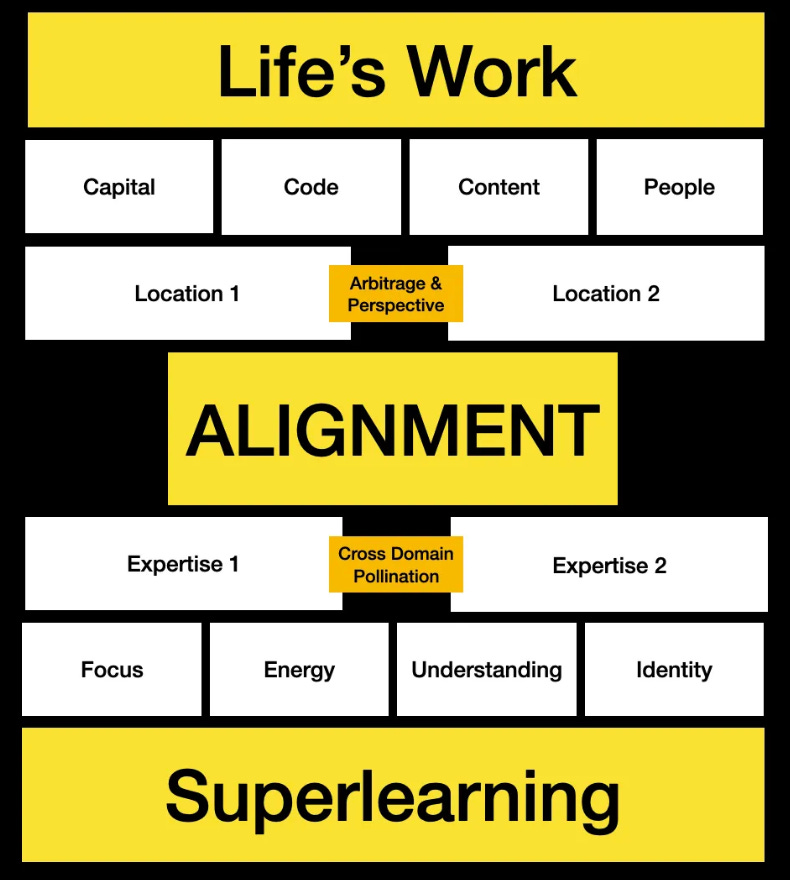
It’s absolutely necessary for us to upgrade ourselves at the same rate or faster than we are developing technology.

Lets Resonate
This is part of a bigger framework I'm developing. If it resonates, let me know which part landed most - That's my signal on where to go deeper next…
What are some examples that you’ve found in your own life or ways to distinguish between noise vs signal?