
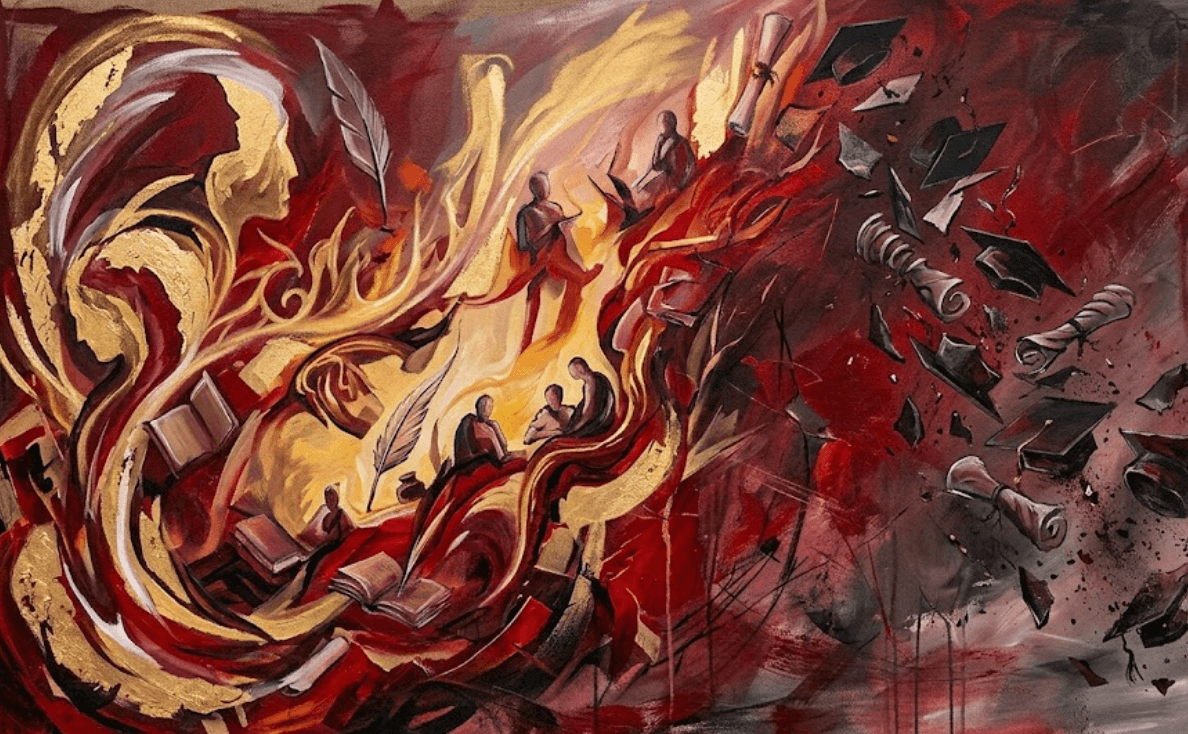
From the UK to China, all around the world, demand for studying the humanities and languages is dropping and universities are reducing programs.
The funny thing is that in the age of AI, the value of humanities is becoming far more important - judgement, taste, critical thinking, being able to write and think, the cultural understanding. And humanities, history, debate, are all essential for a functioning society.
It’s the humanities degree as a credential that is becoming less valuable.
I think there are two things happening, and it says more about the degree than it does about the humanities.
- The degree as a credential is shifting
- The changing labour market
Like, restaurants aren’t in the food business, they’re in the hospitality business. Food is cheap at home, but you can’t get that restaurant experience - where you can relax and someone does it for you, the environment, the people, the fun, the connection.
Universities aren’t just places of education, they’re currently a combination of education, credentials, community, research, immigration, tourism for short term programs, applied learning, experience, and becoming an adult.
It’s the humanities-credential that has shifted
because the work itself is the credential.
You can now assess someones ability in the humanities more by reading their articles on substack, by watching their showreel on Youtube, or by having a conversation in a foreign language than you can by a degree certificate.
This is quite different to a medical degree.
At the same time the labour market has shifted.
There is no longer a big mass job market, but a long tail of opportunities.
Translation for the masses can now be done by AI or soon-to-be AI glasses or earpieces. What can’t be done by AI is translating between Polish and Chinese and building connections in the supply chain between those countries, and applying cultural insights and empathy to business strategy.
That’s why I think for students, everyone needs to study the humanities but also combine it with other subjects - technology and science and apply it, like at the University of Texas at Austin.
And students should be doing, building, creating and publishing work online, and universities encouraging students as creators.
With content creation and real-world building, the feedback is almost instant and, it attracts opportunities and builds the university brand.
For universities the core product is moving away
- from single degree program, towards multi disciplinary programs
- 4 year degree, to 1 year full time + 3-5 year part time combining work experience with learning, and lifelong learning.
- applying it to work and projects - students as creators and builders
Combining two or more fields enables people to combine the rigor of STEM with humanities and finding opportunities at the intersections. I talk about this more in the Superhuman curriculum.
Applied learning helps to apply it to fast moving fields, and learning is now a lifelong process.
By what I’m seeing all around we’re entering a new renaissance period for the humanities and potentially for universities.
The old world four year mass translation and one size fits all jobs and degrees are fading.
The new world with unique, creative, interdisciplinary doer-thinkers is here.
The humanities aren’t in decline, they’re more important. It’s the four year humanities degree and university experience that is evolving.