
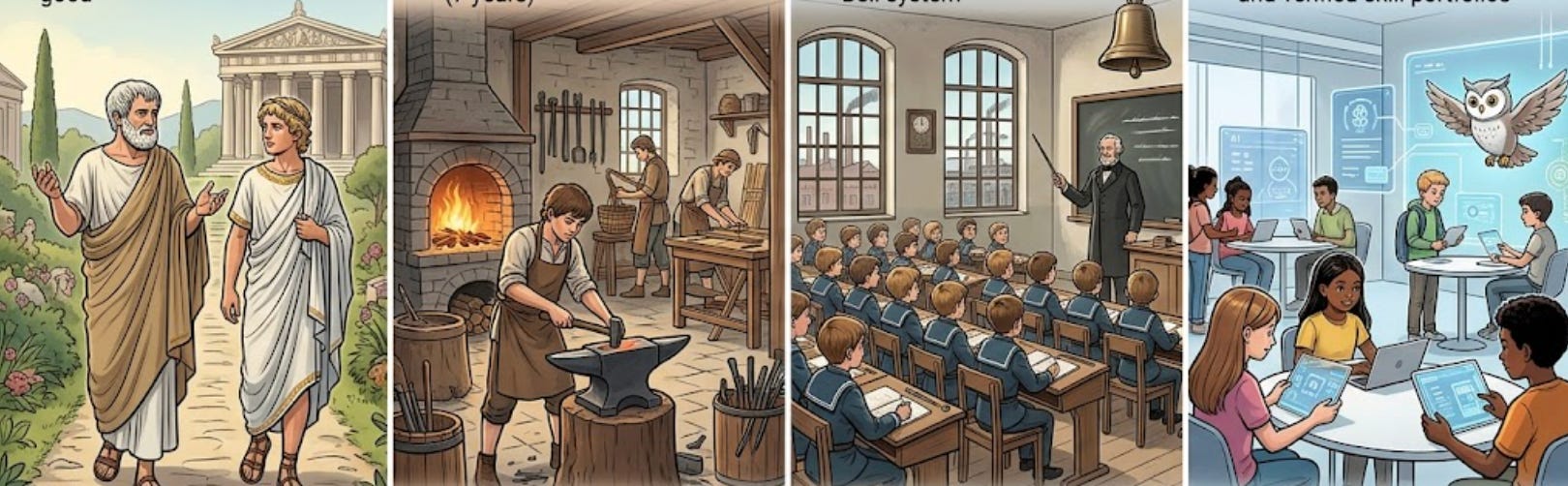
Introduction: The Great Convergence
For most of human history, the “industry” of learning has been defined by a cruel trade-off: you could have quality, or you could have scale, but you could never have both.
If you wanted the highest quality of education, you needed a dedicated master -an Aristotle - which meant you had to be a prince. If you wanted to educate the masses to build a modern nation, you had to treat students like widgets in a factory, moving them through the “Prussian” assembly line at a uniform speed. For two centuries, we accepted this compromise as the cost of progress.
But in 2026, the trade-off is dying. We are entering an era where the personalized depth of the ancient world is meeting the infinite scale of the digital one.
This is the story of how we moved from the elite shadows of the Lyceum to the clanging bells of the industrial schoolhouse, and why we are finally returning to a model of education that actually fits the human mind.
1. 1 on 1 Tutors
In the 4th century BCE, education was a luxury good, as bespoke as a hand-tailored toga. The model was simple: one master, one student, and a lot of walking. When Aristotle tutored the young Alexander the Great, the curriculum wasn’t a standardized test; it was a deep dive into philosophy, medicine, and politics, tailored to the specific needs of a future world-conqueror.
The Philosophy: Education was about character and inquiry. You didn’t just learn facts; you learned how to think.
The Problem: It was incredibly unscalable. If you weren’t royalty or high nobility, your “education” was whatever your parents knew. This created a massive “wisdom gap” that lasted for millennia.
2. The Practical Pivot: The Age of Apprenticeship
As the Middle Ages rolled in, the “industry” shifted toward the Guild system. If you weren’t destined for the Church or the University, you became an apprentice.
The Model: You were “bound” to a master for 7 years. You didn’t read about blacksmithing or weaving; you lived it.
The Innovation: This was the first “competency-based” education. You moved from Apprentice to Journeyman to Master based on the quality of your work, not the years you sat in a chair. It was highly effective for the economy but left little room for “liberal arts” or general literacy.
The University model actually grew out of the Guild model. A "Master's Degree" was originally literally a license to be a "Master" of the Teacher's Guild.
3. The Great Leveler: The Prussian Model
By the 18th century, the Industrial Revolution was looming, and nations needed a new kind of human: the reliable citizen. Prussia led the charge, creating a system designed to produce soldiers and workers who could follow instructions and read a manual.
The Factory Model: This is the school system most of us recognize today. It introduced:
Age-based cohorts: Everyone born in 2015 learns the same thing at the same time.
The Bell System: Training the internal clock for factory shifts.
Standardized Curricula: Ensuring a kid in Berlin knew the same math as a kid in Munich.
The Candor: We often criticize this “factory model” today, but let’s be fair: it was a miracle of its time. It took global literacy from under 15% to over 85%. It was the first time “the masses” were invited to the table of knowledge.
4. The Full Circle: 2026 and the AI Renaissance
Today, in 2026, the pendulum is swinging back. The “Prussian Factory” is creaking because it can’t keep up with a world where information is free but insight is scarce. We are entering the era of Aristotle for Everyone.
What’s happening right now:
Hyper-Personalization: AI tutors (like the ones powered by Gemini or specialized EdTech agents) provide that 1-on-1 Aristotelian experience at zero marginal cost. If a student struggles with a concept, the AI doesn’t move on; it pivots, changes the analogy, and waits.
The “Skills Economy”: The 4-year degree is losing its monopoly. In 2026, employers are increasingly looking at micro-credentials and verified skill portfolios. We are essentially returning to a high-tech “Apprenticeship” model where “what you can do” matters more than “where you sat.”
Decentralization: “Micro-schools” and learning pods are replacing the massive, monolithic high school. Families are “unbundling” education—using a physical hub for socialization but digital platforms for core subjects.
The 2026 Renaissance
The “Bloom’s 2 Sigma” Connection: In 1984, educational psychologist Benjamin Bloom found that a student tutored 1-on-1 performed two standard deviations (2 Sigma) better than those in a classroom. We’ve known the 1-on-1 model was better for 40 years; we just couldn’t afford it until now.
In the Prussian model, the teacher was a "content delivery system." In the AI era, the teacher becomes a Life Coach. Their value isn't in knowing the facts, but in knowing the student - their anxieties, their sparks, and their potential.
The “Unbundling”: This is the biggest shift in 2026. Education is moving from a “Platform” (the School Building) to a “Service” (The AI + Local Social Hub). The “Unbundling” doesn’t mean kids stay home in VR pods. It means the School Building transforms from a “Lecture Hall” into a “Community Hub” for sports, drama, and collaboration, while the AI handles the math and history.
The Verdict
The future of the education industry isn’t about replacing teachers; it’s about augmenting them. We are moving away from the “Sage on the Stage” (Prussian) and back to the “Guide by the Side” (Socratic). The factory is closing, and the Lyceum is reopening - but this time, the doors are open to everyone.
