
"Demography is destiny" Auguste Comte
Birth rates are falling all over the world in every economy.
This one of the core economic problems of our time and is leading to all sorts of economic and political issues. It is increasingly unsustainable and leads to an increase in debt, a failure to grow, increasing reliance on immigration, and the follow on issues that arise.
Without a clear understanding of this this issue, it will continue to compound.

I have a unique insight into this because I grew up with 2 brothers in the UK countryside and I've lived in China which now has one of the lowest birth rates in the world. I have also lived in UAE and I speak to students all over the world making study, career decisions and from this wide range of conversations and life experiences from different systems I've noticed a pattern that I feel compelled to share.
Why is it a problem? Because fewer young people means a shrinking workforce and shrinking economy. Our whole economic system relies on increasing growth, without it, our whole economic model unsustainable. This puts more pressure on young people, which increases the problem and it becomes a self reinforcing cycle.
The common theories are that people are prioritising education, careers, and that housing is less available, and that living costs are going up. But I argue that those are symptoms, and not the root cause and would like to propose what I believe the link and an explanation is, and start with biology.
There are three core points:
What is carrying capacity?
Housing Supply
GDP-Growth Economic Distortions
Our society is in demographic decline because we live in an economy that fails to produce sufficient housing, incentivises rising living costs and makes young people feel poor, and our instincts - shaped by evolution tell us not to reproduce when we sense there isn’t enough to go around. GDP focused growth amplify this squeeze by rewarding extraction, not long-term flourishing. To reverse this, we should reframe birth rates not as a problem but as an indicator of a problem in our economic model, and rethink what it means to build a sustainable, abundant, flourishing human-centric society.
Carrying capacity
The carrying capacity is the maximum population that a given environment can sustain given the availability of resources.
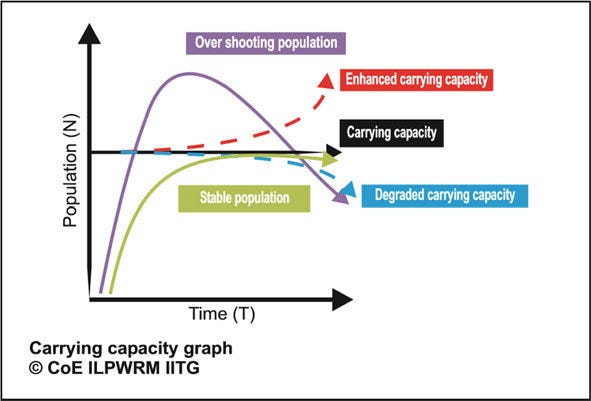
When a population exceeds its carrying capacity, it can lead to environmental degradation, resource depletion, and a decline in population size as the ecosystem can no longer support the excess individuals.
It can be incredibly risky for a species to overpopulate when there aren’t enough resources. In times of famine, and competition, animals conserve resources. In times of conquest, animals populate at a rapid rate.
It is proven that animals have an innate drive or unconscious instinct as to whether to populate their species more, in times of abundance, or to have fewer offspring, and I argue that humans have this same instinct too.
I argue that young people perceive that the carrying capacity has been reached, because of living costs and housing limitations, and so are not having large families. But this is not compatible with our economic system and incentives.
Housing & Living Costs
There is extremely strong evidence that young people are having fewer children because of lack of affordable housing. This aligns with when I speak to young people who are making career and life choices.
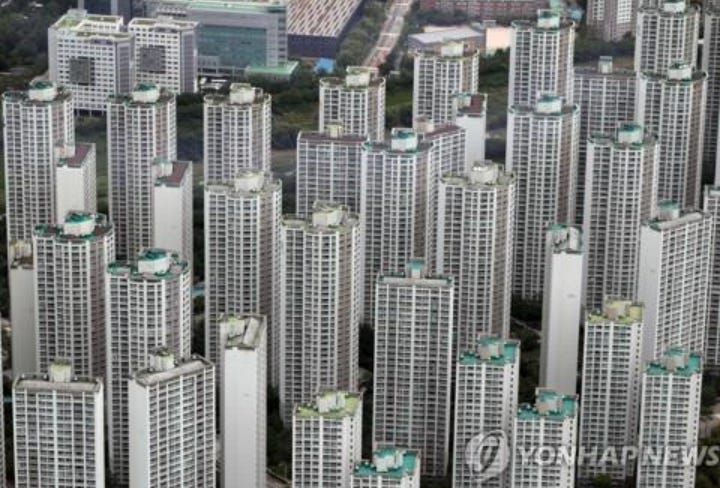
But is there less housing? There is evidence that not enough housing is being built. This is increasingly true in Asia, where fertility is some of the lowest worldwide, and large numbers of people live in cities (81% in Korea) compared to the countryside.
The reasons there are limited housing is that in many economies the housing market has been distorted. It has become financialised and has become more an investment and store of wealth, than a place to live. Housing markets worldwide are restricted and we are not building adequate housing to expand the carrying capacity.
With inadequate housing, young people need to live further from work, or spend more of their income on living costs. This gives them less money to spend on childcare, they perceive a smaller carrying capacity. They have less physical space to and this reality and these signals makes them less likely to feel the abundance and less likely to have children.
But why is there insufficient housing? Why don't we build more housing for young people? I argue that our economic system is creating these distortions.
GDP Creates Economic Distortions
The welfare of a nation can, therefore, scarcely be inferred from a measurement of national income as defined above. Simon Kuznet, the creator of GDP.
Our primary economic goal is to increase growth. This is measured by GDP, this is a core KPI of our economic system. This KPI and goal, completely shapes all the worlds policy decisions to what to invest in, how to increase it from housing policy, to education to healthcare and more.
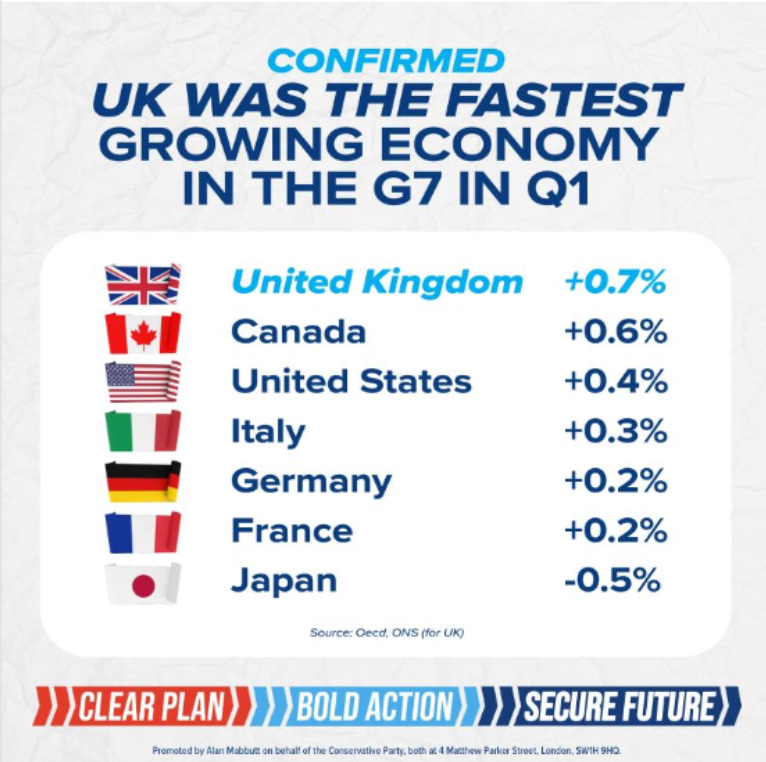
GDP was proposed in 1934 by Simon Kuznets an industrial economy recovering from the great depression. But it has some major weaknesses, and is increasingly seen as outdated. I argue that it is causing economic distortions which is leading the lower birth rates. These are compounding.
“Chasing GDP growth results in lower living standards. Better indicators are needed to capture well-being and sustainability” Joseph Stiglitz
What's wrong with GDP?
Gross Domestic Product is a sum of economic activity. It does not measure if that economic activity was good or bad.
GDP is like going to the doctor and saying: I'm healthy, I ran 100 miles last week, but ignoring your heart health, your diet, and your strength and ability to run next week.
It is an indicator that looks backwards instead of forwards. It incentivises debt and spending in the present, regardless of the future cost or potential value.
It's like a company focusing more on short term profit rather than long term direction, strategy and, customer satisfaction.
What are some of the things that can increase GDP? Spending on wars, increase in living costs. What are some of the things that are not included? Taking time off work to raise a child, learning online. Digging a hole and filling it up again is going to increase GDP, but raising a child or teaching someone how to program for free is not going to show up until they become productive.
Interestingly, investing in education and human are considered consumption figures, whereas investing in machinery are considered an investment.
I would argue that if you take everything away, in the knowledge economy, humans shouldn't just be counted as a component of the economy.
We are the economy. We are the primary capital asset
Monetising the Consumer Surplus
One of the core problems is that our focus on GDP growth leads to monetising the consumer surplus.
The consumer surplus is the difference between the price people are willing to pay and the price they pay. A large consumer surplus gives people the feeling that they can expand and have large families, it makes us feel like we are not yet at the carrying capacity. But when we monetise the consumer surplus, we feel we are at or near the carrying capacity, which causes a reduction in birth rates.
You could say that, when an economy runs out of ideas or productive areas for growth, the people become the resource to be milked. This is the low hanging fruit. Our system incentivise extraction rather than value creation because it doesn't differentiate between the two, and extraction is easier.
Every model of the world is a simplification, the question is, is it useful? It is clear that we need a more comprehensive measure of our economy.
Environmental & Sustainability Concerns
Economic distortion is not the only force restricting housing supply. In many developed nations, we face a powerful and often well-intentioned pressure: environmental preservation and sustainability. Concerns about urban sprawl, carbon footprints, and the protection of green spaces have led to stringent regulations and a cultural resistance to new development.
This creates a direct and painful conflict: the perceived long-term environmental health of the planet versus the immediate, foundational need of young people to find affordable homes where they can build their own lives and our drive to grow the economy. This deadlock is amplified by our flawed economic model which doesn't effectively differentiate between good growth and bad growth.
Because our system is unable to place a clear economic 'value' on a thriving new generation, but it can assign value to undeveloped land or carbon reduction, the argument against building often appears more righteous or even economically sound in policy debates. This leaves young people feeling that their essential needs are secondary to other priorities, reinforcing the instinct that the 'carrying capacity' has been reached.
I would argue that our environmental and sustainability concerns are valid. We can sense that something is not sustainable, but we do not solve it by limiting our growth, but by updating the model to incorporate the factors that are important and to reflect reality.
Solutions
Falling birth rates is the canary in the coal mine that our economic system need updating. We need to solve the global housing crisis and move to more human focused long term KPI in line with our economic needs.
In order to boost birth rates we should reframe birth rates as a problem to solve but as a key economic indicator, a KPI in itself, that tells us something about the nature of our economy.
Birth rates is not just important because it is a measure of the future productive capacity of the workforce and future strength of the economy, but it measures the optimism and abundance of young people that is not measured and in GDP.
To boost birth rates we need to solve the housing supply, and increase the feeling of abundance and optimism for young people.
Treating land as a profit-maximizing resource is like putting tolls on public roads then wondering why traffic, commerce, and growth slow down. Housing is core civilisational infrastructure essential for future growth and flourishing.
In order to do that we need to redesign and update our GDP focused economic model that incentivise extraction.
Creating a dashboard new human focused KPI, considering birth rates and other human focused metrics that show a forward looking signal that indicates young peoples optimism.
Using a balance sheet approach which includes the value of people as a core component and which can show assets and liabilities and will also reduce the incentive away from unsustainable debt.
"I spend more time looking at balance sheets than I do income statements because there's certain things that are harder to hide or play games with on the balance sheet" Warren Buffet
On a practical level, could assigning a value of a child on our economic model result in more children? If not just for their future earning potential.
A balance sheet can also consider the future environmental value of our resources as an asset.
As our economy matures much of what is valuable is not being measured, and if we are don't value it, we are not incentivising or protecting it, and we are in danger of losing what is most valuable.
Let's start to really recognise the true value of teachers, on healthcare, on housing, not for their money that is exchanged, but because what they are doing is valuable and important and building our future strength.
Ironically, less focus on GDP is likely to see more GDP growth.
Re-introducing Surplus Economics

An economy can’t claim the economy is growing by pointing to GDP growth whilst the population is in decline.
Let's update our economic KPI and build a more abundant future.
Now I’ve written the diagnostic, here are solutions in more detail here.

We can also come together to build new towns.
