
For most of human history, universities and libraries were valuable because they were the only places certain knowledge existed.
In the Industrial Age, education was a process you complete. You attended a physical institution, and filled yourself with specialized knowledge.
You spent the next forty years slowly draining it in a stable career.
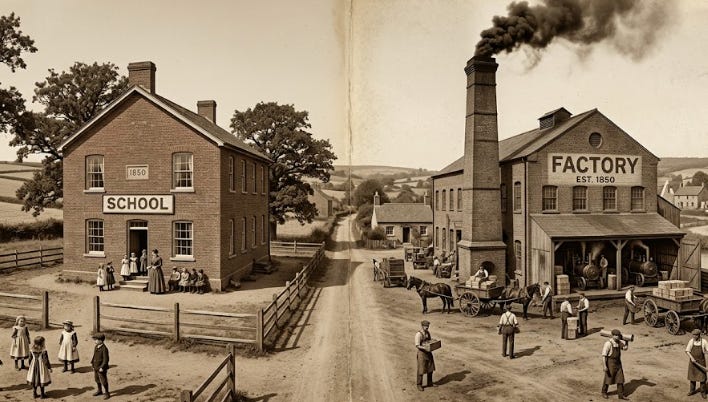
That world no longer exists. Information is now completely abundant, and becomes outdated faster than ever. Additionally, the physics and fundamentals of our world are changing in real time.
The old system is creating a situation where people think that:
Knowledge is no longer as valuable as experience and ability.
Too many people are silo’d thinking and too specialised and unable to see the connections between related industries - this presents and opportunity. The old system wants you to be a cog in a specific machine. The new system wants you to understand the whole factory. (In fact understanding the factory isn't enough; the goal is to design the systems that run the factory)
Innovation almost always happens when you take a "boring" idea from Industry A and apply it to Industry B for the first time. The person who can see the whole map- not just one coordinate- is the one who leads.
The old system wants you to be a cog in a specific machine.
The new system wants you to understand and redesign the whole factory.
By just working hard they can get ahead - but which direction you go and what tools you use is more important than working hard.
Just in case vs when you need it - Stop hoarding information you might use in 10 years which will become obselete. Start downloading the tools you need to build when you need it.
Consumption vs. Contribution: In the old system, a “good student” is a quiet one who absorbs. In the Superhuman system, a “good student” is a loud one who creates.
Being different and unique is a huge advantage and opportunity. Anything that can be standardized can be automated. Your "weirdness," your unique combination of skills, and your personal narrative are the only things that AI cannot replicate.
Anything that can be standardized will be automated.
Your 'weirdness' is your only moat.
The old system was built for a world of scarcity; the Superhuman Curriculum is built for a world of abundance. In scarcity, you follow the rules. In abundance, you create the direction.
Why This is Essential Now
With the rise of technology, it’s becoming absolutely critical, we are at risk of technology absorbing more and more tasks, which leaves those worse off in a society more vulnerable.
It’s essential on a personal level, to stay ahead of the curve, but also on a national level. Technology by other nations provides a big risk.
To survive and flourish in the Intelligence Age, we must adopt a radical new mandate:
We must keep learning at the same rate or faster than technology is developing.
And at the national levels, we must keep improving our education system faster than we are improving AI and technology.

The Limits of Human Potential
The synergy between human potential and our internal belief systems creates a powerful framework for personal evolution. While biological and environmental factors once seemed like fixed boundaries, modern science and philosophy suggest that these “limits” are far more porous than we previously imagined.
The Science of Change: Epigenetics and Growth Mindset
For a long time, we believed our genetic code was a final blueprint. However, the field of epigenetics has revealed that our environment and behaviors can actually influence how our genes are expressed. This means that while you cannot change the DNA sequence you were born with, your lifestyle choices—and even your thought patterns—can “turn on” or “turn off” certain genetic markers.
This biological flexibility perfectly complements the growth mindset. Coined by psychologist Carol Dweck, this is the belief that intelligence and talent are not fixed traits, but abilities that can be developed through dedication and hard work. When you embrace a growth mindset, failure stops being a limit and starts being a data point for future improvement.
The Psychological Edge: Positive Psychology
Positive psychology shifts the focus from “what is wrong with us” to “what is right with us.” By studying strengths like resilience, gratitude, and flow, this field provides practical tools to push past perceived mental plateaus. It suggests that by cultivating positive emotions, we broaden our awareness and build lasting personal resources. This “broaden-and-build” theory posits that a positive state of mind isn’t just a result of success - it is often the primary engine that drives it.
The Foundation of Resilience: Faith
Whether viewed through a religious lens or as a secular “faith in oneself,” faith acts as the ultimate psychological safety net. It provides a sense of purpose and a “why” that allows individuals to endure almost any “how.” Faith bridges the gap between where we are and where we want to be, providing the conviction necessary to take risks when the outcome is uncertain. It serves as a reminder that the human spirit possesses an intangible quality that often defies logical limitations.
Faith is the conviction that allows a person to act despite "Information Overload” or uncertain information.
Purpose
Beyond the biological and psychological frameworks, purpose acts as the ultimate fuel for human performance, serving as the “north star” that coordinates our energy toward a singular objective.
When an individual possesses a clear sense of “why,” their capacity to endure hardship and maintain focus expands exponentially; purpose transforms labor into a mission and obstacles into necessary milestones. It is the bridge between potential and actualization, providing the gravity needed to keep one’s efforts grounded while aiming for ambitious heights. We will explore this further in the context of alignment, specifically how synchronizing your daily actions with your core values ensures that your energy is not just spent, but invested in a way that yields the highest leverage for your long-term vision.
The Limitless Self
The New Architecture of Personalised Learning
The “one-size-fits-all” classroom was designed to produce compliant factory workers.
In the new curriculum, learning is decentralized and hyper-personalized. We are moving from a world of “just-in-case” learning (memorizing facts you might need one day) to “just-in-time” bootloading. This requires a sophisticated, curated resource stack that you manage like a master architect.
The Primary Skill: Meta-Learning
Before you can master any specific domain, you must master the mechanics of mastery itself.
This is Meta-Learning - the practice of building and refining your own internal “learning algorithm.” In an era where the half-life of technical knowledge is shrinking, the specific what you learn often matters less than the velocity at which you can “install” it.
Meta-learning is the study of your own cognitive architecture; it involves identifying your blind spots, understanding how you personally synthesize complex data, and shortening the distance between “zero” and “competence.” If the Superhuman Curriculum is a map, meta-learning is the ability to navigate any terrain the world throws at you. You aren’t just learning a subject; you are upgrading the system that does the learning.
Creating Your Own Curriculum
A few years ago I created my own education curriculum covering a wide range of topics from accounting, chess and comedy.
The Goal: Transcendence

The end goal of creating your own curriculum isn’t a diploma; it’s Human Flourishing. By choosing your own frequency rather than accepting the one assigned to you, you move from being an NPC in the background of society to the Main Character of your own “Life’s Work.”
The curriculum is no longer something you complete; it is the system by which you transcend.
Eudaimonia
Derived from the Greek words eu (good) and daimon (spirit or inner self), eudaimonia is often translated as “happiness,” but that doesn’t quite capture its weight.
In modern terms, it is more accurately described as human flourishing or living to your full potential.
Unlike hedonia (the pursuit of fleeting pleasures and comfort), eudaimonia is an active state. It’s the difference between the “high” of eating a great meal versus the deep satisfaction of mastering a difficult skill or building something meaningful.
In consumerism, we promoted hedonia. In the intelligence age, we promote Eudaimonia. Producing and creating to our limits
The Aristotelian Perspective
Aristotle, the primary architect of the concept, argued that eudaimonia is the “highest human good.” To achieve it, he believed you must live in accordance with virtue (arete).
Functionality: Just as a “good” knife is one that cuts well, a “good” human is one who reasons well and acts with excellence.
Activity, Not a Feeling: It isn’t a mood you fall into; it’s the result of how you spend your time. It’s “doing well” and “living well” combined.
The Long Game: Aristotle famously noted that you can’t truly judge if someone had a eudaimonic life until it’s over, because it’s a measure of their entire life’s trajectory, not a snapshot of a single day.
The Superhuman Resource Stack
To stay ahead of the curve, you must strategically deploy five distinct resources:
AI Agents & Tutors: These are your personalized “intelligence augmenters.” and mirrors that give feedback loops. Unlike a static textbook, an AI tutor understands your current cognitive load and specific gaps in logic. They provide the 1-to-1 ratio of teacher to student that allows for rapid synthesis and technical deep-dives at any hour of the day. I’m not going to mention any specific ones because this is constantly changing.
Mentors: While AI handles the what and the how, mentors provide the why and the when. Mentors offer high-level judgment and “un-googleable” wisdom. They act as your North Star, ensuring your learning is aligned with the deep, often irrational, realities of human nature and markets.
Peers: Your peers are your “active mirrors.” They provide high-intensity connection and a social feedback loop that AI cannot replicate. These are the people who challenge your internal narrative, force you to articulate your ideas, and provide the friction necessary to sharpen your thinking. You can learn together with them and help each other, multiplying your effort.
Environments: This is the “container” for your focus. Environments are one of the most important parts of learning. Your environment is the physical and digital space you inhabit. A high-signal environment is a “low-noise floor” that allows for deep work and resonance. If your environment is polluted with distractions, your learning capacity is throttled, regardless of your tools.
Curated Content: This is your raw material. In a world of infinite information, your ability to select high-signal books, papers, and data is a competitive advantage. You must curate “smart streams” of information that feed your subconscious the patterns it needs to innovate.
Reflection and Creation: The process of incorporating reviews and creating content using this information is a valuable part of learning. I’ve found writing, speaking and teaching to be one of the best ways to incorporate learnings.
The War of Attentional Frequency: Signal vs. Noise
The greatest threat to this stack is Frequency Pollution. Most people are living on someone else’s frequency, reacting to the high-volume, low-value “noise” of news cycles and algorithmic feeds.
Noise is the default state- it is the entropy that creates an illusion of progress while keeping you an “NPC” (Non-Playable Character) in your own life.
Signal is any input that has compounded value and high-leverage impact. This is why personalized learning is now a survival mechanism. Because signal is relative - what is high-signal for a petroleum engineer is pure noise for a novelist - you cannot rely on “mass” education. You must use your resource stack to filter the world to your specific “tuning.”
More about that here.

Applied Wisdom: The Feedback Loop
Information is not knowledge, and knowledge is not wisdom. The bridge is the Feedback Loop. You do not study theory for months; you apply it in hours. You receive immediate feedback from your AI agents or the market, reflect on the mirror held up by your peers, and synthesize the lesson.
This cycle ensures that you aren’t just “finishing” a curriculum; you are installing an organism that is constantly refining, improving, and compounding. You are no longer just a student; you are an active player in the Intelligence Age, using the 4 Levers of leverage to turn your learning into Life’s Work.
Now i’ve shared more about why learning is important and how to learn, I’m going to discuss what to learn.
