
Our location was pre-selected by a random number generator. You “spawned” into a specific location code and cultural narrative without your consent.
This is the Spawn Point: the cognitive bias that assumes your birthplace is your optimal ecosystem.
In reality, your high-leverage skills are likely “misaligned” and your potential constrained by your current geography.
You cannot outwork a misaligned environment; you can only transcend it by choosing a new one.
Choosing your own geography is one of the fastest ways to improve your life.
To reach the next level of human flourishing, you must stop viewing geography as destiny and start treating it as a strategic operating system - the invisible architect of your potential.
What I’ll cover
Spawn point fallacy
Growth through change and challenge
How the world is interconnected - understand them is essential
Increase the opportunities - and choose one - Abritrage and bridge
How to choose - connects to your purpose and alignment - explore and discover phase, then build phase
The Randomization of Birth: Transcending the Spawn Point
The Spawn Point Fallacy is the cognitive bias that assumes the environment you were randomly assigned at birth is the optimal ecosystem for your unique talents. In reality, your birth is a statistical lottery; you “spawned” into a specific tax code, cultural narrative, and economic climate without your consent. Just as a Ferrari engine is wasted in a traffic-congested city, your specific skills might be “misaligned” with your current geography.
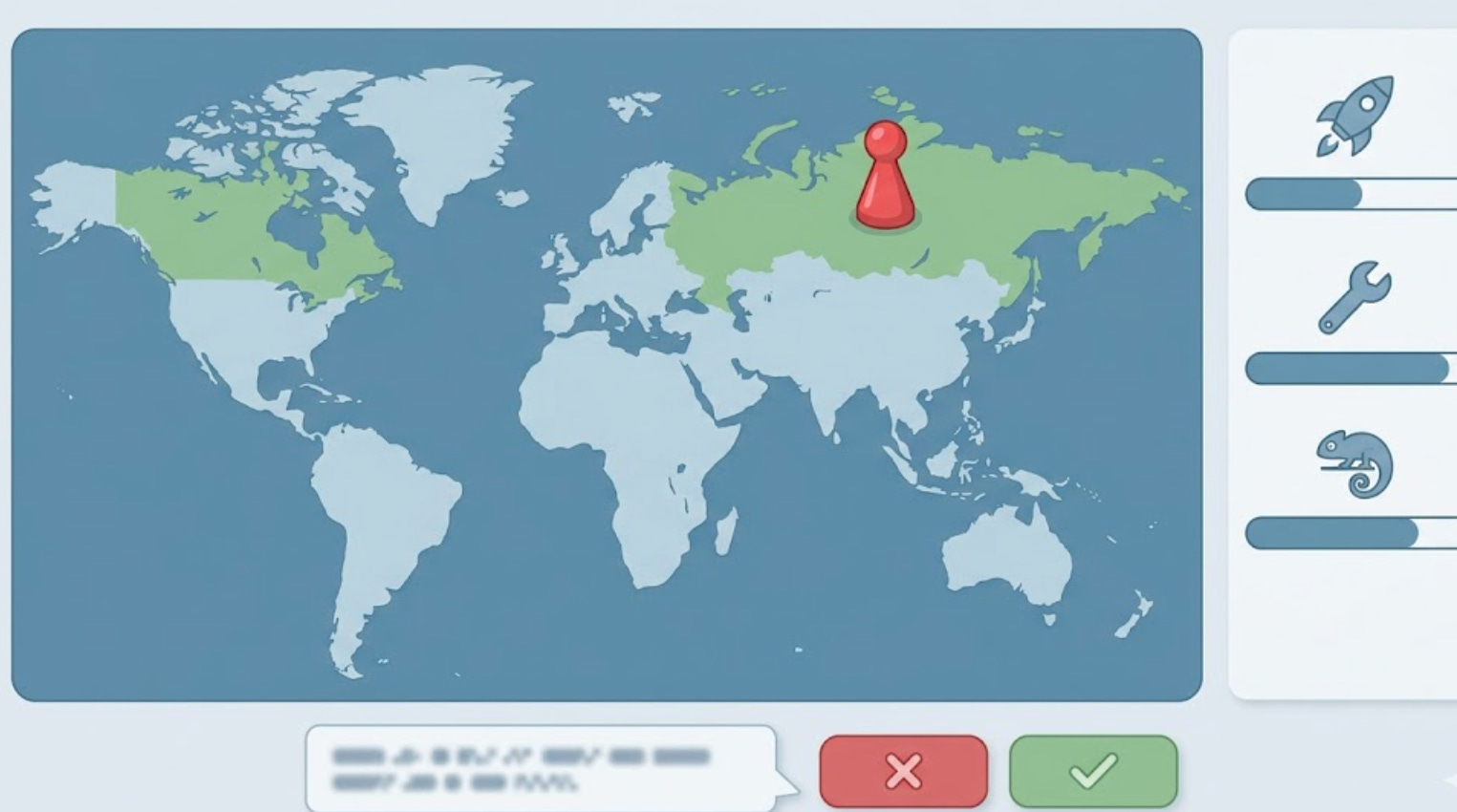
Most people in the world are not born in the best environment for them to become their best self, and would benefit from moving to a ‘better’ place.
The world is essentially a collection of different servers, each running different software - some prioritize rapid growth and “permissionless” innovation, while others offer stability and deep-rooted heritage. By treating geography as a strategic choice rather than a destiny, you move from being a passenger of your circumstances to an architect of your environment. There is a high probability that the “Product-Market Fit” for your soul exists in a jurisdiction you haven’t even visited yet, where your specific pillars of expertise would compound at an exponentially higher rate.
For most people they can benefit from being in another of the worlds locations, or learning from the others and bring that to your home as a richer person.
Your Environment Shapes You
Your environment acts as the invisible architect of your identity, serving as a continuous “software update” for your ambition, habits, and perspective. While we often credit willpower for our progress, the reality is that the systems, social circles, and cultural norms surrounding us set our internal “factory settings” by default. If you are immersed in an ecosystem that prioritizes stability over scale or silos over synthesis, your growth will eventually hit a systemic ceiling regardless of your individual effort. To achieve true alignment, you must treat your surroundings as a strategic choice rather than a random inheritance - intentionally selecting geographies and networks that provide the intellectual density and high-leverage opportunities necessary to fuel your life’s work. You cannot outwork a misaligned environment; you can only transcend it by choosing a new one.
Much of the study abroad industry is just about students moving to a better place.
You cannot outperform your environment indefinitely. Eventually, the system wins. If you want to reach the next level of transcendence, stop trying to work harder within a broken simulation and start building the bridge to a better one.
What kind of person do you want to become, and and what kind of environment suits you best?
Property and Urban Environment
Your living space and urban environment aren’t just passive backdrops; they function as the primary operating system for your future self. A home designed for focus provides essential cognitive leverage, reducing the friction required for deep work and high-level habit formation.

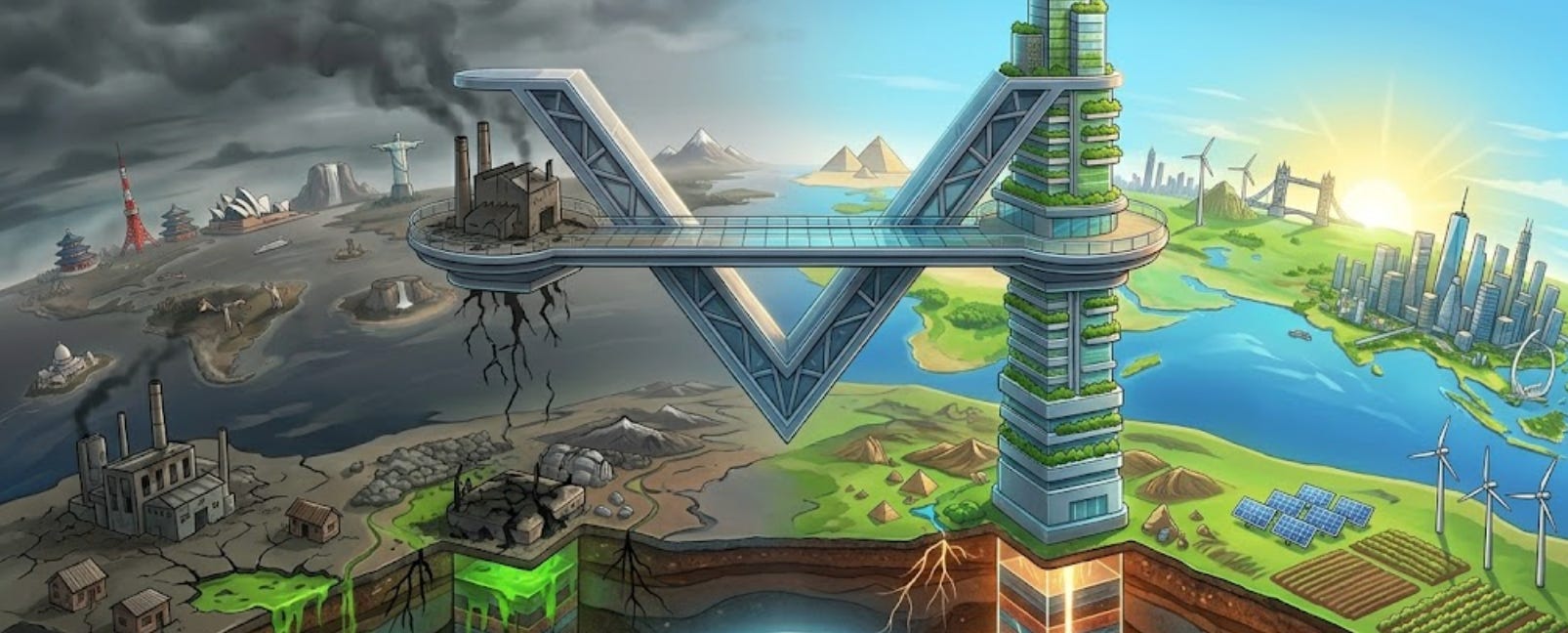
While the above image is an extreme example, it can manifest on multiple levels.
On a larger scale, a thriving urban environment acts as a massive matching engine. When density is high and housing is abundant, the “friction” of daily life decreases, creating a surplus of time and energy that allows you to move beyond mere survival and toward the “M-shaped” development of deep expertise across multiple fields.
Equally critical is the social architecture of your surroundings, as proximity remains the strongest designer of personal standards. Being immersed in a community that pushes the boundaries of intelligence and agency creates a silent, constant pressure to “upgrade” your own capabilities.
Ultimately, your property and the people around you are the architects of your potential; by consciously selecting both, you are choosing your future identity.
Growth through Change And Challenge
Growth is a byproduct of friction, and there is no greater source of friction than the total displacement of your environment. When you remain in your “spawn point,” you live largely through autonomic habits - your culture, language, and social structures act as an invisible auto-pilot that makes decisions for you. Stepping into a radically different geography forces a “hard reset” on your cognitive software.
Because you can no longer rely on the default settings of your upbringing, every interaction - from negotiation to navigation - requires a conscious, high-resolution choice. This constant state of navigational challenge is the ultimate forge for agency. You stop being a passenger in a pre-written narrative and start acting as the primary agent of your own survival and success. By forcing yourself to solve for X in a foreign equation, you develop a level of adaptability and self-reliance that simply cannot be simulated in the safety of the familiar.
Cultures
In a globalized, intelligence-driven age, culture is better understood as an Operating System (OS). Just as you wouldn’t run high-end graphics software on an outdated OS, you shouldn’t try to run a high-leverage life on a cultural system that isn’t built for your specific goals. If your results are stagnating, the problem might not be your effort; it might be your environment’s architecture.
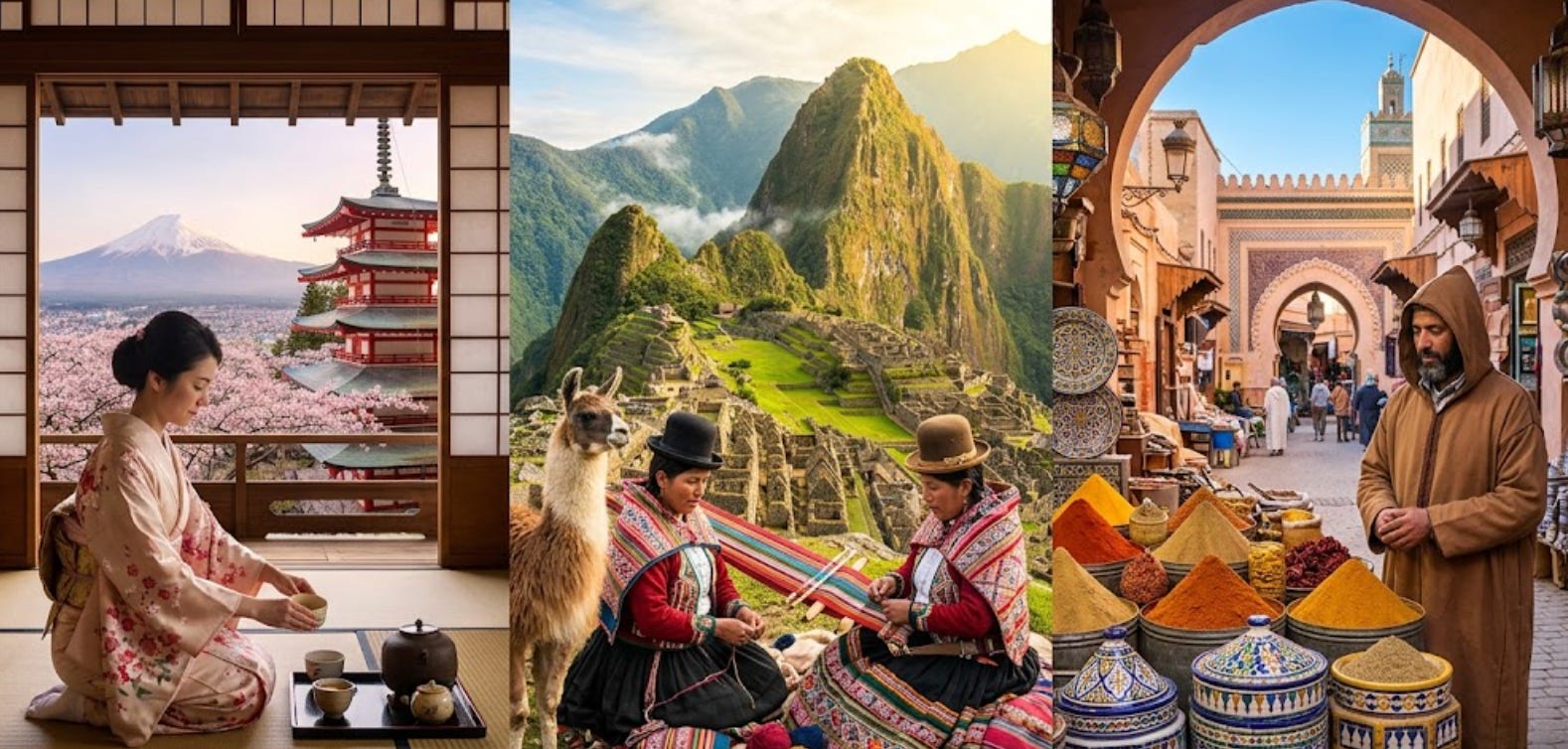
The first step in choosing a culture is identifying its primary objective. Every society is optimized for something.
The Growth OS: These cultures prioritize speed, “permissionless” innovation, and meritocracy. The underlying code says: “If you can build it, you should.” You see this in hubs like Shenzhen or the United Arab Emirates, where the physical and digital landscape changes month by month.
The Stability OS: These cultures prioritize social safety nets, heritage, and “work-life balance.” The code says: “Protect what we have built.” You find this in much of Western Europe, particularly the Nordic countries, where the focus is on a high “floor” for all citizens rather than an infinite “ceiling” for the few.
High-Context vs. Low-Context
Communication is the “data transfer” of culture. Different OSs handle this differently.
Low-Context (Direct): In countries like the US, Germany, or the Netherlands, communication is literal. Information is “packaged” into the words themselves. It is highly efficient for transactional tasks but can feel “soulless” or blunt.
High-Context (Indirect): In cultures like China, Japan, or the UAE, the message is in the relationship, the hierarchy, and the setting. What is not said is often more important than what is.
Knowing the Language: The Insiders Software Update
Language is the firmware of a culture’s operating system; without it, you are merely interacting with the user interface of a geography. Mastering a complex tongue doesn't just facilitate communication - it changes how you think, allowing you to think in new dimensions and process logic through a different cultural lens.
It also enables you to interact and build deeper relationships. Just the act of knowing the language breaks down a barrier.
In an era of AI-driven real-time translation, many will think learning a language is obsolete, but while AI translates the words; only the human brain can translate the cultural subtext.
Mastering a language isn't just about utility; it's about signaling deep commitment and gaining access to the high-trust protocols where the real deals are made.
This depth is what transforms a tourist into an architect capable of building within the "backend" of a society.
Beyond mere understanding, language serves as a formidable barrier to entry. Most competitors are unwilling to invest the thousands of hours required to pay the "linguistic tax," leaving the highest-leverage opportunities to those who do.
By scaling this barrier, you create a defensible moat around your presence in that geography, turning your ability to navigate local nuances into a unique advantage that a mono-lingual specialist simply cannot replicate.
Understanding Truth through Triangulation
Mastering multiple geographies provides a unique form of intellectual triangulation, allowing you to filter out regional noise to find the objective “ground truth” of the global economy.
When you are rooted in only one system, you mistake local cultural quirks or temporary policy shifts which are excessively loud.
However, by observing a phenomenon - such as the roll-out of agentic AI or a shift in capital allocation - across three distinct jurisdictions, you can identify the exact point where the narratives converge.
This creates a high-resolution map of the future. If you see a specific technological pattern emerging in the high-speed execution of Shenzhen, being validated by the deep capital structures of London, and refined by the regulatory flexibility of Dubai, you aren’t just guessing - you are triangulating a global inevitability. This multi-point perspective transforms geography from a mere location into a diagnostic tool, providing the navigational accuracy required to make high-stakes bets with a clarity that the mono-geographical mind simply cannot access. You stop looking at a flat, 2D projection of the world and begin to see the underlying architecture of the 3D reality.
The World is Interconnected
We often fall into the trap of believing that mastering our local location is sufficient to navigate the global landscape, but this is a dangerous illusion of completeness. The world does not operate in isolated silos; it is a single, hyper-integrated, and complex system where a ripple in one jurisdiction can trigger a tidal wave in another’s economy, culture, or technology.
By focusing only on a single part of the machine, you are essentially trying to navigate a ship while only looking at a tiny fraction of the horizon. To achieve true Systems Intelligence, we must recognize that the world is a unified organism - one where the relationships and feedback loops between different regions are just as critical as the regions themselves. Relying on a single “operating system” leaves you vulnerable to blind spots that only a global, interconnected perspective can reveal.
The Gravity of World Cities
World cities function as the high-performance hardware of the global economy, acting as concentrated nodes where capital, talent, and influence collide to create massive leverage.
These aren’t just urban centers; they are strategic “operating systems” that define the speed of progress for anyone plugged into their networks.
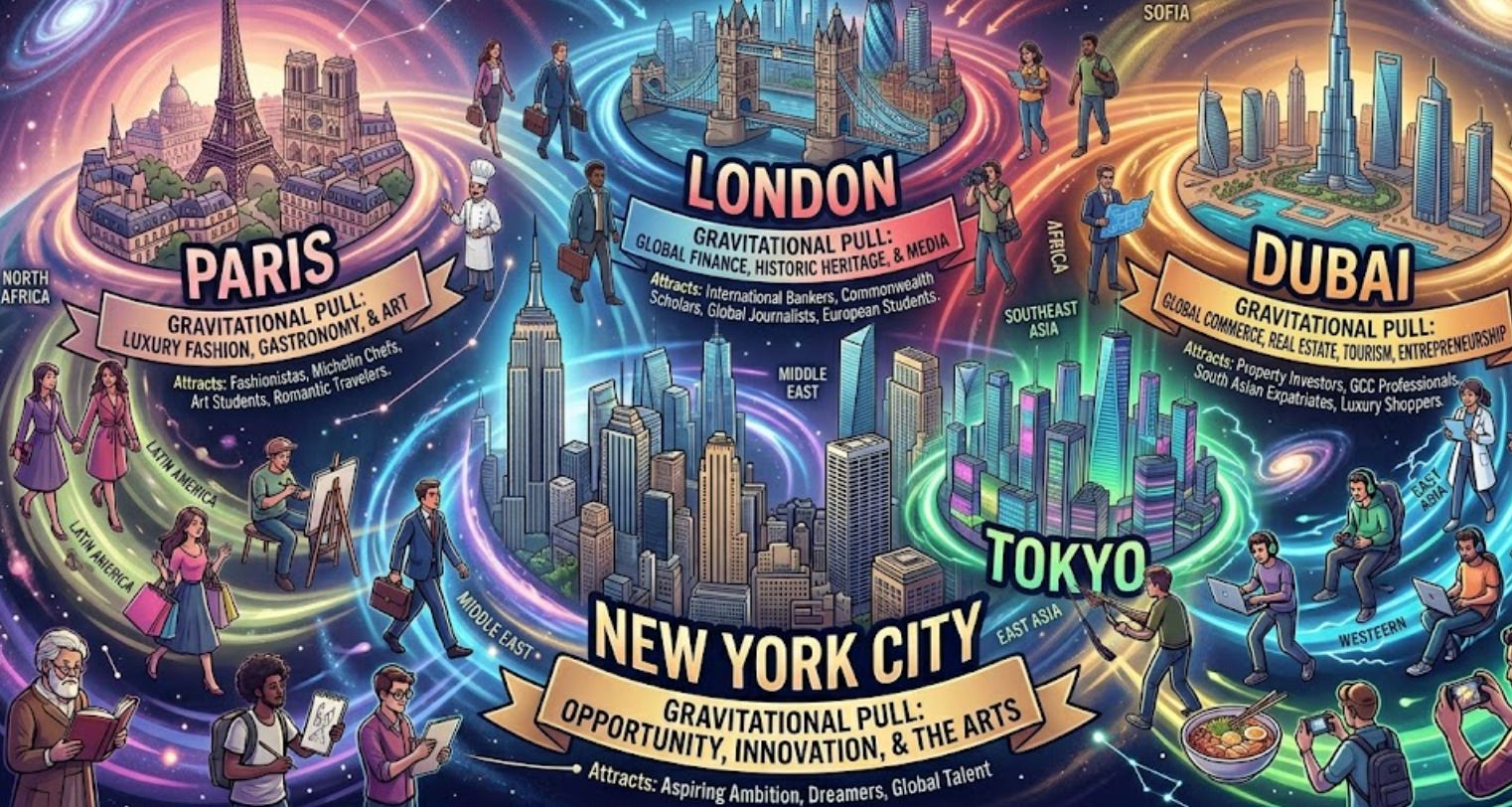
London remains an unparalleled legal and financial anchor, providing the stable “source code” for global trade, while New York exerts dominant cultural and capital force through its sheer density of media and markets.
Meanwhile, the rising power of hubs like Shenzhen has redefined the limits of physical execution and hardware innovation, and Dubai has positioned itself as the ultimate bridge for geographic arbitrage, connecting disparate markets through hyper-efficient logistics and a pro-business “clean slate” architecture.
In the Intelligence Age, being positioned in the right city is a force multiplier that determines how fast your life’s work can actually compound.
Double or Triple the Opportunities
Mastering a second or third geography isn't just an additive skill; it is a geometric multiplier for your life’s work. When you move beyond the boundaries of your native and learn to navigate the cultural, legal, and economic protocols of another country, you don't just "add" a market - you exponentially expand your field of play.
This dual or triple perspective allows you to see arbitrage opportunities that are invisible to the mono-geographical mind, effectively doubling or tripling your potential for impact and wealth.
Instead of fighting in a competitive, saturated pond, where there are multiple people similar to you, you gain the ability to move talent, capital, and ideas across borders with the ease of an insider, while being different. By bridging the friction between different jurisdictions, you create a unique Category of One that is mathematically protected by the sheer complexity of your cross-border expertise.
The Advantages of Being an Outsider
Being an outsider is a strategic superpower because it grants you immunity to the "Native Blindness" that plagues those who have never left their spawn point. When you are the "other" in a system, you are not bound by its unspoken dogmas or the social pressure to conform to its traditional scripts.
This difference is your highest-value asset; while the locals are swimming in the water they no longer notice, you are the only one who can see the currents, the obstacles, and the untapped reservoirs of potential.
By maintaining the perspective of the "Perpetual Outsider," you turn your lack of assimilation into a tool for Intellectual Arbitrage, importing foreign rigor to solve local chaos. You don't need to fit in to be successful - you need to stand out as the unique bridge that links disparate worlds.
Arbitrage or Bridge
Exposure to multiple geographies enables you to spot arbitrage opportunities or be a bridge. Being a bridge between worlds allows you to capture the margin that lives in the friction of borders - margin that narrow specialists can’t even see.
When you master multiple geographies, you stop being a passenger in someone else's economy and start practicing strategic arbitrage, moving ideas, talent, or capital from where they are common to where they are revolutionary.
By synthesizing the best protocols of different systems, you become the essential link that connects them, effectively exiting the competitive rat race to occupy a Category of One. You aren't just "working" across borders; you are the infrastructure that makes global progress possible, turning cultural and economic gaps into your own personal force multiplier.
How to Navigate and Choose Geographies
Selecting a new geography or navigating between them begins understanding yourself and your direction.
During the Explore and Discover phase, you act as a strategic scout, learning about different cultural operating systems to see which one provides the most frictionless Alignment with your internal narrative.
I think usually we can know which ones are best with us or they feel more aligned. We are naturally more drawn or attracted to them.
Alignment and Building a Geographical Advantage is a part of what I call becoming a Szegemon.

While some people say choose the one where you are treated best, I would argue to choose the one where you are likely to grow the most.
Go where you’ll grow the most
Once you find the jurisdiction where your “Life’s Work” feels like play and the market’s needs match your soul’s output, you transition into the Build phase.
This is where you move from tourist to architect, officially “installing” your presence, anchoring your assets, and allowing your progress to compound in an environment specifically designed for your transcendence.
Overcoming The Emotional And Practical Barriers
The greatest barriers to geographic freedom is rarely logistical - it is emotional. The idea of leaving your home triggers a primal resistance: family guilt, financial anxiety, relationship uncertainty, and the quiet fear of starting from zero in a place where nobody knows your name.
These are real costs, not excuses, and pretending otherwise is dishonest. But the mistake most people make is treating geographic exploration as binary - either you stay forever or you uproot everything at once.
The smarter approach is to sequence your exposure. A university exchange program or studying abroad is often the lowest-risk, highest-leverage first move available - you arrive with a built-in community, a structured reason to be there, and zero pressure to perform.
Extended travel or a dedicated exploration trip of three to six months comes next, long enough to get beneath the tourist surface and feel whether a place genuinely fits your operating system.
From there, digital nomad visas - now offered by over fifty countries including Portugal, the UAE, and Thailand - provide a legitimate, low-commitment legal pathway to live and work remotely in a new jurisdiction without permanently severing your existing roots.
Think of it as a trial installation before you commit to a full migration. The goal is not to make one irreversible leap; it is to lower the cost of each experiment until the right geography reveals itself through lived experience rather than imagination.
Connector Nodes
Connectors are the high-leverage hubs of any network - individuals or entities that bridge “structural holes” between disparate groups. In a world defined by silos, a connector node is the single point of contact that links otherwise isolated clusters, functioning as the social and professional infrastructure that allows information, capital, and talent to flow.
By spotting these nodes, you save years of manual effort; instead of building a thousand individual bridges yourself, you plug into one central hub that grants you immediate access to the entire web.
You can also seek to become a connector node yourself which also takes a lot more time but has it’s own unique value. When you inhabit the intersection of multiple geographies or industries.
This positions you in a Category of One, where you help provide the “on-ramp” for others, turning your network density into an exponential force multiplier that compounds with every new connection made.
Building Roots vs Being Rootless

There is a shadow side to the pursuit of geographic freedom that few nomadic philosophers will admit: the danger of becoming a ghost.
When you optimize purely for arbitrage and mobility, you risk building a life that is wide but paper-thin - present everywhere and rooted nowhere. Humans are tribal by deep biological design; belonging, continuity, and being truly known by a community are not soft luxuries, they are load-bearing pillars of psychological health and long-term performance.
The perpetual outsider who never transitions to chosen insider eventually pays a hidden tax: loneliness, a fragmented identity. The goal is not to be permanently rootless - it is to be deliberately rooted. Choose your geography with the same rigor you would apply to any high-stakes strategic decision, plant yourself with intention, and build the kind of depth that only time and commitment can create.
A tree with shallow roots can survive fair weather. During a storm those who are rootless can move but those who are deeply rooted are also more secure.
Depth Vs Breadth
In the pursuit of global leverage, the tension between depth and breadth is often misunderstood as a binary choice, but it is a strategic optimization problem.
Geographic breadth - having a surface-level awareness of many regions - is valuable for identifying macro-trends, but it lacks the defensibility required to build a Category of One.
True power is found in geographic depth: the professional-grade immersion that allows you to navigate a jurisdiction's unspoken social protocols, legal architecture, and linguistic nuances with the precision of an insider.
While the "jack of all trades" traveler experiences the world as a consumer of scenery, the individual with deep roots in two or more strategic anchors becomes an architect of results. The goal is to avoid the trap of being everywhere but belonging nowhere; instead, you cultivate deep, compounding expertise in your primary "Growth" and "Safety" anchors while maintaining enough breadth to recognize when the global "puck" is shifting toward a new horizon.
Why This Is More Important
In an era of shifting alliances and increasing jurisdictional volatility, geographic optionality is no longer a luxury; it is also an insurance policy.
The 20th-century illusion of a flat, stable world has been replaced by a multipolar reality where different “Operating Systems” are frequently in conflict.
If your assets, your residence, and your business are all in a single jurisdiction, you are 100% exposed to that system’s specific black swan events - whether they are regulatory, economic stagnation, or geopolitical friction.
By diversifying your presence across multiple geographies, you move from dependence to antifragility. You own sovereignty and agency, while also building unique advantages.
You gain the ability to “switch servers” if a local environment becomes hostile or stagnant and navigate between the world.
In this new landscape, the Bridge doesn’t just generate profit; it provides a strategic escape hatch.
You aren’t just betting on one country; you are betting on your self and your own ability to remain mobile and relevant, regardless of which way the wind blows.
To Summarise
In conclusion, transcending the randomness of birth requires treating geography as a part of your life plan, not as a fixed constraint, but as a strategic variable for optimization.
By moving away from the “Spawn Point Fallacy” and viewing world cultures as distinct Operating Systems, you can intentionally select the specific environment - from micro-living spaces to macro-urban hubs - that provides frictionless alignment with your personal purpose and amplifies your ambition.
Leveraging the advantages of the “outsider” perspective, building bridges for geographic arbitrage, and cultivating functional language skills enables the geometric multiplication of opportunities.
This deliberate approach to navigation, transitioning from exploration to deliberate construction and deep rooting in strategic anchors, moves you from a passive passenger to an active architect of your identity.
Ultimately, in a volatile, multipolar world, geographical optionality is not just a tool for profit or growth through displace friction; it is the ultimate insurance policy that converts dependence into sovereign antifragility.
The Superhuman Curriculum
This is one of the core pillars of the superhuman curriculum which you can read about here.
