
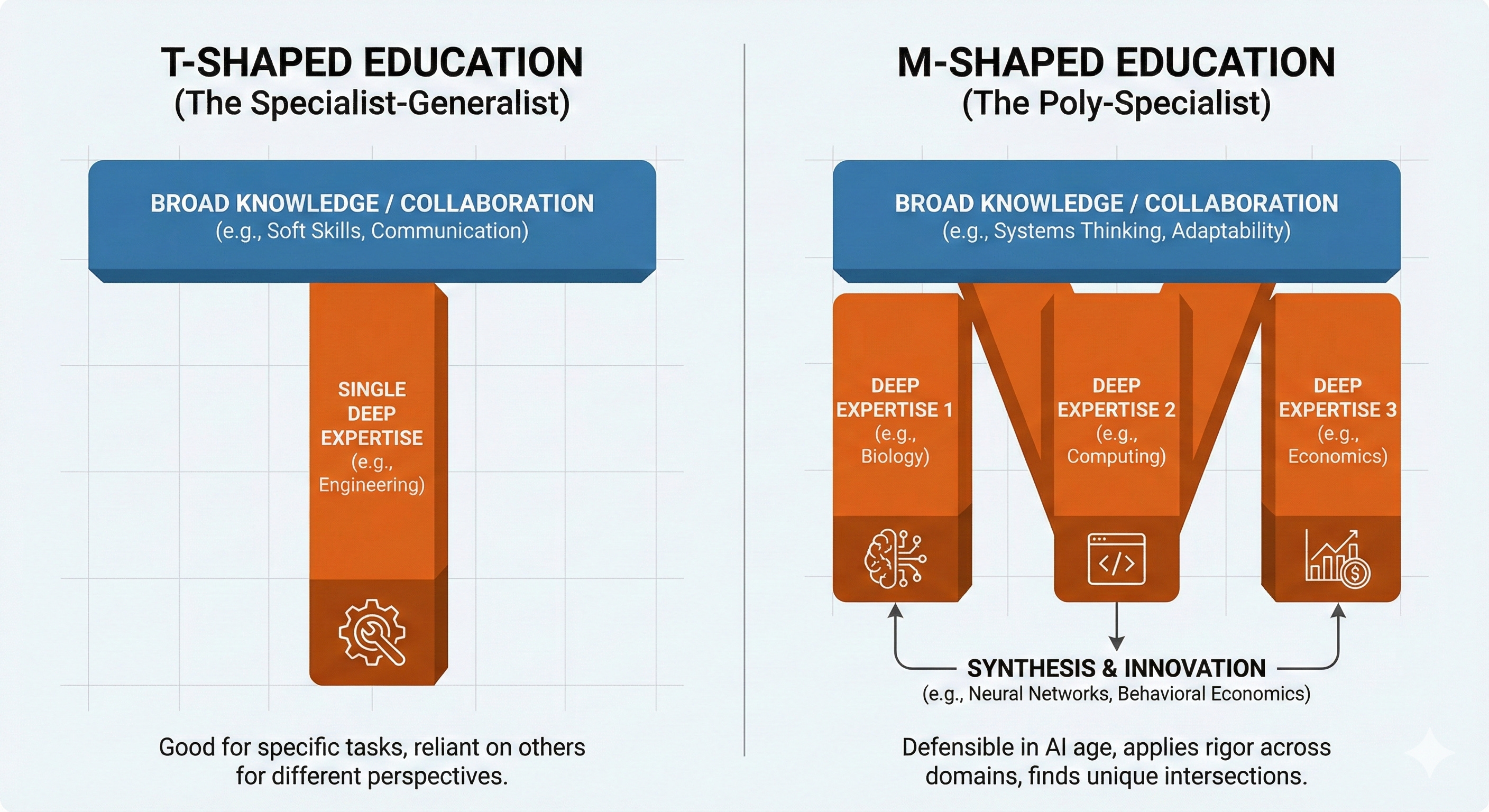
One of the trends I’m seeing globally is the importance in the shift from T-shaped to M-shaped education.
Before T-shaped expertise - deep expertise in one area and the ability to understand and collaborate with others was enough. But in the age of AI, it is no longer defensible. AI is better at that narrow, predictable data. Those educated in a single silo are most easily replaceable. Defensibility now lives at the intersections.
By mastering the unique space where your pillars overlap, you stop competing with others in a crowded market and instead occupy a Category of One - a position where your specific synthesis of skills is impossible for a machine or a narrow specialist to replicate - you become a Szegemon.

On an individual level, being M-shaped - having multiple pillars of deep expertise - allows you to apply the rigor of one discipline to the chaos of another. It allows you to see the opportunities that narrow experts miss.
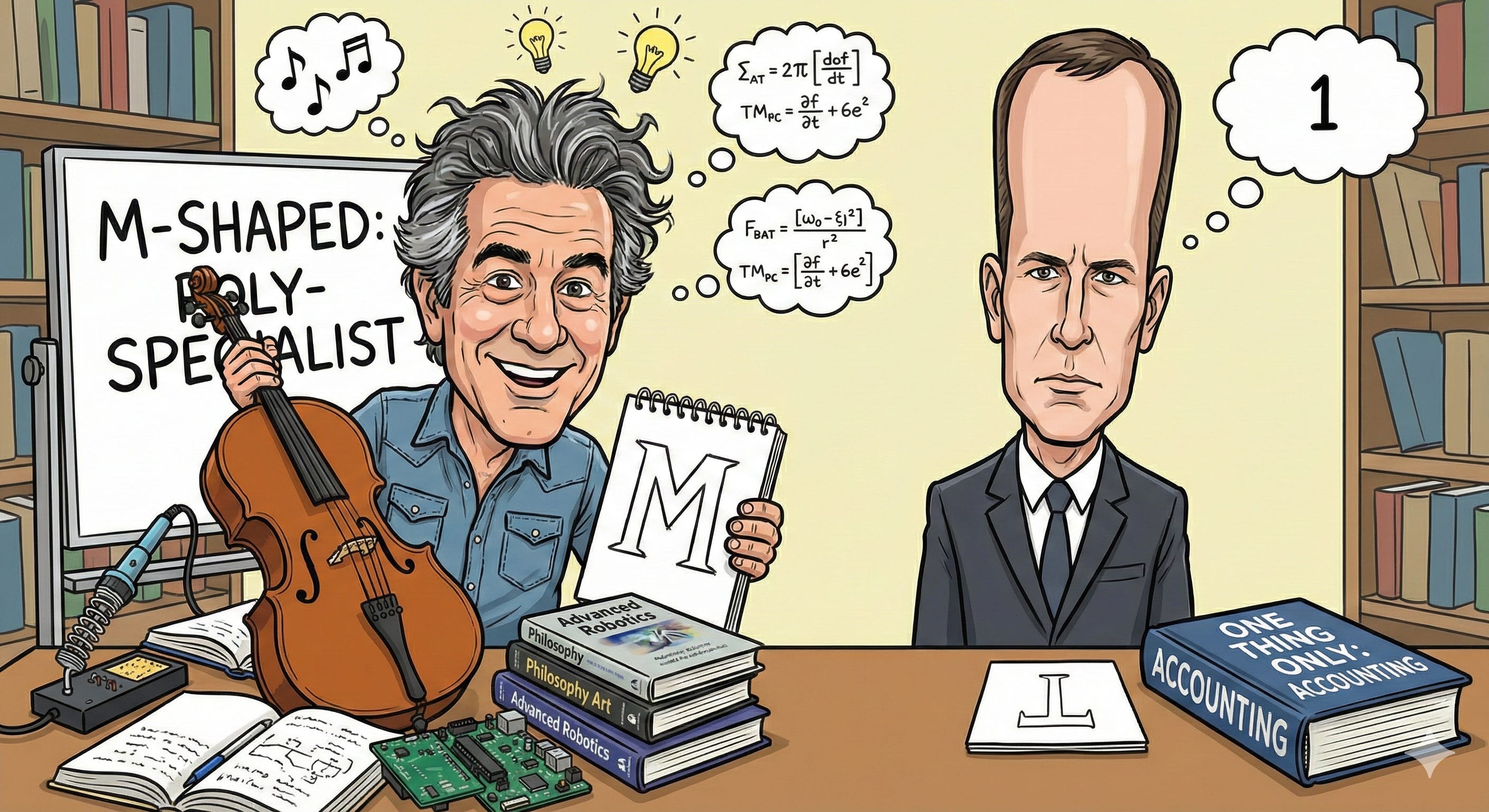
M-shaped is not about being a jack of all trades, master of none. The “M” is multiple DEEP pillars of expertise - a “Poly-Specialist”.
But it is even more important on a societal level. To have more multi-experts. If we train and work in silos, we create echo chambers, group think and intellectual narrowing which is like re-arranging the deckchairs while the titanic is sinking.
But when we have multi-experts these become painfully obvious.
Different disciplines have different advantages and disadvantages. And the rigor, and insights from one subject can be applied to another.
During the Renaissance, the Medici family brought together artists, scientists, bankers, and philosophers in Florence. That "M-shaped" ecosystem created the most explosive era of human progress in history.
Many of the best discoveries and breakthroughs came from cross-polination.
- The origin of Computer Programming came from Silk Weaving. Joseph Marie Jacquard used punched cards to tell a weaving loom which threads to lift to create complex patterns in silk which was then incorporated in computer programming.
- Neural networks was the mixing of biology and computing.
- The printing press came from the wine industry.
- Henry Ford developed the assembly line came by studying meatpacking.
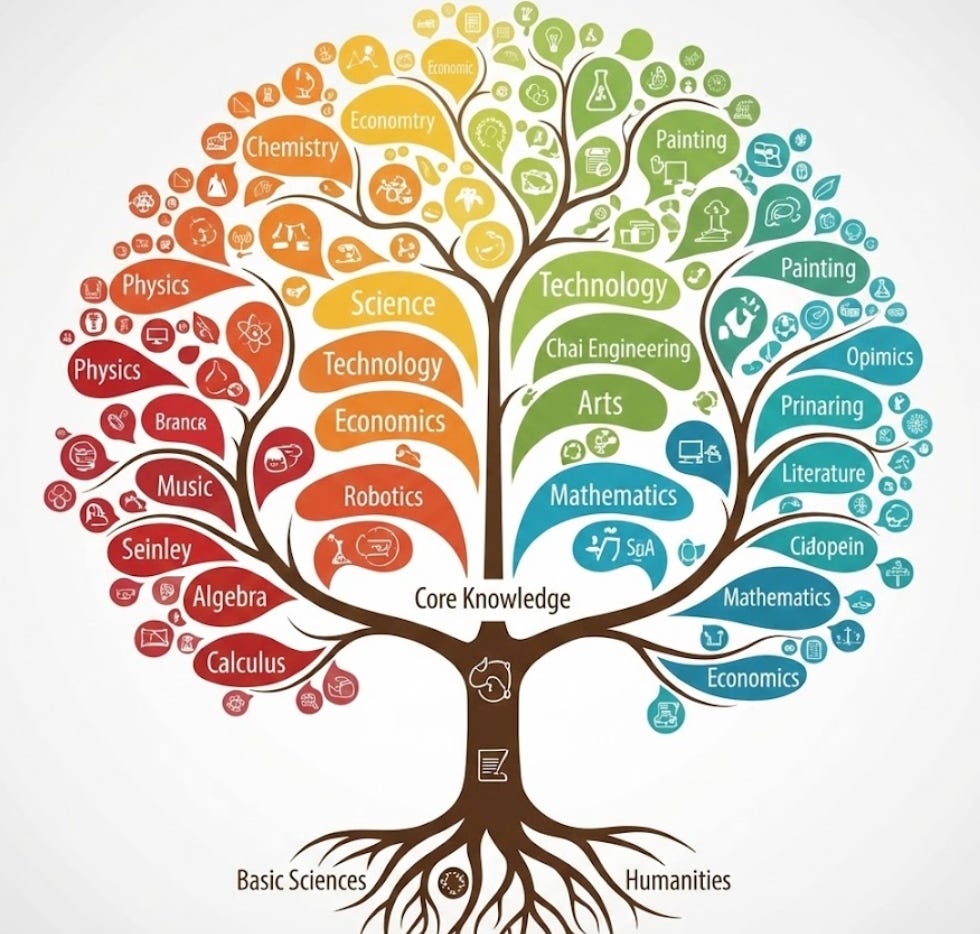
They are all connected and are branches in a single tree of unified knowledge. As Einstein said: “All religions, arts, and sciences are branches of the same tree.”
Many of the most successful business people actually studied engineering. The best product managers studied art. The most effective politicians came from law, engineering or business.
We desperately need more of that cross-pollination.
We don’t just need leaders who “know about” different things and defer to experts. We need multi-experts.
We need physics in economics, art in technology, and the empathy of literature and philosophy in the development of AI.
- Florence Nightingale was so influential because of her abilities in statistics and created the first version of the pie chart. She proved that over 7 times more soldiers died from preventable illnesses than combat wounds.
- Steve Jobs brought the rigor of calligraphy and design to computing.
Every individual can become more effective if they learn multiple areas of expertise and tools of leverage - ability to create content, create code, allocate capital, and connect with and lead people.
But there are disadvantages in this. It’s takes longer to become expert in two or more disciplines, and it can be distracting. So it’s about finding the balance. We don’t want everyone to be M shaped otherwise we suffer from the opposite - lack of really intense specialisation on one domain that is rapidly developing, and some people may be suited more to W M or N shaped, X, T, I or even _ shaped however those can be interpreted. But usually, when we reached the limit to a certain level of progress like in economics, we can benefit from more M shapers.
The era of the “narrow specialist” is ending. The future belongs to the M-shaped mind and societies - those who can see the bigger picture and connect the dots.
The Superhuman Curriculum
This is a core part of the Superhuman curriculum. A new framework for how to navigate the intelligence age.
