
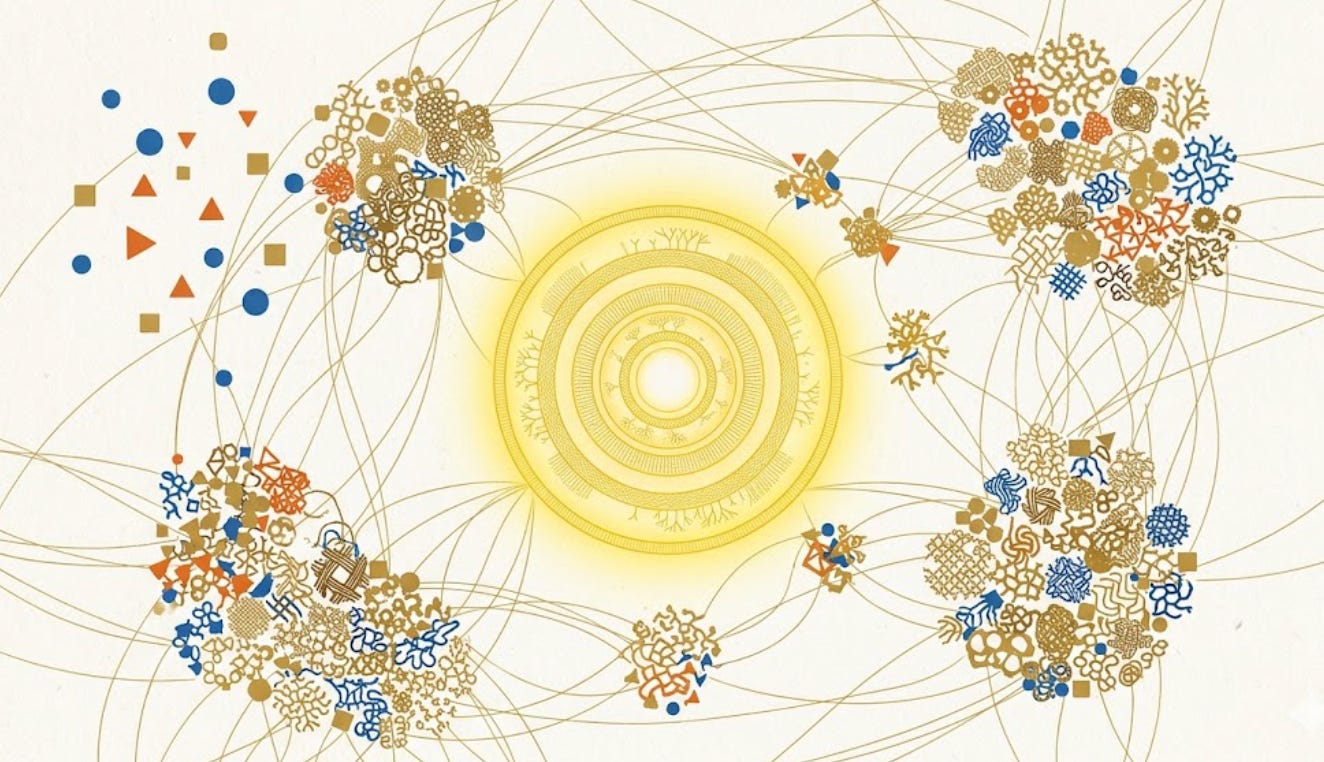
In order to be a better thinker, doer, more successful, entrepreneur, thinker, creator, entpereneur, parent, friend and anything else - to understand the world better.
It’s necessary to understand this one concept.
Emergence.
In the previous article I introduced emergence
Opportunities Are Emergence

TLDR: Opportunities are emergence, the entrepreneur is the catalyst, emergence literacy is the core skill
In this article I’m going to dig into a deeper understanding of what emergence is so you can understand it better - to spot patterns and opportunities.
We can actually see emergence in everything. Grass is emergence, trees are emergence, humans, cities and society, language and trade, ships and planets are all emergence.
Humans as being emergence from the universe.

It’s also incredibly powerful to understand that principles from each foundational layer carry up and exist at each higher level of emergence too.

Here are a few concepts about when emergence arises:
Critical mass / threshold crossing Systems often sit in a stable state, then tip. Below a threshold, nothing; above it, a new order snaps into place. Think of how a market doesn't exist until enough buyers and sellers are present simultaneously - then suddenly network effects kick in and the thing is self-sustaining. Entrepreneurs who succeed early are often those who correctly estimated where the threshold was.
New connectivity between previously isolated elements Emergence frequently happens when things that couldn’t interact before suddenly can. The internet didn’t create new human desires - it connected existing ones in new configurations, and entirely new behaviors (viral content, flash mobs, crowdfunding) emerged from that. The substrate changed; the emergence followed.
So AI x X - is a big number of opportunities.
Constraint removal When a rule, cost, or friction that was suppressing a latent behavior disappears, emergence can be sudden and surprising. Uber didn’t create the desire to make money from your car or to avoid parking — it removed friction. The behavior that emerged (the gig economy, dynamic pricing norms, city traffic changes) wasn’t fully predictable from the removal alone.
So AI applied to something removes a lot of constraints and enables new possibilities.
How to recognise emergence in the early stages? (Before the market has priced it in)
Look for behaviors that exist but have no good infrastructure When people are doing something in a clunky, workaround way at scale, that’s a signal that a latent pattern is trying to emerge but hasn’t found its form yet. Airbnb saw people already renting out couches on Craigslist. The behavior preceded the platform.
Watch the edges and subcultures Emergent patterns almost always appear at the margins first - in hobbyist communities, teenagers, immigrants, or technical early adopters - before diffusing to the mainstream. The center of a system is optimized for the current order; the edges are where new configurations get tried. What nerds do in 2005 is often what everyone does in 2015.
Track what’s newly cheap or newly possible Every time a cost curve collapses (compute, bandwidth, genome sequencing, solar), a wave of emergence follows. The question to ask is: what behaviors or businesses were previously impossible or uneconomic that are now viable? The emergent pattern is often the aggregate of thousands of people independently discovering the same new possibility.
Notice when the same thing is being reinvented in parallel Independent invention is a strong signal of emergence. If five people in different places are building the same thing without knowing about each other, the pattern is being pulled into existence by structural forces, not pushed by individual genius. That’s a much stronger signal than a single smart person with an idea.
Feel for phase transitions in social behavior Emergence in markets and culture often has a phase-transition quality - gradual buildup, then sudden snap. The buildup phase shows up as: rising search interest, growing but fragmented communities, increasing media coverage that’s still confused about what the thing is, and incumbents dismissing it. Learning to read that pre-transition state is enormously valuable.
What you're really developing is sensitivity to the difference between noise and signal in early-stage systems

take anomalies seriously
When something small doesn't fit the existing model - a weird user behavior, an unexpected use case, a product people love for the wrong reasons - they treat it as a message from an emerging order rather than as noise to be explained away.
Opportunities close to threshold
New institutions for collective sense-making
Coordination tools for fluid, project-based work
A new social contract around work and income - people compared to AI
New better media
New models of housing and co-living
Equity-sharing models, Subscription living
The tension between community Vs individual autonomy
New models for democratic decision making
Others
AI incorporated into life in all aspects
Human-scale community is definitely evolving
Remote work geography reshuffling - Lisbon, Tsiblsi, Medellín
In education
Credentials decoupling from degrees
Self-directed learning infrastructure
Tutoring and personalized instruction via AI
What’s coming?
The AI personal tutor
Project and portfolio as the primary educational record
Lifelong learning as a real market
The main thing in education is the social and motivational infrastructure. We learn best in relationships and through experience
A 38-year-old marketing director whose industry is being reshaped by AI doesn’t want a course. She wants to know: what specifically do I need to understand, what’s the fastest path to understanding it, who else is navigating this same transition, and will anyone believe me when I say I’ve done it?
In education the community is the product.
A platform that helps students develop and signal their own value
Entrepreneurship education